
Close Menu
    Facebook X (Twitter) Instagram
    SciTechDaily
    • Biology
    • Chemistry
    • Earth
    • Health
    • Physics
    • Science
    • Space
    • Technology
    Facebook X (Twitter) Pinterest YouTube RSS
    SciTechDaily
    Home»Biology»Size of Nucleolus Plays Important Role Protecting Cells Against Infection
    Biology

    Size of Nucleolus Plays Important Role Protecting Cells Against Infection

    By Dr. Annegret Burkert, Max Planck InstituteSeptember 14, 2018No Comments3 Mins Read
    Facebook Twitter Pinterest Telegram LinkedIn WhatsApp Email Reddit
    Share
    Facebook Twitter LinkedIn Pinterest Telegram Email Reddit
    Size of the Nucleolus Plays Important Role
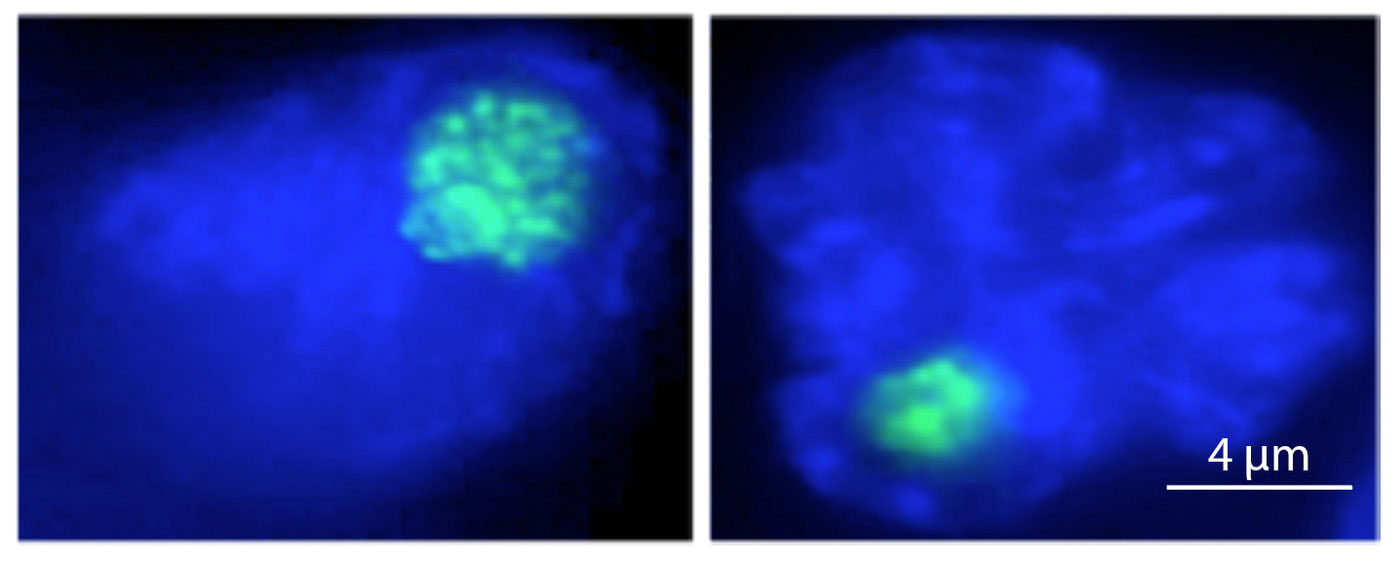
    The nucleolus (in green) of macrophage cells shrinks upon bacterial infection (left: uninfected macrophage, right: bacteria-infected macrophage). © Max Planck Institute for Biology of Ageing

    All cells in the body have the basic ability to protect themselves from infection, called the innate immune response. But how cells do this is not very well understood. Recently, scientists from the Max Planck Institute for Biology of Ageing and the University of Cologne, found that the size of the nucleolus plays an important role in protecting cells against infection.

    The nucleolus is a small organelle present in the nucleus of cells, which regulates physiologic processes such as growth and stress responses. Scientists from Cologne discovered that upon bacterial infection, the nucleolus shrinks in size, revealing a remarkable visible change as part of the host response. But how might nucleolar reduction combat infection?

    Prof. Antebi from the Max Planck Institute for Biology of Ageing in Cologne notes that “the nucleolus contains a protein highly conserved in evolution called fibrillarin, which also decreases during infection. When we reduce fibrillarin in the nucleolus it is sufficient to defend against bacterial infection.” On the other hand, Antebi and his colleagues could show that activities that expand the nucleolus and increase fibrillarin make cells more sensitive to infection. In collaboration with Dr. Robinson’s lab at the University of Cologne, they have furthermore shown that this is true of cells from tiny roundworms all the way up to mammals including human cells.

    The scientists believe that the bacterial killing activity of the nucleolus and fibrillarin upon bacterial infection may be related to their function in producing ribosomes, miniature factories that make the proteins of the cell. When ribosome activity is decreased, cells put more effort into fighting bacteria and decreasing inflammation.

    Interestingly, Antebi’s lab previously found that reduced nucleolar size and fibrillarin reduction are linked with longer life in different species. Prof. Antebi therefore speculates that perhaps reduced nucleolar size may prolong life through the balanced control of the innate immune response. These studies may provide new ways to stimulate the cell’s natural defense response and promote health.

    The research was performed in collaboration with CECAD (Cologne excellence cluster on cellular stress responses in aging-associated disease).

    Reference: “Nucleolar fibrillarin is an evolutionarily conserved regulator of bacterial pathogen resistance” by Varnesh Tiku, Chun Kew, Parul Mehrotra, Raja Ganesan, Nirmal Robinson and Adam Antebi, 6 September 2018, Nature Communications.
    DOI: 10.1038/s41467-018-06051-1

    Never miss a breakthrough: Join the SciTechDaily newsletter.
    Follow us on Google and Google News.

    Aging Cell Biology Infection Max Planck Institute University of Cologne
    Share. Facebook Twitter Pinterest LinkedIn Email Reddit

    Related Articles

    Unlocking Longevity – New Research Suggests That Aging Could Be Influenced by Random Changes

    Researchers Discover New Way To Fight the Aging Process

    Researchers Have Discovered a Mutation That Significantly Increases Lifespan

    Stem Cells Sense Density to Make Decisions

    Sugar Molecule Helps Fight Off Pathogenic Helicobacter Strains

    Study Shows Nucleolar Size Correlates with Health and Lifespan in Organisms

    Increased Parkin Gene Levels Can Delay the Aging Process

    Ajuba Regulates Stem Cell Activity in the Heart

    DNA Jumps Directly From the Cell’s Chloroplasts Into Its Nucleus

    Leave A Reply Cancel Reply

    • Facebook
    • Twitter
    • Pinterest
    • YouTube

    Don't Miss a Discovery

    Subscribe for the Latest in Science & Tech!

    Trending News

    JWST Finds a “Star” 100 Billion Times Brighter Than Any Star Should Be

    Scientists Find a Hidden Biological Link Across Different Forms of Autism

    Astronomers Discover a Ghostly River of Stars That Could Reveal Dark Matter

    Why Is Colorectal Cancer Rising in People Under 50? New Clues Point to the Environment

    Quantum Fluctuations Break a Crystal’s Symmetry Rules

    Why Does an Irregular Heartbeat Strike 40 Years Early in Some People?

    Scientists Reveal How ADHD Could Fuel Creative Thinking

    Scientists Find Just 3 Minutes of Sprinting Can Transform Blood Chemistry

    Follow SciTechDaily
    • Facebook
    • Twitter
    • YouTube
    • Pinterest
    • Newsletter
    • RSS
    SciTech News
    • Biology News
    • Chemistry News
    • Earth News
    • Health News
    • Physics News
    • Science News
    • Space News
    • Technology News
    Recent Posts
    • A 20-Year Study Finds Preschool Can Influence Success for Years
    • 55-Million-Year-Old Penguin Fossils Preserve Clues to a Warmer Antarctica
    • A 35,000-Year-Old Neanderthal Pelvis May Explain Why Men and Women Walk Differently
    • Hidden Brain Wiring May Help Preserve Thinking As Gray Matter Shrinks
    • Dual Stem Cell Treatment Restores Vision in First Human Trial
    Copyright © 1998 - 2026 SciTechDaily. All Rights Reserved.
    • Science News
    • About
    • Contact
    • Editorial Board
    • Privacy Policy
    • Terms of Use

    Type above and press Enter to search. Press Esc to cancel.