
Close Menu
    Facebook X (Twitter) Instagram
    SciTechDaily
    • Biology
    • Chemistry
    • Earth
    • Health
    • Physics
    • Science
    • Space
    • Technology
    Facebook X (Twitter) Pinterest YouTube RSS
    SciTechDaily
    Home»Space»Skywatching Highlights for December: Don’t Miss Comet Leonard and Geminid Meteors
    Space

    Skywatching Highlights for December: Don’t Miss Comet Leonard and Geminid Meteors

    By NASA’s Jet Propulsion LaboratoryDecember 3, 2021No Comments4 Mins Read
    Facebook Twitter Pinterest Telegram LinkedIn WhatsApp Email Reddit
    Share
    Facebook Twitter LinkedIn Pinterest Telegram Email Reddit

    What’s Up for December? Your early evening highlights, a chance to catch a comet, and the annual Geminid meteors.

    On December 6th through the 10th, look westward following sunset for the Moon visiting Venus, Saturn, and Jupiter in turn. The Moon’s crescent fills out as it appears higher in the sky each evening over the course of the week.
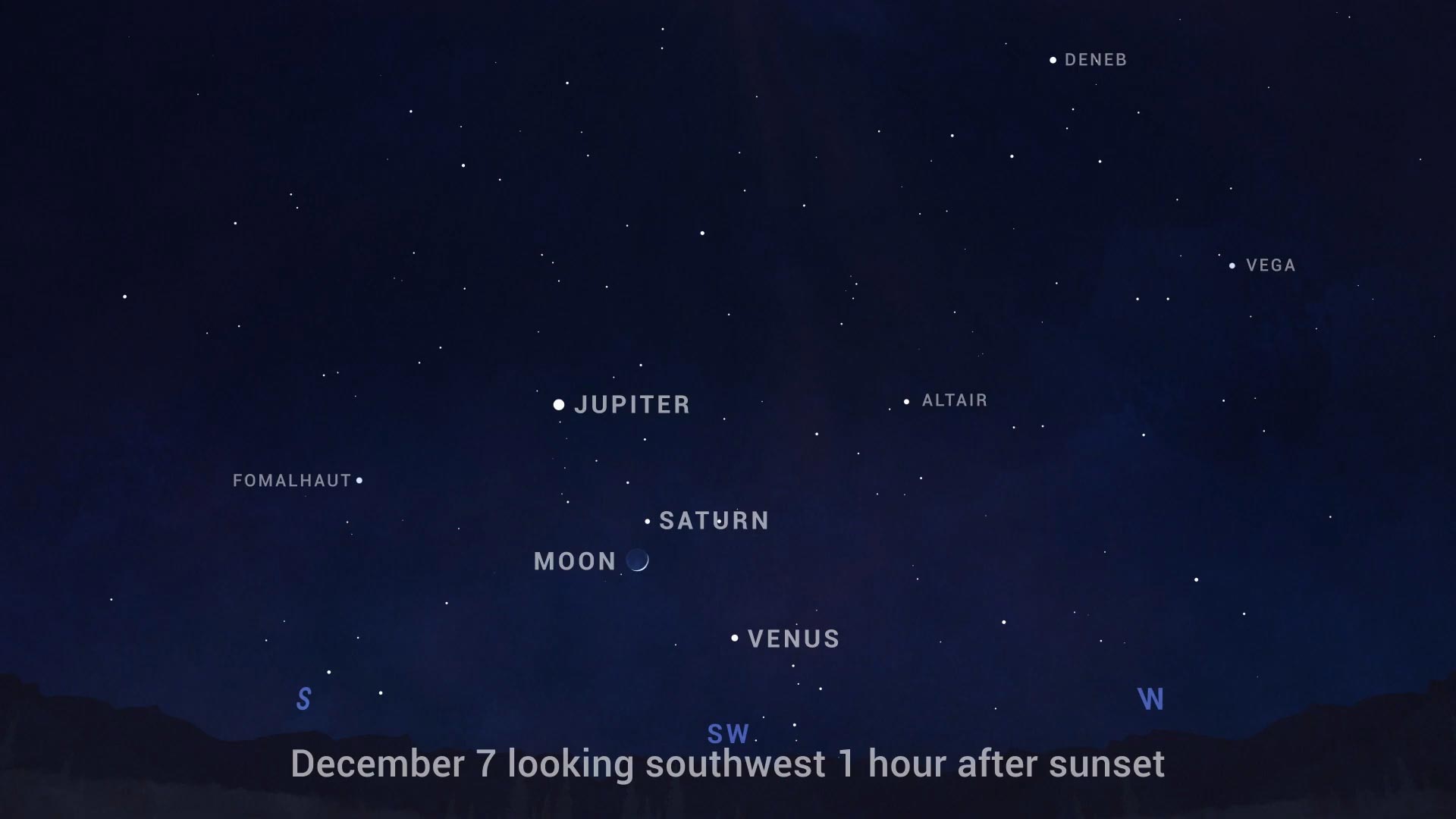
    Sky Chart Moon Passes by Venus, Saturn, and Jupiter 2021
    The Moon passes by Venus, Saturn, and Jupiter in turn, each evening after sunset, December 6-10. Credit: NASA/JPL-Caltech

    Enjoy the view of dazzling Venus as the “evening star” while it lasts, though. Our cloud-covered neighbor planet will sink ever closer to the horizon during the month, disappearing for most of us by New Years’. It’ll reappear in late January as a morning planet preceding the sunrise, and won’t be back in evening skies until December of next year.

    Next in December, there’s a recently discovered comet on its way into the inner solar system that might be worth trying to observe. It’s known as Comet Leonard, and it will be at its closest to Earth on December 12th, just a couple of weeks before it reaches its closest distance from the Sun.
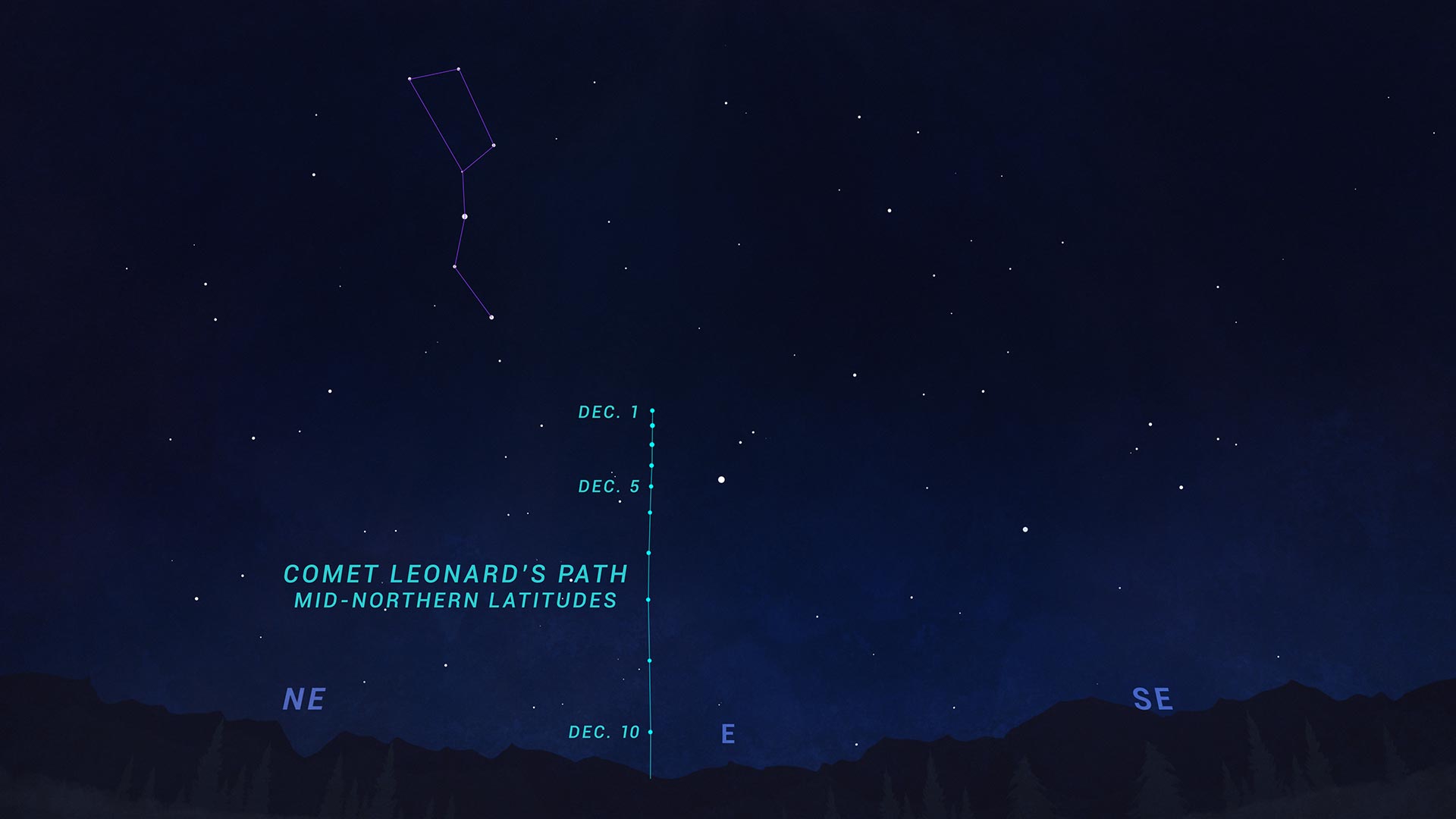
    Sky Chart Comet Leonard 2021
    Sky chart showing the position of Comet Leonard in the east about 2 hours before sunrise, December 1-10. Binoculars may be required to observe the comet. Credit: NASA/JPL-Caltech

    Now, comets are notoriously difficult to predict in terms of brightness and visibility. Comet Leonard is predicted to peak at a brightness that will probably require binoculars to spot it. There’s a chance it could be bright enough to see with the unaided eye, but again, with comets, you really never know.

    In the first couple of weeks of December, Comet Leonard can be found in the east before sunrise, passing between Arcturus and the handle of the Big Dipper. It approaches the horizon right around the time of its closest approach to Earth, meaning it’ll likely be brighter but more challenging to observe. It then switches over to being an evening object after around December 14th, for just a little while after the Sun sets – as it begins its long haul outward from the Sun again, progressively fading in brightness.

    Finally, the Geminid meteors are a highlight of December skies each year. This year’s meteor shower peaks overnight on December 13th and 14th. Apart from the weather, the phase of the Moon is usually the main factor in whether a meteor shower will have good viewing any given year. This year, the Moon will be almost 80% full at the peak of the Geminids, which isn’t ideal. However, that bright Moon will set somewhere around 2 a.m. wherever you’re located, leaving a couple of hours for meteor watching before dawn.
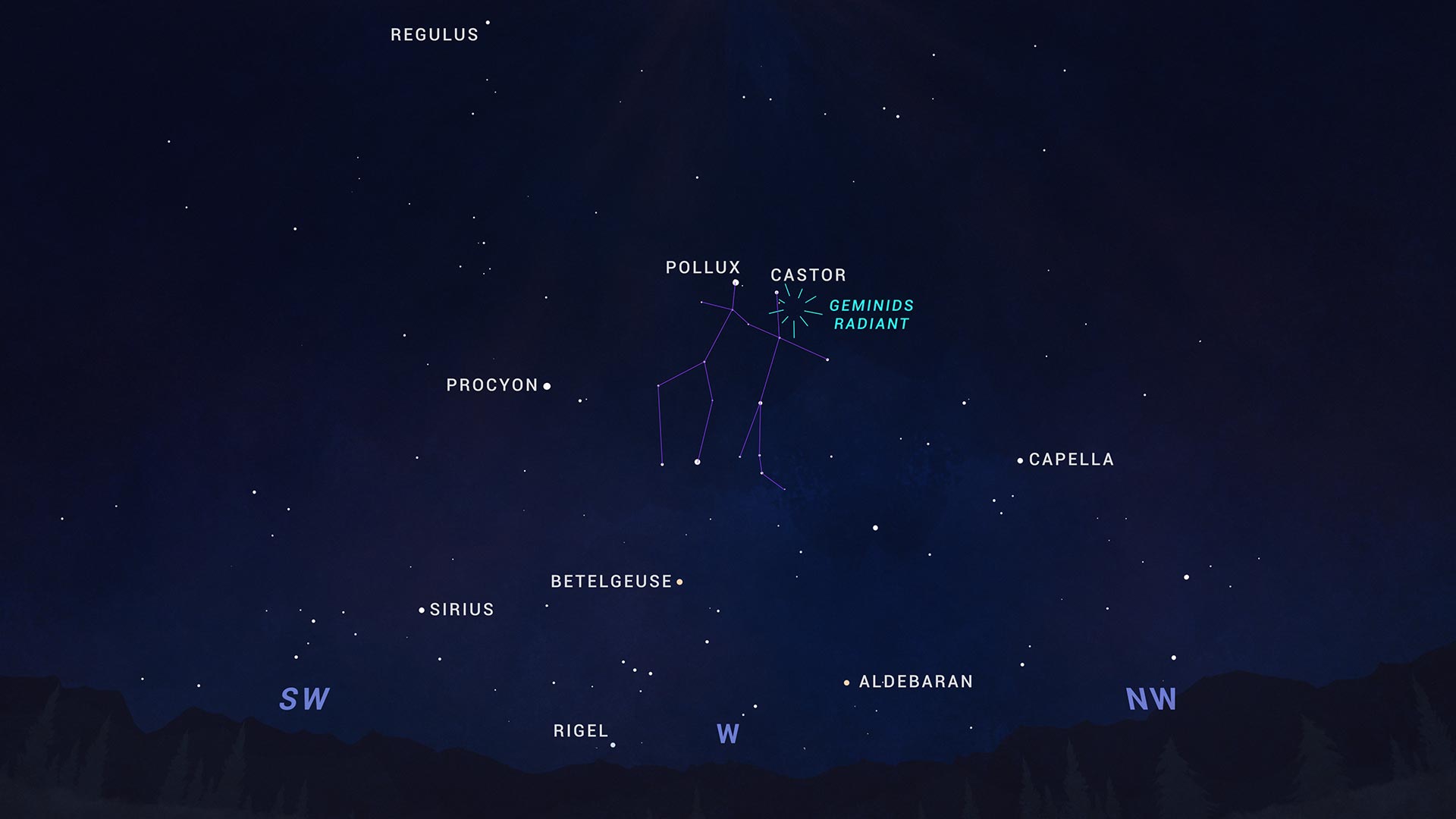
    Sky Chart Geminid Meteors 2021
    Sky chart showing the region of the sky from which the Geminid meteors appear to radiate. This year’s shower is best observed after the Moon sets on the morning of December 14. Credit: NASA/JPL-Caltech

    The meteors appear to radiate from the constellation Gemini, which you’ll find high in the west. Now while most annual meteor showers are caused by Earth passing through trails of dust-sized particles of comet debris, the Geminids are one of the few meteor showers that are caused by debris from an asteroid that crosses Earth’s orbit – in this case, one called Phaethon.

    Recently, NASA scientists shared findings that suggest the difference between an asteroid and a comet might be less clear than we realized, with fizzing sodium on Phaethon playing the same role as vaporizing ice on comets.

    And whether you catch a glimpse of Comet Leonard, or meteors from Asteroid Phaethon, both are reminders of the deep connections between Earth and the rest of the solar system that we discover because we look outward, and we explore.

    Never miss a breakthrough: Join the SciTechDaily newsletter.
    Follow us on Google and Google News.

    Astronomy JPL NASA Popular
    Share. Facebook Twitter Pinterest LinkedIn Email Reddit

    Related Articles

    Don’t Miss: Total Solar Eclipse, Mars and Saturn Rising, Slim Lunar Crescent, Comet 12P

    Webb’s Ethanol Discovery Fuels Search for Alien Life

    Don’t Miss: Jupiter Plows Through the Pleiades

    NASA’s Next-Gen Exoplanet-Imaging Technology Advances Search for Extraterrestrial Life

    NASA Telescopes Are Unlocking the Secrets Behind Mysterious Deep Space Signals

    Catch the Quadrantid Fireballs: A January Sky Spectacle With Moon and Planet Pairings

    From IRAS to Webb: The Incredible Evolution of NASA’s Infrared Telescopes

    End of an Era: NASA’s NEOWISE 10-Year Mission Ending Due to Solar Activity

    Don’t Miss: Geminid Meteor Shower and Asteroid Vesta

    Leave A Reply Cancel Reply

    • Facebook
    • Twitter
    • Pinterest
    • YouTube

    Don't Miss a Discovery

    Subscribe for the Latest in Science & Tech!

    Trending News

    Your Blood Pressure Reading Could Be Wrong Because of One Simple Mistake

    Astronomers Stunned by Ancient Galaxy With No Spin

    Physicists May Be on the Verge of Discovering “New Physics” at CERN

    Scientists Solve 320-Million-Year Mystery of Reptile Skin Armor

    Scientists Say This Daily Walking Habit May Be the Secret to Keeping Weight Off After Dieting

    New Therapy Rewires the Brain To Restore Joy in Depression Patients

    Giant Squid Detected off Western Australia in Stunning Deep-Sea Discovery

    Popular Sugar-Free Sweetener Linked to Liver Disease, Study Warns

    Follow SciTechDaily
    • Facebook
    • Twitter
    • YouTube
    • Pinterest
    • Newsletter
    • RSS
    SciTech News
    • Biology News
    • Chemistry News
    • Earth News
    • Health News
    • Physics News
    • Science News
    • Space News
    • Technology News
    Recent Posts
    • Hidden Warm Water Beneath Antarctica Could Rapidly Raise Global Sea Levels
    • Scientists Revive Ancient Chemistry Trick To Engineer Next-Generation Glass
    • Scientists Use AI To Supercharge Ultrafast Laser Simulations by More Than 250x
    • Scientists Just Found a Surprising Way To Destroy “Forever Chemicals”
    • Popular Supplement Ingredient Linked to Shorter Lifespan in Men
    Copyright © 1998 - 2026 SciTechDaily. All Rights Reserved.
    • Science News
    • About
    • Contact
    • Editorial Board
    • Privacy Policy
    • Terms of Use

    Type above and press Enter to search. Press Esc to cancel.