

Researchers at SLAC National Accelerator Laboratory have discovered new behaviors in an ultrathin material that may revolutionize optoelectronic devices.
Using a high-speed electron camera, they observed how tungsten ditelluride polarizes light under terahertz radiation, potentially enhancing devices used in LEDs, medical imaging, and more. This groundbreaking work could lead to the development of smaller, multifunctional optoelectronic devices through the stacking of two-dimensional materials.
While taking snapshots with the high-speed “electron camera” at the Department of Energy’s SLAC National Accelerator Laboratory, researchers discovered new behavior in an ultrathin material that offers a promising approach to manipulating light that will be useful for devices that detect, control, or emit light, collectively known as optoelectronic devices, and investigating how light is polarized within a material. Optoelectronic devices are used in many technologies that touch our daily lives, including light-emitting diodes (LEDs), optical fibers, and medical imaging.
As reported in the journal Nano Letters, the team, led by SLAC and Stanford professor Aaron Lindenberg, found that when oriented in a specific direction and subjected to linear terahertz radiation, an ultrathin film of tungsten ditelluride, which has desirable properties for polarizing light used in optical devices, circularly polarizes the incoming light.
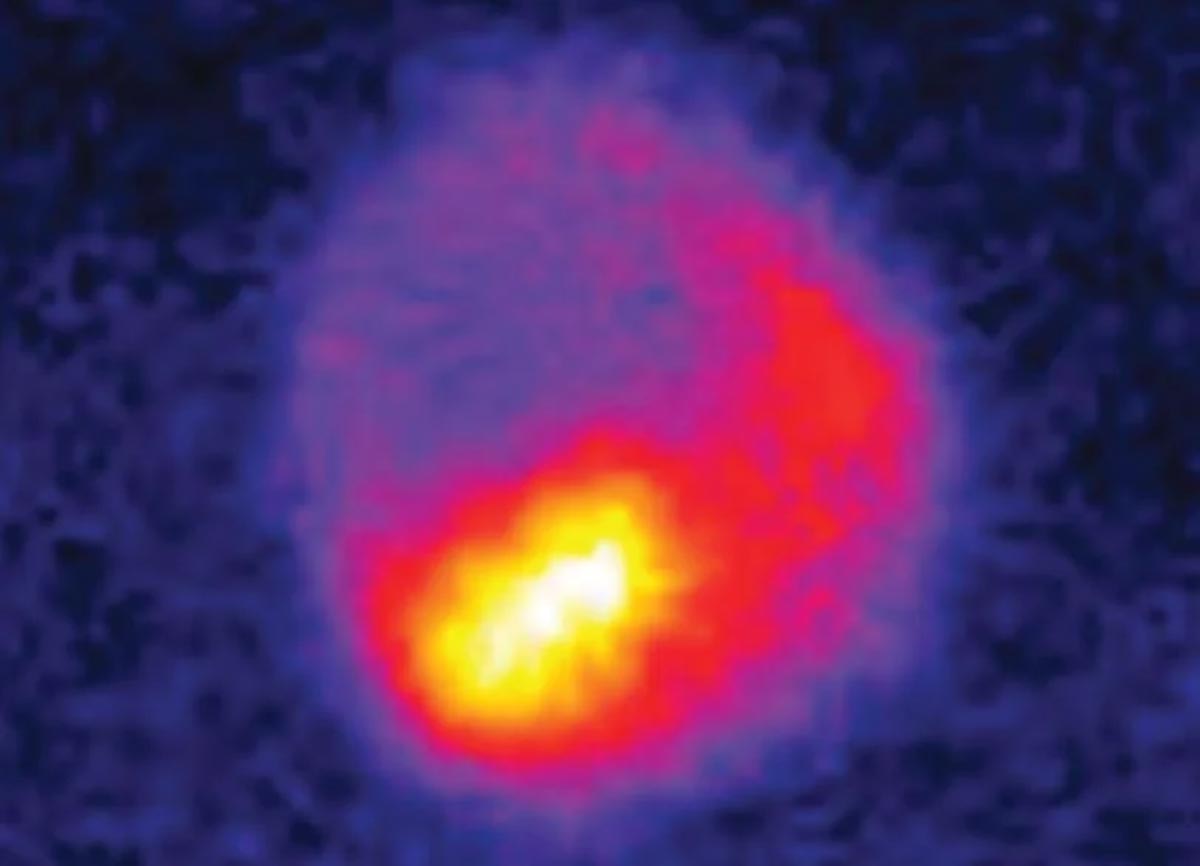
Terahertz Radiation: A Key to Next-Gen Optoelectronics
Terahertz radiation lies between the microwave and the infrared regions in the electromagnetic spectrum and enables novel ways of both characterizing and controlling the properties of materials. Scientists would like to figure out a way to harness that light for the development of future optoelectronic devices.
Capturing a material’s behavior under terahertz light requires an advanced instrument capable of recording the interactions at ultrafast speeds, and SLAC’s world-leading instrument for ultrafast electron diffraction (MeV-UED) at the Linac Coherent Light Source (LCLS) can do just that. Whereas the MeV-UED is normally used to visualize the motion of atoms by measuring how they scatter electrons after hitting a sample with an electron beam, this new work used the femtosecond electron pulses to visualize the electric and magnetic fields of the incoming terahertz pulses, which caused the electrons to wiggle back and forth. In the study, circular polarization was indicated by images of the electrons that showed a circular pattern rather than a straight line.
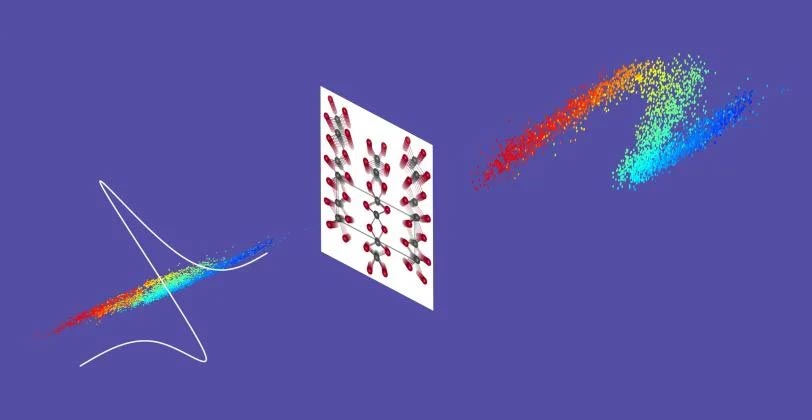
The ultrathin material was a mere 50 nanometers thick. “This is 1,000 to 10,000 times thinner than what we typically need to induce this type of response,” said Lindenberg.
SLAC researchers pioneer new methods in ultrafast science for sharper molecular movies.
SLAC’s “electron camera” can reveal some of nature’s ultrafast processes. Now, researchers across the lab have collaborated to achieve improvements to that tool to make its molecular movies even sharper, keeping SLAC at the forefront of pioneering tools for ultrafast science.
Future Applications and Innovations
Researchers are excited about using these ultrathin materials, known as two-dimensional (2D) materials, to make optoelectronic devices smaller and capable of more functions. They envision creating devices from layers of 2D structures, like stacking Legos, Lindenberg said. Each 2D structure would be composed of a different material, precisely aligned to generate a specific type of optical response. These different structures and functionalities can be combined into compact devices that could find potential applications – for example, in medical imaging or other types of optoelectronic devices.
“This work represents another element in our toolbox for manipulating terahertz light fields, which in turn could allow for new ways to control materials and devices in interesting ways,” said Lindenberg.
Reference: “Giant Terahertz Birefringence in an Ultrathin Anisotropic Semimetal” by Edbert J. Sie, Mohamed A. K. Othman, Clara M. Nyby, Das Pemmaraju, Christina A. C. Garcia, Yaxian Wang, Burak Guzelturk, Chenyi Xia, Jun Xiao, Andrey Poletayev, Benjamin K. Ofori-Okai, Matthias C. Hoffmann, Suji Park, Xiaozhe Shen, Jie Yang, Renkai Li, Alexander H. Reid, Stephen Weathersby, Philipp Muscher, Nathan Finney, Daniel Rhodes, Luis Balicas, Emilio Nanni, James Hone, William Chueh, Thomas P. Devereaux, Prineha Narang, Tony F. Heinz, Xijie Wang and Aaron M. Lindenberg, 8 May 2024, Nano Letters.
DOI: 10.1021/acs.nanolett.4c00758
The study was supported by the DOE Office of Science and used resources of the National Energy Research Scientific Computing Center (NERSC). LCLS and NERSC are DOE Office of Science user facilities.
Never miss a breakthrough: Join the SciTechDaily newsletter.
Follow us on Google and Google News.