
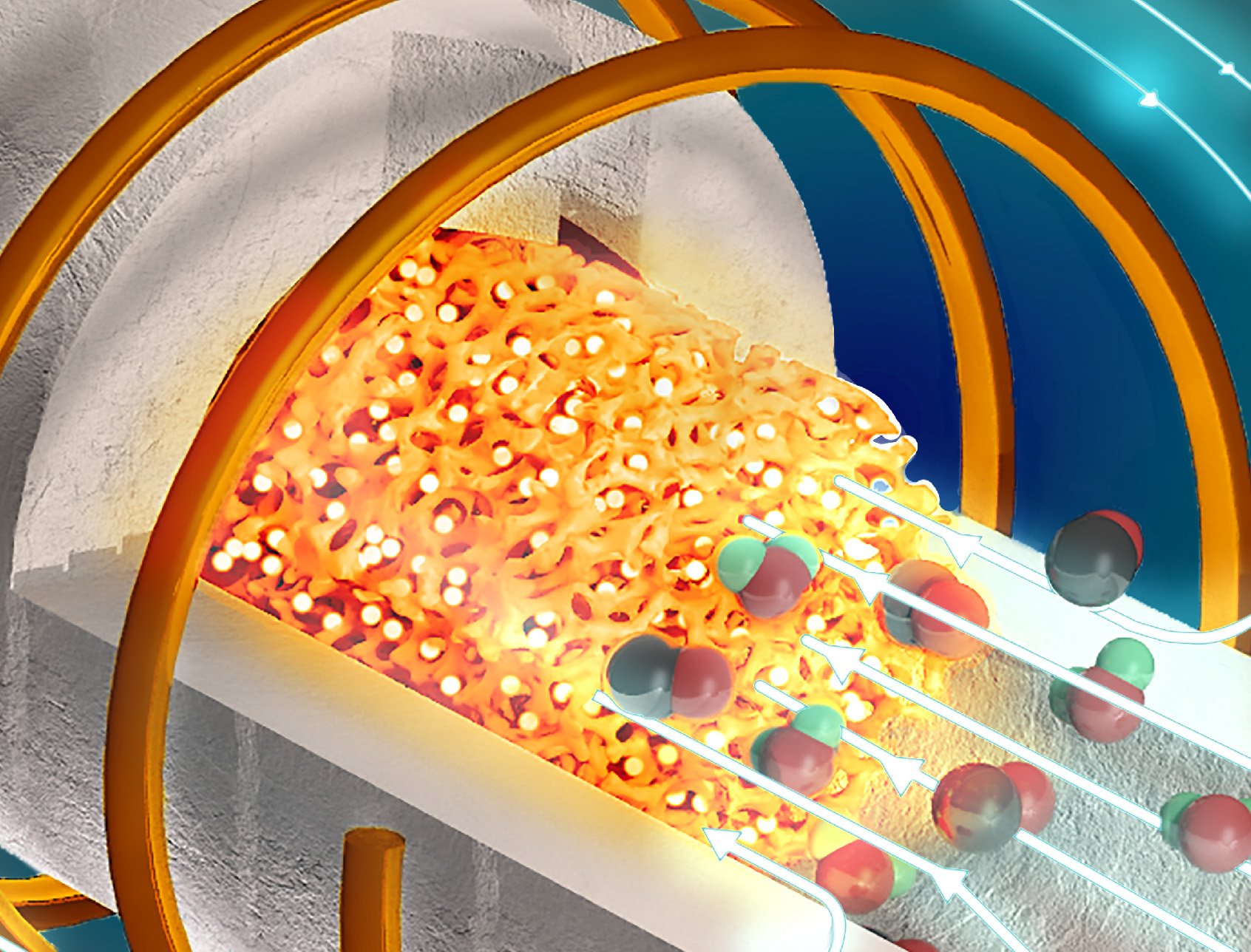
Researchers at Stanford have created an innovative reactor that uses electricity instead of fossil fuels, offering a cleaner alternative for industrial heating and potentially reducing carbon emissions significantly.
Industrial processes in the U.S. currently contribute about a third of the nation’s carbon dioxide emissions, surpassing the combined annual emissions from passenger vehicles, trucks, and airplanes. Decarbonizing this sector is a challenging yet crucial step toward mitigating future climate impacts.
Researchers at Stanford Engineering have designed and demonstrated a new type of thermochemical reactor that is capable of generating the immense amounts of heat required for many industrial processes using electricity instead of burning fossil fuels. The design, published August 19 in Joule, is also smaller, cheaper, and more efficient than existing fossil fuel technology.
“We have an electrified and scalable reactor infrastructure for thermochemical processes that features ideal heating and heat-transfer properties,” said Jonathan Fan, an associate professor of electrical engineering at Stanford and senior author on the paper. “Essentially, we’re pushing reactor performance to its physical limits, and we’re using green electricity to power it.”
Heating with induction
Most standard thermochemical reactors work by burning fossil fuels to heat a fluid, which then flows into pipes in the reactor – like a boiler sending hot water to cast iron radiators in an old house, but with better insulation and at much higher temperatures. This requires a fairly large amount of infrastructure and there are many opportunities to lose heat along the way.
The new electrified reactor uses magnetic induction to generate heat – the same sort of process used in induction stoves. Instead of having to transport heat through pipes, induction heating creates heat internally within the reactor, by taking advantage of interactions between electric currents and magnetic fields. If you wanted to inductively heat up a steel rod, for example, you could wrap a wire around it and run an alternating current through the coil. These currents create an oscillating magnetic field which, in turn, induces a current in the steel. And because steel is not a perfect conductor of electricity, some of that current turns into heat. This method effectively heats the whole piece of steel at the same time, rather than creating heat from the outside in.
Adapting induction heating for the chemicals industry is not as easy as just turning up the heat. Industrial reactors need to evenly create and distribute heat in a three-dimensional space and be much more efficient than the average stovetop. The researchers determined that they could maximize their efficiency by using particularly high-frequency currents, which alternate very quickly, in conjunction with reactor materials that are particularly bad conductors of electricity.
The researchers used new, high-efficiency electronics developed by Juan Rivas-Davila, an associate professor of electrical engineering and co-author on the paper, to produce the currents they required. They then used those currents to inductively heat a three-dimensional lattice made of a poorly conducting ceramic material in the core of their reactor. The lattice structure is just as important as the material itself, Fan said, because the lattice voids artificially lower the electrical conductivity even further. And those voids can be filled with catalysts – the materials that need to be heated to initiate chemical reactions. This makes for even more efficient heat transfer and means the electrified reactor can be much smaller than traditional fossil fuel reactors.
“You’re heating a large surface area structure that is right next to the catalyst, so the heat you’re generating gets to the catalyst very quickly to drive the chemical reactions,” Fan said. “Plus, it’s simplifying everything. You’re not transferring heat from somewhere else and losing some along the way, you don’t have any pipes going in and out of the reactor – you can fully insulate it. This is ideal from an energy management and cost point of view.”
Electrified industry
The researchers used the reactor to power a chemical reaction, called the reverse water gas shift reaction, using a new sustainable catalyst developed by Matthew Kanan, a professor of chemistry at Stanford and co-author of the paper. The reaction, which requires high heat, can turn captured carbon dioxide into a valuable gas that can be used to create sustainable fuels. In the proof-of-concept demonstration, the reactor was over 85% efficient, indicating that it converted almost all electrical energy into usable heat. The reactor also demonstrated ideal conditions for facilitating the chemical reaction – carbon dioxide was converted to usable gas at the theoretically predicted rate, which is often not the case with new reactor designs.
“As we make these reactors even larger or operate them at even higher temperatures, they just get more efficient,” Fan said. “That’s the story of electrification – we’re not just trying to replace what we have, we’re creating even better performance.”
Fan, Rivas-Davila, Kanan, and their colleagues are already working to scale up their new reactor technology and expand its potential applications. They are adapting the same ideas to design reactors for capturing carbon dioxide and for manufacturing cement, and they are working with industrial partners in the oil and gas industries to understand what those companies would need to adopt this technology. They are also conducting economic analyses to understand what system-wide sustainable solutions would look like and how they could be made more affordable.
“Electrification affords us the opportunity to reinvent infrastructure, breaking through existing bottlenecks and shrinking and simplifying these types of reactors, in addition to decarbonizing them,” Fan said. “Industrial decarbonization is going to require new, systems-level approaches, and I think we’re just getting started.”
Reference: “Electrified thermochemical reaction systems with high-frequency metamaterial reactors” by Calvin H. Lin, Chenghao Wan, Zhennan Ru, Connor Cremers, Pinak Mohapatra, Dolly L. Mantle, Kesha Tamakuwala, Ariana B. Höfelmann, Matthew W. Kanan, Juan Rivas-Davila and Jonathan A. Fan, 19 August 2024, Joule.
DOI: 10.1016/j.joule.2024.07.017
This work was funded by the Stanford Doerr School of Sustainability Accelerator, the National Science Foundation, the Gates Millennium Scholarship, and the Stanford Graduate Fellowship.
Never miss a breakthrough: Join the SciTechDaily newsletter.
Follow us on Google and Google News.
1 Comment
I wrote this letter to the editor not long ago. It’s contents are applicable.
Hello – My name is Robert Cole. I am moved to write regarding your article I found in SciTechDaily.
From studies, I found the earth has had a 0.2% CO2 atmosphere (chart below). Only in the last epochs has it fallen to the present 0.04% – where we now see declining forest health. An example, the Sahara was once lush. As you are well aware, ‘Climate Change’ is quite popular with much attendant funding. If the ongoing fad of sequestering CO2 were to actually pull down atmospheric levels of 0.02% (half the present level), all plant life would die.
The world is psychologically on fire with “The Sky is Falling” syndrome.
Cutting CO2 levels from breathing forests is exactly analogous as cutting Oxygen from animals. Science publishers require ‘Climate Change’ for any distribution where, it seems, the whole tenor is simply untruth.
The side of the ecosystem that supplies Oxygen, needs carbon. That’s the truth. I am hoping you will at least consider this.
Sincerely,
Robert Cole
—