

Utilizing a slime mold algorithm, astronomers have mapped the cosmic web, enhancing our understanding of galaxy evolution. This breakthrough research provides deeper insights into how large cosmic structures influence galaxies over time.
In 2010, an experiment in Japan using slime mold to replicate the Tokyo railway system led to the development of a concept called biologically inspired adaptive network design. This idea was later utilized by a graduate student at New Mexico State University in his Ph.D. thesis to enhance methods for detecting the universe’s vastest structures, known as the “cosmic web.”
Algorithm Enhancement for Astronomical Studies
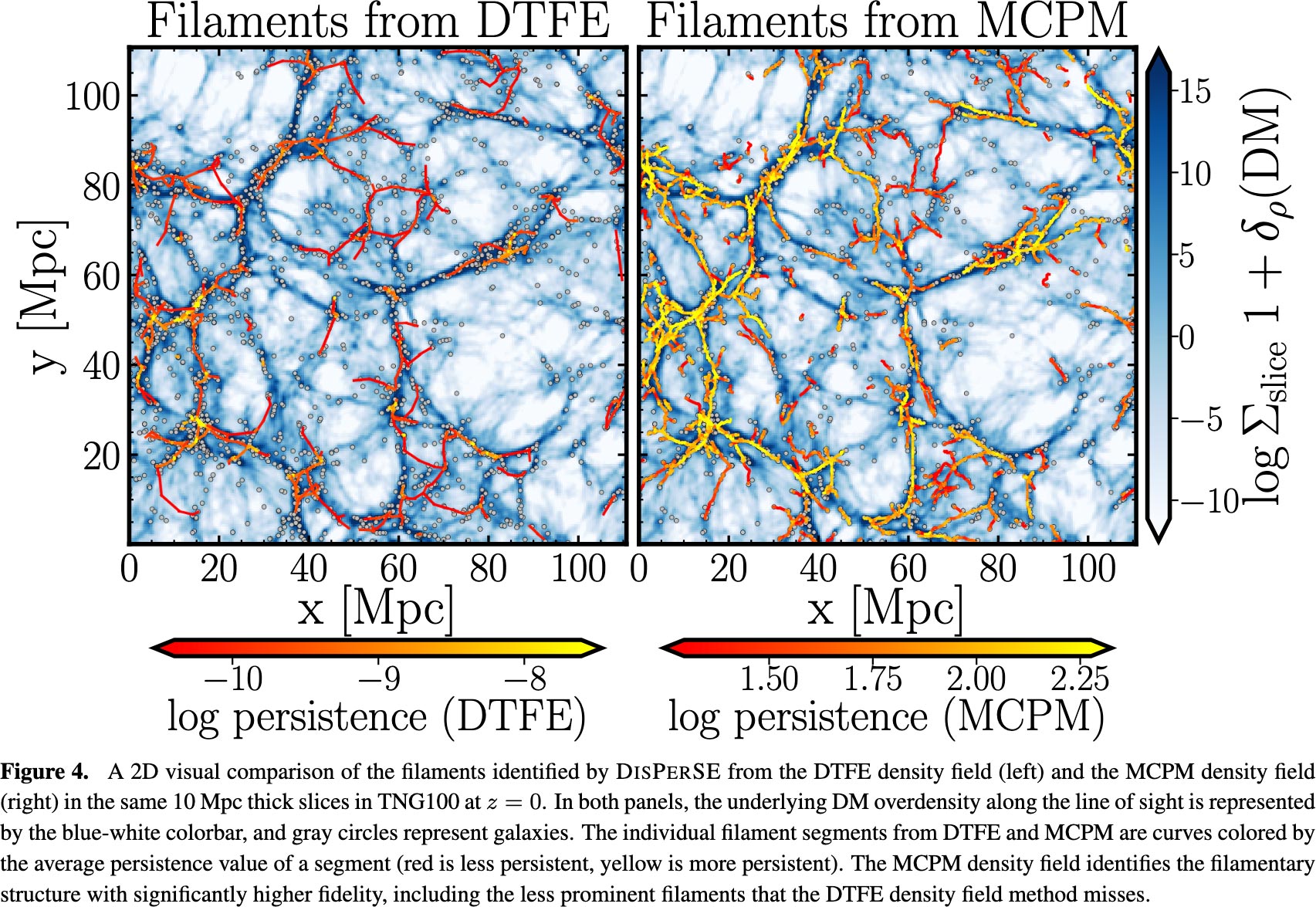
Measuring the environmental density of galaxies isn’t new, but the paper “Filaments of the Slime Mold Cosmic Web and How they Affect Galaxy Evolution,” published in August’s Astrophysical Journal, outlines how Hasan changed one step in the existing research framework combining it with a new method using an algorithm based on the slime mold model.
“I didn’t know how well it was going to work or not work, but I had a hunch the slime mold method could tell us much more detailed information about how density is structured in the universe, so I decided to give it a try,” said Farhanul Hasan, lead author on the paper who subsequently earned his Ph. D. in astronomy at NMSU. “As it turned out, it produced a lot more detailed discrete structures than the old method.”
Insights Into Galaxy Evolution
NMSU assistant astronomy professor Joe Burchett co-authored the paper with Hasan and eight other authors. Burchett introduced the slime mold method to the astrophysical application at the University of California, Santa Cruz as a post-doctoral fellow. With Burchett’s help, Hasan took this research a major step further at NMSU.
“We were looking for a way to visualize the cosmic web, the large-scale structure of the universe, and in particular the gas that sort of permeates the cosmic web,” Burchett said. “Working with an expert on graphics rendering, Oskar Elek, we came across this algorithm that was designed to mimic slime mold and its ability to find food sources by reforming itself to kind of look a lot like the cosmic web. That was the inspiration for setting off on this whole path. We’ve worked on that now for several years. Farhan’s work has taken it to new heights that we’d only dreamed of back then.”
Impact of Cosmic Structures on Galaxy Development
Scientists have known since the eighties that the environment of a galaxy impacts how it grows and evolves, but the exact nature of that connection is still debated. Hasan’s research demonstrates the way galaxies evolve is impacted by their proximity to dense cosmic structures.
“These filaments are the highways of the universe and just as highways affect cities in real life, these filaments affect galaxies in the universe in many different ways,” Hasan said. “But another thing I want to highlight is that this connection completely depends on what era of the universe you’re looking at.”
What Hasan’s research found is that the impact on galaxies has flipped. In earlier times, galaxies’ growth was stimulated by close proximity to larger structures. Now galaxies are stymied by being near these larger structures.
“One of the big takeaways here is that if we can map out the gas around the real universe at many different times it’s easier to build a consistent picture,” Hasan said. “If we collect data from earlier times where things looked different and later times, we can get a physical picture of how that gas is distributed on large scales and how that distribution affects whether galaxies are growing because of them or being hindered in their growth.”
“We have very fundamental questions about how galaxies effectively live and die,” Burchett said. “The data that we’ve collected for nearly a century now suggests that where a galaxy lives has a huge impact on its lifespan. Basically, galaxies have a harder time surviving in the ‘big cities’ of the universe.
“What Farhanul has done is to look at the state-of-the-art models we have of galaxy formation and evolution via these large-scale computer simulations and try to understand how a galaxy’s local environment and large-scale environments really impact its evolution.”
Future Research and Applications
After earning his Ph.D. at NMSU, Hasan began a post-doctoral fellowship in September at the Space Telescope Science Institute, where he will continue this research. What’s next? Applying his theory to real data from NASA’s Hubble Space Telescope. Hasan plans to present results of that work in a couple of years.
“We’re applying it to observational data to actually map out the filamentary structure in the real universe,” Hasan said. “We’re using data from the Hubble that’s already been taken to identify how the gas in these filaments is distributed. It can help us test many theories about galaxy and structure formation on many large scales. It really brings this whole thing full circle.”
Reference: “Filaments of the Slime Mold Cosmic Web and How They Affect Galaxy Evolution” by Farhanul Hasan, Joseph N. Burchett, Douglas Hellinger, Oskar Elek, Daisuke Nagai, S. M. Faber, Joel R. Primack, David C. Koo, Nir Mandelker and Joanna Woo, 30 July 2024, The Astrophysical Journal.
DOI: 10.3847/1538-4357/ad4ee2
Never miss a breakthrough: Join the SciTechDaily newsletter.
Follow us on Google and Google News.
2 Comments
Memo 2409291343
1.
As biological phenomena or models represent the physical twist dark transition in the early universe (my **binary mathematical msbase.qpwoms hypothesis), slime mold algonism claims to “reveal the secrets of the cosmological structure.” Uh-huh
*https://www.nature.com/articles/s41598-018-28963-0
https://www.nature.com/articles/s41598-018-28963-0.pdf
**For your information,
Discrete mathematics studies objects that have distinct values, such as integers, graphs, and logical operations, rather than objects that have continuous properties such as real numbers. Discrete mathematics therefore does not address topics covered in ‘continuous’ fields such as differential calculus or numerical analysis. Discrete objects are often numbered as integers. Officially, discrete mathematics can be characterized as a class of mathematics that deals with additive sets.
2.
The cosmic structure is likely msbase or qpeoms.ems.void.
In any case, the dark transition twist phenomenon in Lee Hyun-kyu’s paper will be defined in the gap between a and b in qms.qvixer.a,b. This part manifests itself as a twist dance of helium gas in the early days of the universe, suggesting how the space-time ems.universe expanded tsp.Helium particles gasify to form a twist. This intuitive insight appears in my memo from last year.
Now, biological models based on mucus fungi give astronomers new insights into the structure and evolution of the universe.
Source 1. Edit 1.
Leveraging a mucus mold algorithm, astronomers have enhanced their understanding of galactic evolution by mapping the cosmic web. This groundbreaking study offers deeper insight into how giant cosmic structures affect galaxies over time. This led to the development of the concept of biologically inspired adaptive network design, in which experiments mimicking rail systems were developed. This idea was later used by a graduate student at New Mexico State University to improve how they detect the “space network,” the universe’s most extensive structure, in his doctoral dissertation. Uh-huh.
Measuring the environmental density of galaxies is not new, but the paper describes how the filaments of mucinous fungal space networks and their impact on galaxy evolution have combined with new methods using algorithms based on mucinous fungal models by Hasan taking the existing research framework to the next level.
I didn’t know how well it would work or not, but I had a hunch that the slime mold method would give me much more details about how the density of the universe is structured, so I decided to try… as a result, a much more detailed discrete structure was created than the previous method. Oops!
In other words, it showed that the msbase filaments were captured more faithfully by the mucus mold model than the traditional standard framework (the sloppy stuff in the mold???!!) huh. Was that too dismissive?
The paper shows that the large-scale distribution of matter in the universe and filaments in the universe (the distribution map of ems.void.emptive{}) were captured more faithfully by the mucus mold model than the conventional standard framework. Hmmm. ems.qpeoms.msbase has a scale of greater precision. Hmmm.
Edit Source2.
Scientists have known since the ’80s that the galaxy’s environment influences its growth and evolution, but the exact nature of the connection is still up for debate. Hassan’s research shows that the way galaxies evolve is influenced by their proximity to dense cosmic structures.
-The dense space structure is ems and its contents are msbase filled with qpeoms particles.
These filaments are highways in the universe, and just as highways affect cities in real life, these filaments affect galaxies in the universe in many different ways. Therefore, the option of reconsideration may be needed for Einstein’s theory of gravity.
What we found in Hassan’s study is that the effects on galaxies have been reversed. In the past, the growth of galaxies was stimulated by their proximity to larger structures. Now galaxies are disturbed in their proximity to these larger structures.
One of the big lessons learned here is that it is easier to create a coherent picture if the gas around the real universe can be mapped to the twist of Lee Hyun-kyu’s paper by qms.qvixer.cancer at several different times.
Collecting data from previous and later eras, when things looked different, gives a physical picture of how that gas (qms.qvix.cas) is distributed on a large scale and how that distribution affects whether galaxies grow due to that gas or their growth is hindered.
We have very fundamental questions about how galaxies live and die effectively. Data we have collected for almost a century suggests that where galaxies live has a large impact on their lifespan. Basically, the mbase has more difficulty surviving in the big cities of the universe. Hah.
The authors of the paper began a postdoctoral fellowship at the Space Telescope Science Lab in September after earning a doctorate in NMSU, where he will continue the work. What’s next? Applying his theory to real-world data from NASA’s Hubble Space Telescope. Hasan plans to present the results of the work within a few years. Huh.
ㅡㅡㅡㅡㅡㅡㅡㅡㅡㅡㅡㅡ
Source 1.
https://scitechdaily.com/slime-mold-algorithms-unlock-secrets-of-vast-cosmic-structures/
Slime Mould Algorithm Reveals Secrets of Extensive Space Structures
At the end of the day though, it doesn’t really matter; does it? Because all answers are the correct answer; aren’t they? Because no knowledge of physics is even necessary in order to shape the universe to one’s will, all that’s required is the motive; all of which resides within the mind that conceives of it, because that is the universe, therefore, however the universe is conceived of it can’t be wrong; because that is how it was conceived.
As for a universal universe that all conceiving minds can agree upon; that obviously would be somewhat more difficult to achieve as it would mimic their perception of what perfection is. In the special case of the life form known as, “all the same and intelligent”, (homosapiens), we need only glance for a second at the events unfolding in Palestine and Ukraine to know that we as a species are so far removed from any sort of universal understanding of what a perfect universe would even look like, that we’ll never be able to explain it to any degree of being able to manipulate it to our universal will, because, obviously, we can’t even agree on who should live and who should die.
Then when we include that matter and energy, also has a sense of itself, no matter how small and beyond our comprehension of just how tiny that would be; this prescious universe that we are able to conceive of on some level, then ceases to exist in our minds as something that we can even conceive of as even existing.