

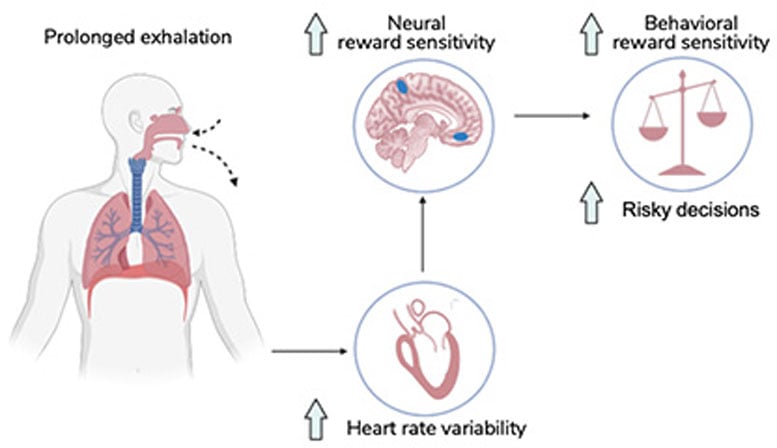
Extended exhalation increases reward sensitivity and heart rate variability, leading to bolder decision-making through measurable changes in brain activity.
Researchers from the German Institute of Human Nutrition Potsdam-Rehbruecke (DIfE) and Charité – Universitätsmedizin Berlin have shown for the first time that consciously controlling breathing patterns can influence decision-making by affecting both heart and brain activity.
Led by Prof. Soyoung Q Park, the team found that extending the exhalation phase of breathing increases heart rate variability and enhances the brain’s response to rewards, making people more likely to choose bolder options. The findings were published in the journal Neuron.
Fast breathing and an elevated heart rate are often associated with rapid decisions. In these situations, people may become more cautious in an effort to avoid losses, whether they are making a financial choice under pressure, navigating an important workplace discussion, or quickly deciding what to eat. Slower breathing and a calmer cardiovascular state, on the other hand, may encourage a more positive assessment of potential outcomes and greater willingness to take risks.
While decision-making is traditionally viewed as a process that originates in the brain, this study examined how signals from different parts of the body can shape brain activity and influence choices. The research was led by Prof. Soyoung Q Park in collaboration with the Neuroscience Research Center at Charité – Universitätsmedizin Berlin, Freie Universität Berlin, and the German Naval Institute of Maritime Medicine.

“Our decisions are rarely determined solely by external information. Rather, our judgment emerges from the interplay between cognitive processes and our current bodily state. It was previously unknown how the conscious regulation of our body, for example, through targeted breathing, could actively control our decision–making process. We wanted to create a physiological shift using a slow breathing pattern to change the quality of our decisions,” said Soyoung Q Park, head of the Department of Decision Neuroscience and Nutrition at DIfE.

Testing Slow Breathing During Risk Decisions
The study involved 41 healthy volunteers who completed risk-based decision tasks while following specific breathing instructions in an advanced research environment. Participants either breathed at their normal pace or followed a slower pattern with a prolonged exhalation (2:8 inhale-exhale ratio). During both breathing conditions, they were asked to make a series of decisions involving risk.
At the same time, researchers measured brain activity using functional magnetic resonance imaging while also tracking breathing, heart function, skin conductance, and pupil responses. Combining these data allowed the team to determine whether longer exhalations not only reduced heart rate but also directly influenced reward-related processing in the brain.
The results showed that extended exhalation increased the likelihood of riskier choices by slowing the heart rate. Importantly, participants became more responsive to potential rewards, while their sensitivity to possible losses did not change. The researchers also observed increased activity in the ventromedial prefrontal cortex and the precuneus.
Brain Regions Link Breathing, Heart Function, and Reward Sensitivity
These brain regions are involved in regulating both heart rate variability, which reflects changes in the time between heartbeats, and sensitivity to rewards. “Our study thus underscores the transformative role of breath-based interventions. The interplay between breathing and cardiac dynamics makes the brain more receptive to rewards,” said lead author Wenhao Huang.

The findings add to growing evidence on body-brain interactions and support neurovisceral models, which suggest that physical states can strongly shape cognitive function. Park said, “Breathing techniques have accompanied humanity for millennia across various religions and cultures. With this study, we provide scientific proof that it is a reliable and targeted method capable of controlling our decisions.”
Because breathing exercises are simple, inexpensive, and easy to learn, they may offer a practical tool for daily self-regulation. They could also have clinical value as a nonpharmacological approach for conditions such as anxiety and depression, which are often linked to disruptions in autonomic regulation and reward processing.
Future research will examine whether these effects extend to broader patient populations, including people who are overweight. “Since dietary decisions are strongly influenced by reward assessment and physical state, targeted breath regulation could also play a role in consciously perceiving and more effectively managing eating behavior,” Park said.
Reference: “Slow breathing impacts inter-organ dynamics modulating brain function and risk behavior” by Wenhao Huang, Mine Schmidt, Ignacio Rebollo, Felix Molter, Min Pu, Beatrix Keweloh, Lok Yan Lam, Peter N.C. Mohr, Gabriele Bellucci, Stefan Röttger and Soyoung Q. Park, 28 May 2026, Neuron.
DOI: 10.1016/j.neuron.2026.04.044
This study received funding from the following sources: Federal Ministry for Research, Technology and Space [Grant 01GP2210C (DecEnt–Project), Grant 01EE2301E for the conceptual development of the German Center for Mental Health; Grant 82DZD03D03 (German Center for Diabetes Research)], the Ministry for Science, Research and Culture of the State of Brandenburg (MWFK). Ignacio Rebollo was supported by the Marie Skłodowska-Curie Action (MSCA) BRAINSTOM (grant agreement no. 101028203).
Never miss a breakthrough: Join the SciTechDaily newsletter.
Follow us on Google and Google News.
1 Comment
Known by yogi’s and Zen practioners since time immemorial.