
Close Menu
    Facebook X (Twitter) Instagram
    SciTechDaily
    • Biology
    • Chemistry
    • Earth
    • Health
    • Physics
    • Science
    • Space
    • Technology
    Facebook X (Twitter) Pinterest YouTube RSS
    SciTechDaily
    Home»Space»SMUGGLE: Modeling Galaxy Formation With a New Stellar Feedback Framework
    Space

    SMUGGLE: Modeling Galaxy Formation With a New Stellar Feedback Framework

    By Harvard-Smithsonian Center for AstrophysicsFebruary 20, 20211 Comment3 Mins Read
    Facebook Twitter Pinterest Telegram LinkedIn WhatsApp Email Reddit
    Share
    Facebook Twitter LinkedIn Pinterest Telegram Email Reddit
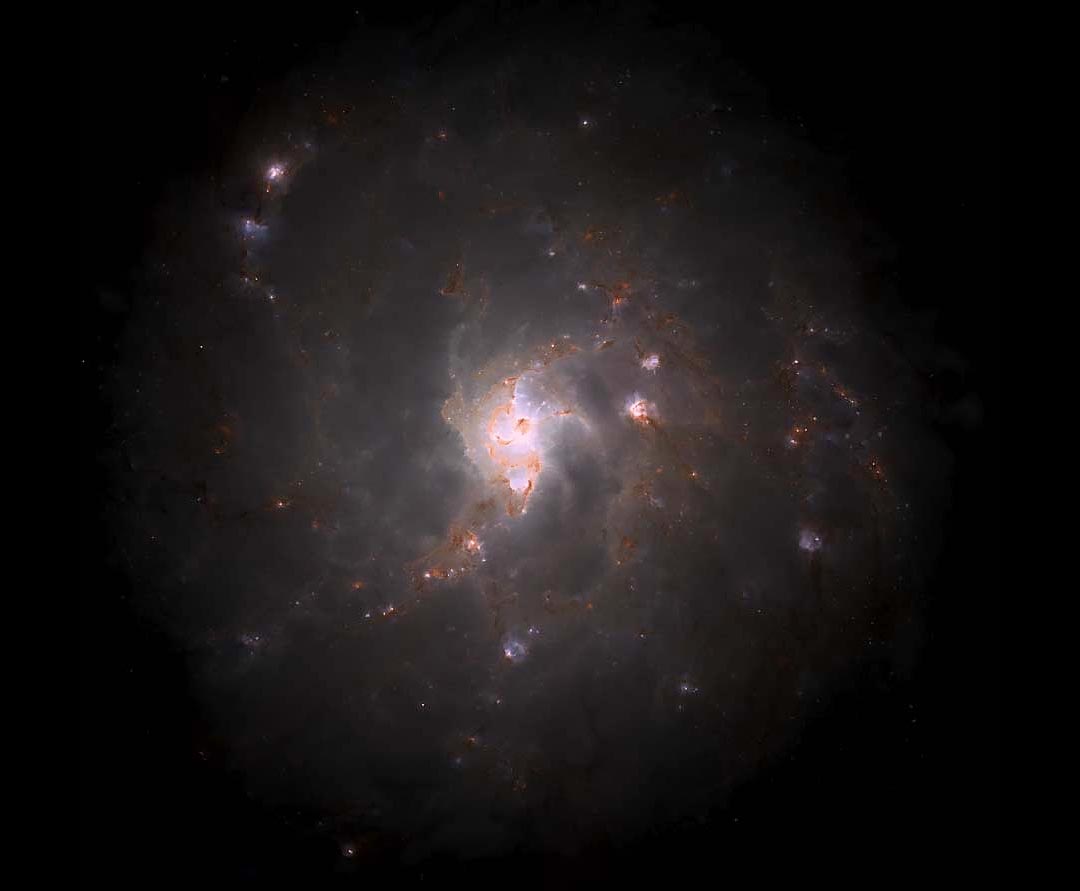
    Computer-Simulated Milky Way-Like Galaxy
    An image of a computer-simulated Milky Way-like galaxy. Astronomers have added improvements to previous codes so that they now can more accurately include processes involving dust, molecular hydrogen, and feedback from radiation on star formation, marking a significant advance in galaxy evolution modeling. Credit: Kannan et al. 2020

    New simulations show stellar radiation reshapes galactic gas and dust more than it alters star formation.

    Understanding the formation and evolution of galaxies is difficult because so many different physical processes besides just gravity are involved, including processes associated with star formation and stellar radiation, the cooling of the gas in the interstellar medium, feedback from accreting black holes, magnetic fields, cosmic rays, and more.

    Astronomers have used computer simulations of galaxy formation to help understand the interplay of these processes and address questions that cannot yet be answered through observations, like how the first galaxies in the universe formed. Simulations of galaxy formation require the self-consistent modeling of all these various mechanisms at once, but a key difficulty is that each of them operates at a different spatial scale making it nearly impossible to properly simulate them all at the same time.

    Gas inflow from the intergalactic medium into a galaxy, for example, takes place across millions of light-years, the winds of stars have influence over hundreds of light-years, while black hole feedback from its accretion disc occurs at scales of thousandths of a light-year.

    SMUGGLE: A Unified Simulation Tool

    CfA astronomers Rahul Kannan and Lars Hernquist, with their colleagues, have developed a novel computational framework that self-consistently includes all these effects. The computations use a new stellar feedback framework called the Stars and Multiphase Gas in Galaxies (SMUGGLE) which integrates processes involving radiation, dust, molecular hydrogen gas (the dominant component of the interstellar medium) and also includes thermal and chemical modeling. The SMUGGLE feedback is incorporated into the popular AREPO hydrodynamic code that simulates the evolution of structures, and which has an added module to include radiation effects.

    The astronomers use a simulation of the Milky Way to test their results, and report very good agreement with observations. They find that the feedback effects from radiation on star formation rates are quite modest, at least in a Milky Way example, where stars are forming at a rate of only two-to-three solar-masses per year.

    Star Formation and ISM Structure

    On the other hand, they find that the radiation from stars drastically changes the structure and heating of the interstellar medium by influencing the distribution of the hot, warm, and cold material which diverges from the simple expectation. The code does a good job of simulating the dust temperature distribution with warm dust lying (as expected) near the star-forming regions but with the cold dust, perhaps as low as ten kelvin, distributed farther away.

    The success of these new simulations motivates the authors to extend their work to simulations at even finer spatial resolution.

    Reference: “Simulating the interstellar medium of galaxies with radiative transfer, non-equilibrium thermochemistry, and dust” by Rahul Kannan, Federico Marinacci, Mark Vogelsberger, Laura V Sales, Paul Torrey, Volker Springel and Lars Hernquist, 20 October 2020, Monthly Notices of the Royal Astronomical Society.
    DOI: 10.1093/mnras/staa3249

    Never miss a breakthrough: Join the SciTechDaily newsletter.
    Follow us on Google and Google News.

    Astronomy Astrophysics Harvard-Smithsonian Center for Astrophysics
    Share. Facebook Twitter Pinterest LinkedIn Email Reddit

    Related Articles

    X-Ray Emission From Mysterious Dark Matter

    Analyzing Dust Storm Sequences on Mars

    Intriguing Remains of a Rare Stellar Explosion Discovered in Milky Way Center

    Puzzling Astrophysics of Quasars in the Early Universe

    Four Exoplanets – Including a Super-Earth Planet – Discovered by High School Students

    Massive Rotating Stars in the Pleiades Cluster

    Astronomers Discover First Cloudless, Jupiter-Like Planet – “Smoking Gun Evidence”

    Chandra X-ray Observatory Studies Extraordinary Magnetar [Video]

    Chandra Studies Extraordinary Magnetar: Fastest Spinning and Possibly the Youngest Magnetar Known

    1 Comment

    1. Duane M Peterson on March 7, 2021 12:03 pm

      No Black Hole at center of galaxies. You are missing the most simplest things why there is mostly likely nothing there, meaning no solid mass, just an empty space like a hurricane or tornado. But I guess that would not be exciting in selling science stories. Here is a question you should ask yourself, what am I asking this small infinite spot in our galaxy to do?

      Reply
    Leave A Reply Cancel Reply

    • Facebook
    • Twitter
    • Pinterest
    • YouTube

    Don't Miss a Discovery

    Subscribe for the Latest in Science & Tech!

    Trending News

    Mezcal “Worm” in a Bottle Mystery: DNA Testing Reveals a Surprise

    New Research Reveals That Your Morning Coffee Activates an Ancient Longevity Switch

    This Is What Makes You Irresistible to Mosquitoes

    Shockingly Powerful Giant Octopuses Ruled the Seas 100 Million Years Ago

    Scientists Stunned by New Organic Molecules Found on Mars

    Rewriting Dinosaur Evolution: Scientists Unearth Remarkable 150-Million-Year-Old Stegosaur Skull

    Omega-3 Supplements Linked to Cognitive Decline in Surprising New Study

    First-of-Its-Kind Discovery: Homer’s Iliad Found Embedded in a 1,600-Year-Old Egyptian Mummy

    Follow SciTechDaily
    • Facebook
    • Twitter
    • YouTube
    • Pinterest
    • Newsletter
    • RSS
    SciTech News
    • Biology News
    • Chemistry News
    • Earth News
    • Health News
    • Physics News
    • Science News
    • Space News
    • Technology News
    Recent Posts
    • Doing This After 9 p.m. Could Double Your Risk of Gut Issues
    • New Research Challenges Long-Held Beliefs About How the Brain Makes Decisions
    • Breakthrough Technology Reveals New Treatment Targets for Cancer
    • Scientists Discover New Way To Make Drug-Resistant Cancer Treatable Again
    • This Simple Exercise Trick Builds Muscle With Less Effort, Study Finds
    Copyright © 1998 - 2026 SciTechDaily. All Rights Reserved.
    • Science News
    • About
    • Contact
    • Editorial Board
    • Privacy Policy
    • Terms of Use

    Type above and press Enter to search. Press Esc to cancel.