
Close Menu
    Facebook X (Twitter) Instagram
    SciTechDaily
    • Biology
    • Chemistry
    • Earth
    • Health
    • Physics
    • Science
    • Space
    • Technology
    Facebook X (Twitter) Pinterest YouTube RSS
    SciTechDaily
    Home»Earth»Soaking Up Sun in the Thar Desert: 2,245 Megawatts From Millions of Solar Photovoltaic Panels
    Earth

    Soaking Up Sun in the Thar Desert: 2,245 Megawatts From Millions of Solar Photovoltaic Panels

    By Adam Voiland, NASA Earth ObservatoryFebruary 23, 2022No Comments2 Mins Read
    Facebook Twitter Pinterest Telegram LinkedIn WhatsApp Email Reddit
    Share
    Facebook Twitter LinkedIn Pinterest Telegram Email Reddit
    Bhadla Solar Park Annotated
    January 26, 2022

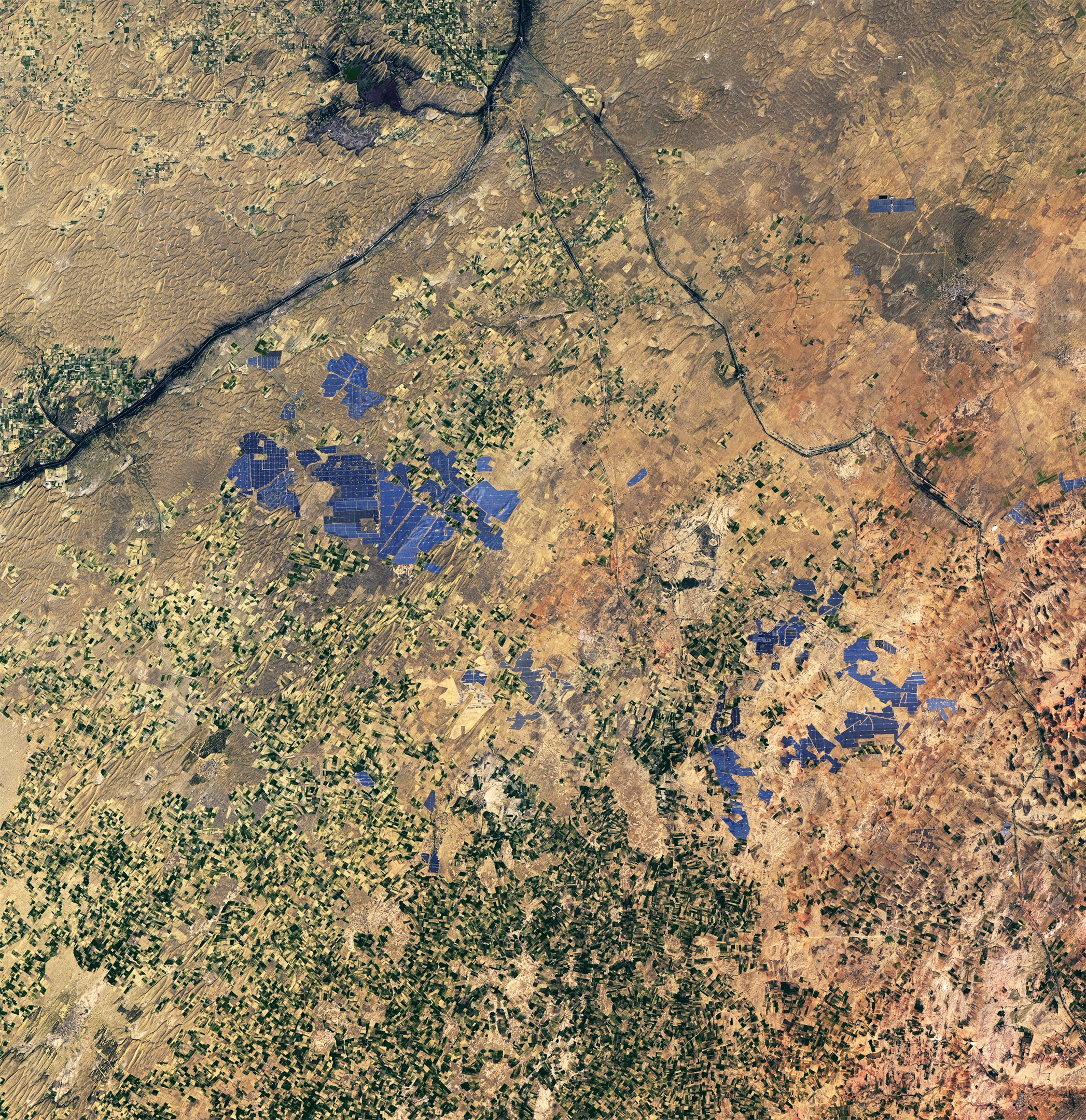
    The Thar desert’s abundance of open space and sunshine make it an ideal place for solar power.

    Scorching temperatures, infertile soils, limited water supplies, and frequent wind storms make the Phalodi township in India’s Thar desert an inhospitable place to live. Yet the abundance of open space and sunshine make this remote part of western Rajasthan an ideal place for harvesting solar power.

    Construction of the Bhadla Solar Park, near India’s border with Pakistan, began to appear in satellite imagery in 2015. Now millions of solar photovoltaic panels blanket Phalodi, giving a metallic look to landscapes that were once sandy and brown. The Operational Land Imager (OLI) on Landsat 8 captured this natural-color satellite image of the park on January 26, 2022.

    Bhadla Solar Park spreads across more than 5700 hectares (22 square miles), an area about one-third the size of Washington, D.C. It has a total capacity of 2245 megawatts, among the largest solar parks in the world. Its presence recently helped Rajasthan overtake Karnataka as the Indian state with the largest installed solar capacity, according to Mercomm India.

    Though the area’s consistently clear skies mean sunlight is abundant, frequent dust storms pose an engineering challenge because they coat the panels with layers of minerals and sand that hamper electricity production. Some operators have chosen to unleash thousands of cleaning robots on the panels, a tactic designed to cut manual labor needs and reduce the amount of water required for cleaning. Some recent research suggests that Landsat imagery could assist such systems by helping companies identify dust buildup and optimize cleaning operations.

    NASA Earth Observatory image by Lauren Dauphin, using Landsat data from the U.S. Geological Survey.

    Never miss a breakthrough: Join the SciTechDaily newsletter.
    Follow us on Google and Google News.

    Geography NASA NASA Earth Observatory Photovoltaics Solar Energy
    Share. Facebook Twitter Pinterest LinkedIn Email Reddit

    Related Articles

    India’s Floating Solar Farms Can Be Seen From Space

    China’s Solar Great Wall: Harnessing the Sun in the Heart of the “Sea of Death”

    Sea Ice in Denmark Strait – Drifted More Than 1,000 Km (600 Miles) From the Arctic Ocean

    NASA Scientists Map Beirut Blast Damage – Devastating Explosion Rocked Port Area

    NASA Advanced Rapid Imaging Satellite Maps Blast Damage: Beirut Explosion Aftermath

    NASA/NOAA Satellites Observe Surprisingly Rapid Increase in Scale and Intensity of Fires in Siberia

    Mars Terraforming: Cultivating Ideas for Mars on Earth

    Meandering Mississippi River: Photo Taken by Astronaut on Space Station Shows Divergence From State Boundaries

    Incredible Rare Peek at Patagonia in Winter

    Leave A Reply Cancel Reply

    • Facebook
    • Twitter
    • Pinterest
    • YouTube

    Don't Miss a Discovery

    Subscribe for the Latest in Science & Tech!

    Trending News

    New Study Reveals Why Ozempic Works Better for Some People Than Others

    Climate Change Is Altering a Key Greenhouse Gas in a Way Scientists Didn’t Expect

    New Study Suggests Gravitational Waves May Have Created Dark Matter

    Scientists Discover Why the Brain Gets Stuck in Schizophrenia

    Scientists Engineer “Tumor-Eating” Bacteria That Devour Cancer From Within

    Even “Failed” Diets May Deliver Long-Term Health Gains, Study Finds

    NIH Scientists Discover Powerful New Opioid That Relieves Pain Without Dangerous Side Effects

    Collapsing Plasma May Hold the Key to Cosmic Magnetism

    Follow SciTechDaily
    • Facebook
    • Twitter
    • YouTube
    • Pinterest
    • Newsletter
    • RSS
    SciTech News
    • Biology News
    • Chemistry News
    • Earth News
    • Health News
    • Physics News
    • Science News
    • Space News
    • Technology News
    Recent Posts
    • This 15,000-Year-Old Discovery Changes What We Know About Early Human Creativity
    • 35-Million-Year-Old Mystery: Strange Arachnid Discovered Preserved in Amber
    • Revolutionary Gas Turbine Generates Power Without Air Compression
    • Is AI Really Just a Tool? It Could Be Altering How You See Reality
    • JWST Reveals a “Forbidden” Planet With a Baffling Composition
    Copyright © 1998 - 2026 SciTechDaily. All Rights Reserved.
    • Science News
    • About
    • Contact
    • Editorial Board
    • Privacy Policy
    • Terms of Use

    Type above and press Enter to search. Press Esc to cancel.