
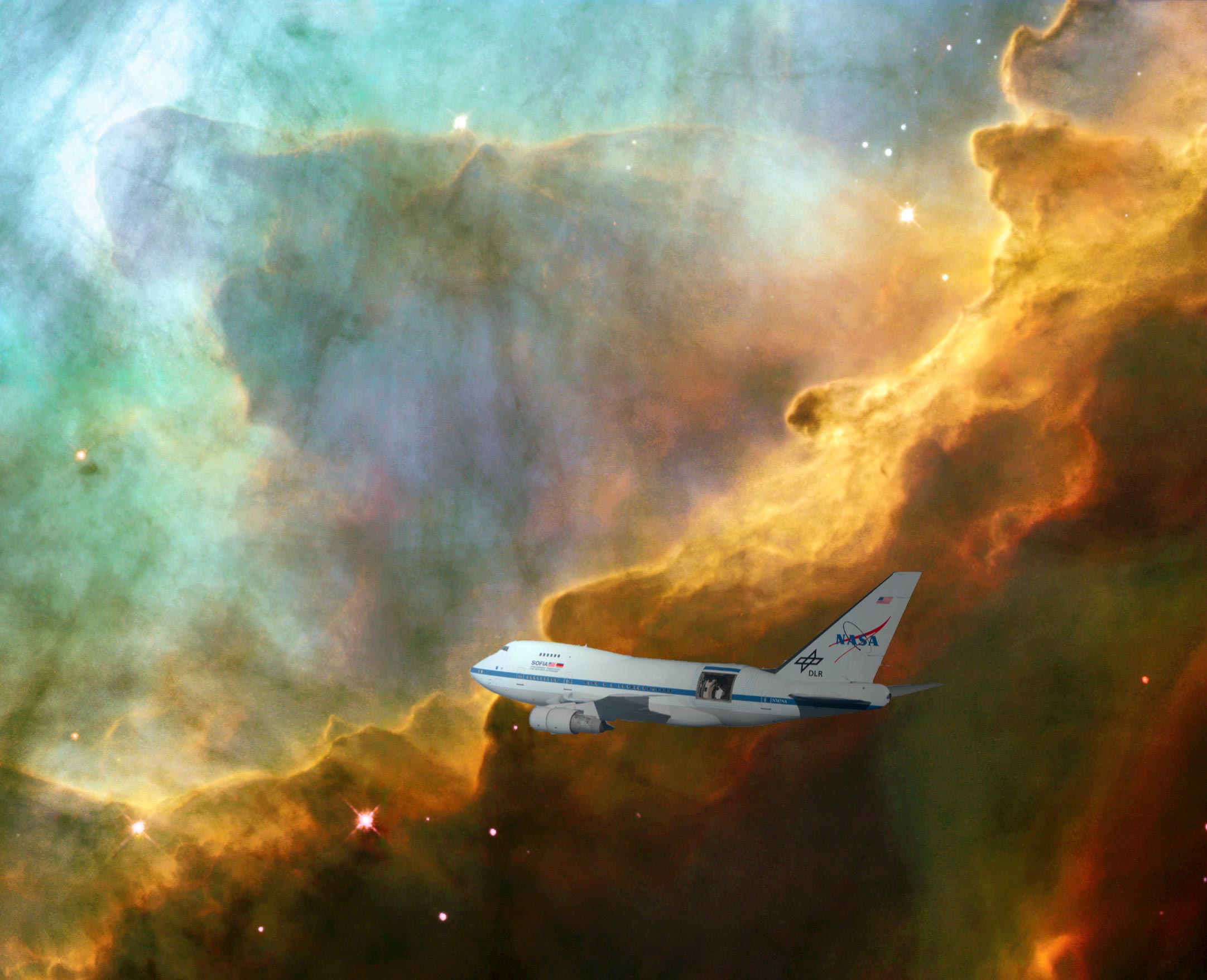
UMD-led team used NASA’s SOFIA telescope to capture high-resolution details of a star nursery in the Milky Way.
University of Maryland researchers created the first high-resolution image of an expanding bubble of hot plasma and ionized gas where stars are born. Previous low-resolution images did not clearly show the bubble or reveal how it expanded into the surrounding gas.
The researchers used data collected by the Stratospheric Observatory for Infrared Astronomy (SOFIA) telescope to analyze one of the brightest, most massive star-forming regions in the Milky Way galaxy. Their analysis showed that a single, expanding bubble of warm gas surrounds the Westerlund 2 star cluster and disproved earlier studies suggesting there may be two bubbles surrounding Westerlund 2. The researchers also identified the source of the bubble and the energy driving its expansion. Their results were published in The Astrophysical Journal on June 23, 2021.
“When massive stars form, they blow off much stronger ejections of protons, electrons, and atoms of heavy metal, compared to our sun,” said Maitraiyee Tiwari, a postdoctoral associate in the UMD Department of Astronomy and lead author of the study. “These ejections are called stellar winds, and extreme stellar winds are capable of blowing and shaping bubbles in the surrounding clouds of cold, dense gas. We observed just such a bubble centered around the brightest cluster of stars in this region of the galaxy, and we were able to measure its radius, mass, and the speed at which it is expanding.”
Where New Stars Are Born
The surfaces of these expanding bubbles are made of a dense gas of ionized carbon, and they form a kind of outer shell around the bubbles. New stars are believed to form within these shells. But like soup in a boiling cauldron, the bubbles enclosing these star clusters overlap and intermingle with clouds of surrounding gas, making it hard to distinguish the surfaces of individual bubbles.
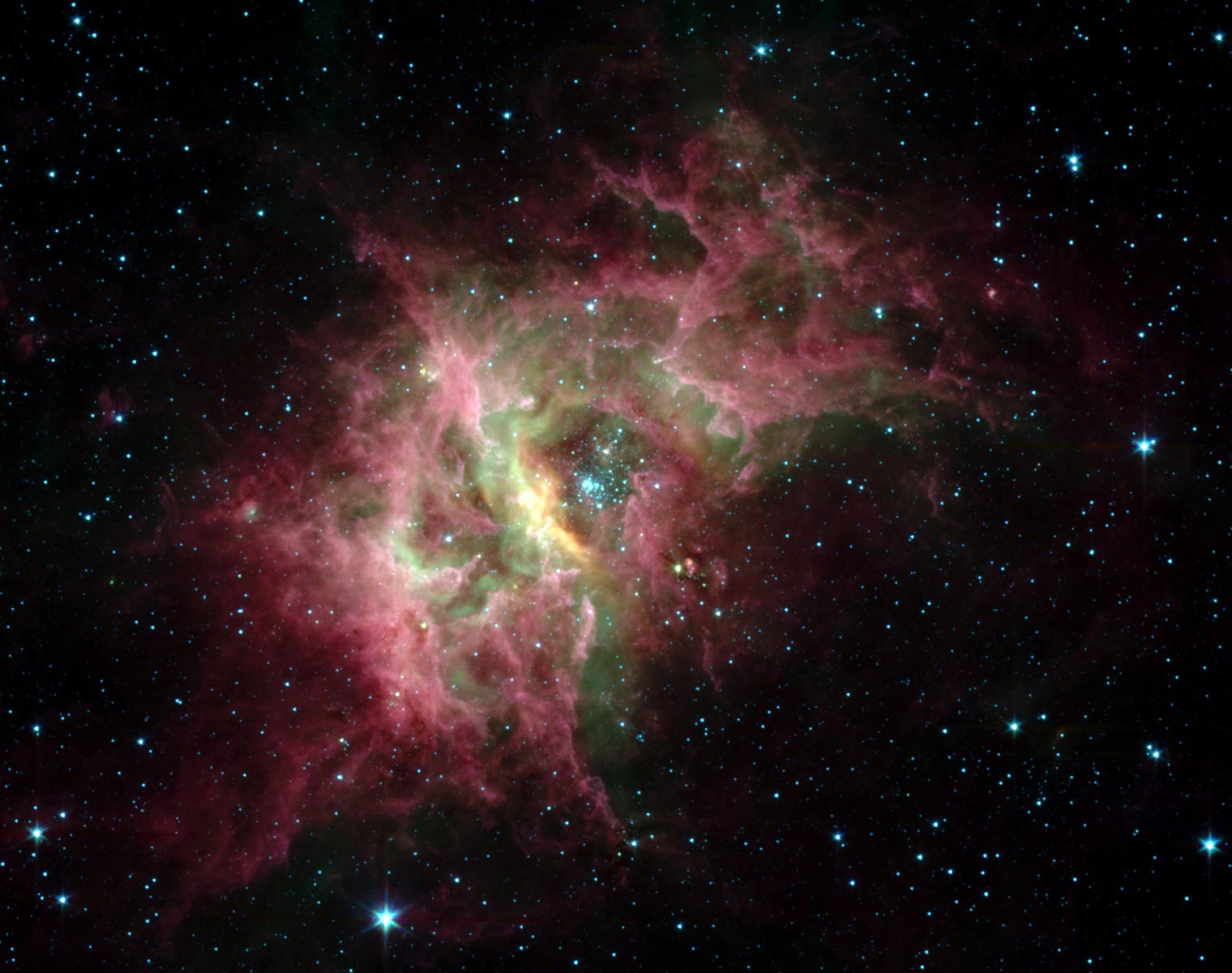
Tiwari and her colleagues created a clearer picture of the bubble surrounding Westerlund 2 by measuring the radiation emitted from the cluster across the entire electromagnetic spectrum, from high-energy X-rays to low-energy radio waves. Previous studies, which only radio and submillimeter wavelength data, had produced low-resolution images and did not show the bubble. Among the most important measurements was a far-infrared wavelength emitted by a specific ion of carbon in the shell.
“We can use spectroscopy to actually tell how fast this carbon is moving either towards or away from us,” said Ramsey Karim (M.S. ’19, astronomy), a Ph.D. student in astronomy at UMD and a co-author of the study. “This technique uses the Doppler effect, the same effect that causes a train’s horn to change pitch as it passes you. In our case, the color changes slightly depending on the velocity of the carbon ions.”
By determining whether the carbon ions were moving toward or away from Earth and combining that information with measurements from the rest of the electromagnetic spectrum, Tiwari and Karim were able to create a 3D view of the expanding stellar-wind bubble surrounding Westerlund 2.
In addition to finding a single, stellar wind-driven bubble around Westerlund 2, they found evidence of new stars forming in the shell region of this bubble. Their analysis also suggests that as the bubble expanded, it broke open on one side, releasing hot plasma and slowing expansion of the shell roughly a million years ago. But then, about 200,000 or 300,000 years ago, another bright star in Westerlund 2 evolved, and its energy re-invigorated the expansion of the Westerlund 2 shell.
New Energy Reinvigorates Bubble Expansion
“We saw that the expansion of the bubble surrounding Westerlund 2 was reaccelerated by winds from another very massive star, and that started the process of expansion and star formation all over again,” Tiwari said. “This suggests stars will continue to be born in this shell for a long time, but as this process goes on, the new stars will become less and less massive.”
Tiwari and her colleagues will now apply their method to other bright star clusters and warm gas bubbles to better understand these star-forming regions of the galaxy. The work is part of a multi-year NASA-supported program called FEEDBACK.
Reference: “SOFIA FEEDBACK Survey: Exploring the Dynamics of the Stellar Wind–Driven Shell of RCW 49” by M. Tiwari, R. Karim, M. W. Pound, M. Wolfire, A. Jacob, C. Buchbender, R. Güsten, C. Guevara, R. D. Higgins, S. Kabanovic, C. Pabst, O. Ricken, N. Schneider, R. Simon, J. Stutzki and A. G. G. M. Tielens, 23 June 2021, The Astrophysical Journal.
DOI: 10.3847/1538-4357/abf6ce
Additional co-authors of the research paper from UMD’s Department of Astronomy include Research Scientists Marc Pound and Mark Wolfire and Adjunct Professor Alexander Tielens. This work was supported by the NASA-funded FEEDBACK project (Award No. SOF070077). The content of this article does not necessarily reflect the views of this organization.
Never miss a breakthrough: Join the SciTechDaily newsletter.
Follow us on Google and Google News.