
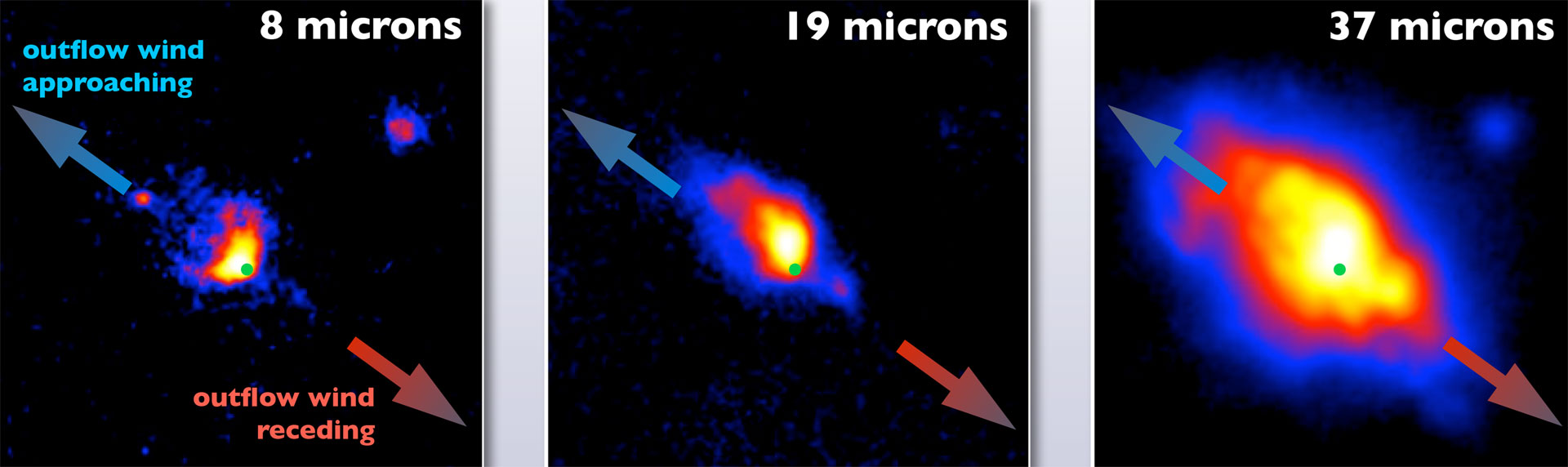
Astronomers are observing star-forming regions in our galaxy with NASA’s flying telescope, the Stratospheric Observatory for Infrared Astronomy, SOFIA, to understand the processes and environments required to create the largest known stars, which tip the scales at ten times the mass of our own Sun or more.
The research team, led by James M. De Buizer, SOFIA senior scientist, and Jonathan Tan at Chalmers University of Technology, Gothenburg, Sweden, and the University of Virginia, has published observations of eight extremely massive and young stars located within our Milky Way Galaxy. SOFIA’s powerful camera, the Faint Object infraRed Camera for the SOFIA Telescope, known as FORCAST, allowed the team to probe warm, dusty regions that are heated by light from luminous, massive stars that are still forming. SOFIA’s airborne location, flying above more than 99 percent of Earth’s infrared-blocking water vapor coupled with its powerful instruments, make it the only observatory that can study the stars at the wavelengths, sensitivity, and resolution necessary to see inside the dense dust clouds from which these stars are born.
The research is part of the ongoing SOFIA Massive (SOMA) Star Formation Survey by Tan and his collaborators. As part of this survey, they are studying a large sample of newborn stars, known as “protostars,” that have different masses, are at varying evolutionary stages, and within different environments. The team hopes to gain insight into the overall process of how massive stars form and to help test and refine new theoretical models of star formation.
Massive stars end their lives in violent supernova explosions, expelling the elements at their centers into the interstellar medium. Over millions or billions of years, these elements are recycled into newly forming stars and their solar systems.
“If it weren’t for massive stars, we wouldn’t have the essential elements needed to create our solar system, our planet, or even the basic building blocks needed for life,” says De Buizer. “It’s not clear whether massive stars form in a similar environment, or even in the same ways, as our Sun formed. That’s the reason we study massive stars, and their birth processes.”
There is no scientific consensus about the mechanism responsible for driving the creation of massive stars. This SOMA Survey reveals that massive star formation is accompanied by the launching of powerful, magnetized winds that flow out from above and below a swirling disk of gas that is feeding the growing star. These winds blow cavities through the dense, dusty cloud, which allowed researchers to see more clearly into the stellar nursery. By measuring how much light escapes from these cavities at different wavelengths, researchers can learn about the structure of protostars and can test different theoretical models of their formation.
“Understanding the birth process of massive stars is one of the most important unsolved problems of modern astrophysics, since these stars are so influential throughout our galaxy and beyond,” says Tan. “The unique ability of the SOFIA telescope to see at infrared wavelengths – wavelengths that are 100 times longer than those of visible light — is crucial for progress on this research, since this is the part of the spectrum where the stars emit most of their energy.”
The first SOMA study was published in the Astrophysical Journal in 2017. Observations in the SOMA study will continue on board SOFIA in the summer of 2018, with plans to observe about fifty regions of massive star formation throughout our galaxy.
“Our recent and upcoming observations will yield a large enough sample to discover the general principles of how massive stars are born,” said Tan.
Reference: “The SOFIA Massive (SOMA) Star Formation Survey. I. Overview and First Results” by James M. De Buizer, Mengyao Liu, Jonathan C. Tan, Yichen Zhang, Maria T. Beltrán, Ralph Shuping, Jan E. Staff, Kei E. I. Tanaka and Barbara Whitney, 28 June 2017, The Astrophysical Journal.
DOI: 10.3847/1538-4357/aa74c8
The research team involves a large international collaboration that includes Chalmers University and University of Virginia students, postdocs, and faculty, along with collaborators from California, Wisconsin, the U.S. Virgin Islands, Japan, and Italy. The SOMA Survey involves the publication and release of the data for use by the whole astronomical community, with this being just the first data release.
SOFIA is a Boeing 747SP jetliner modified to carry a 100-inch diameter telescope. It is a joint project of NASA and the German Aerospace Center, DLR. NASA’s Ames Research Center in California’s Silicon Valley manages the SOFIA program, science and mission operations in cooperation with the Universities Space Research Association headquartered in Columbia, Maryland, and the German SOFIA Institute (DSI) at the University of Stuttgart. The aircraft is based at NASA’s Armstrong Flight Research Center’s Hangar 703, in Palmdale, California.
Never miss a breakthrough: Join the SciTechDaily newsletter.
Follow us on Google and Google News.