
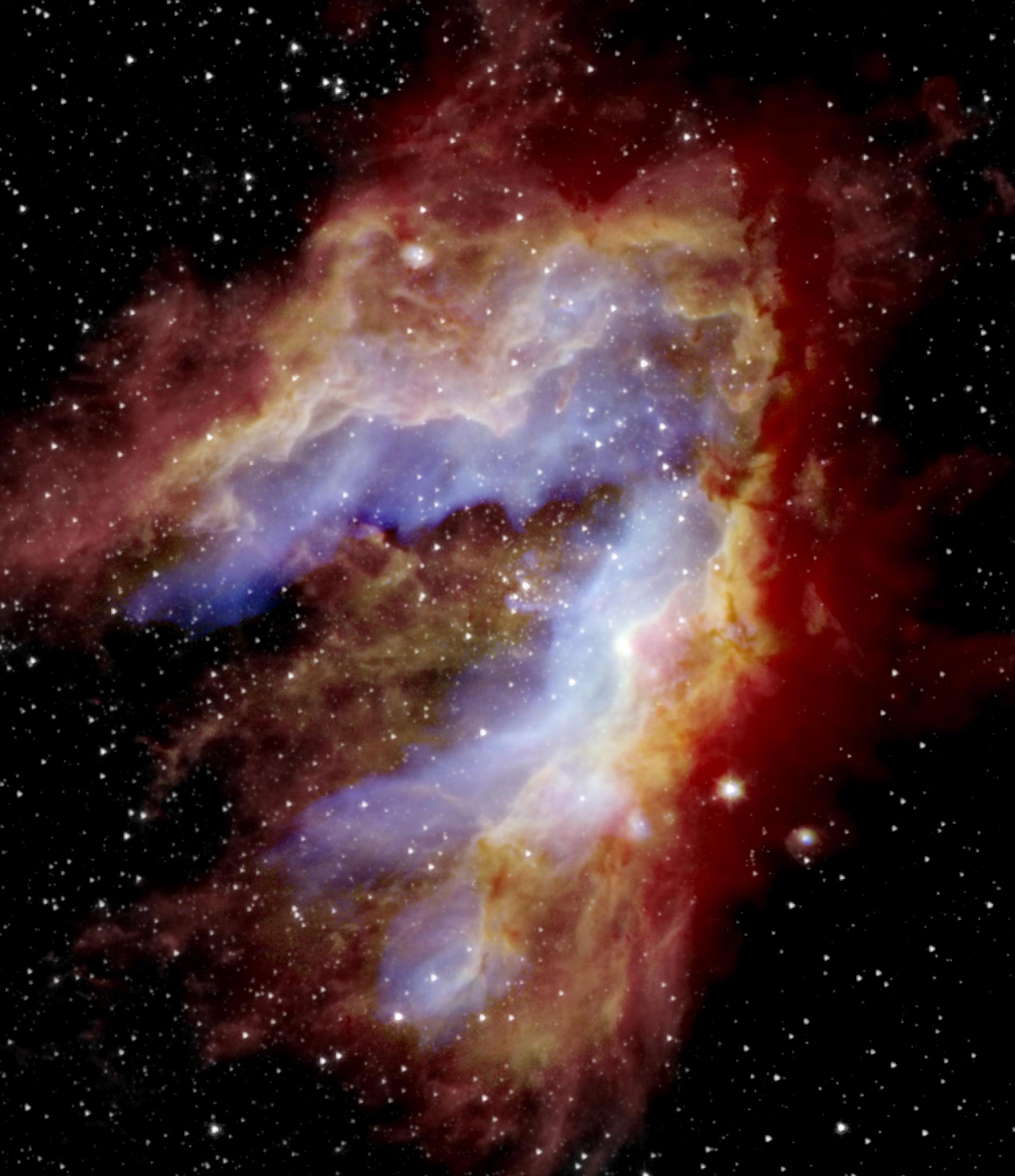
One of the brightest and most massive star-forming regions in our galaxy, the Omega, or Swan, Nebula, came to resemble the shape resembling a swan’s neck we see today only relatively recently. New observations reveal that its regions formed separately over multiple eras of star birth. The new image from the Stratospheric Observatory for Infrared Astronomy, or SOFIA, is helping scientists chronicle the history and evolution of this well-studied nebula.
“The present-day nebula holds the secrets that reveal its past; we just need to be able to uncover them,” said Wanggi Lim, a Universities Space Research Association scientist at the SOFIA Science Center at NASA’s Ames Research Center in California’s Silicon Valley. “SOFIA lets us do this, so we can understand why the nebula looks the way it does today.”
Uncovering the nebula’s secrets is no simple task. It’s located more than 5,000 light-years away in the constellation Sagittarius. Its center is filled with more than 100 of the galaxy’s most massive young stars. These stars may be many times the size of our Sun, but the youngest generations are forming deep in cocoons of dust and gas, where they are very difficult to see, even with space telescopes. Because the central region glows very brightly, the detectors on space telescopes were saturated at the wavelengths SOFIA studied, similar to an overexposed photo.
SOFIA’s infrared camera called FORCAST, the Faint Object Infrared Camera for the SOFIA Telescope, however, can pierce through these cocoons.
The new view reveals nine protostars, areas where the nebula’s clouds are collapsing and creating the first step in the birth of stars, that had not been seen before. Additionally, the team calculated the ages of the nebula’s different regions. They found that portions of the swan-like shape were not all created at the same time, but took shape over multiple eras of star formation.
The central region is the oldest, most evolved and likely formed first. Next, the northern area formed, while the southern region is the youngest. Even though the northern area is older than the southern region, the radiation and stellar winds from previous generations of stars has disturbed the material there, preventing it from collapsing to form the next generation.
“This is the most detailed view of the nebula we have ever had at these wavelengths,” said Jim De Buizer, a senior scientist also at the SOFIA Science Center. “It’s the first time we can see some of its youngest, massive stars and start to truly understand how it evolved into the iconic nebula we see today.”
Massive stars, like those in the Swan Nebula, release so much energy that they can change the evolution of entire galaxies. But less than 1% of all stars are this enormous, so astronomers know very little about them. Previous observations of this nebula with space telescopes studied different wavelengths of infrared light, which did not reveal the details SOFIA detected.
SOFIA’s image shows gas in blue as it’s heated by massive stars located near the center, and dust in green that is warmed both by existing massive stars and nearby newborn stars. The newly-detected protostars are located primarily in the southern areas. The red areas near the edge represent cold dust that was detected by the Herschel Space Telescope, while the white star field was detected by the Spitzer Space Telescope.
The Spitzer Space Telescope will be decommissioned on January 30, 2020, after operating for more than 16 years. SOFIA continues exploring the infrared universe, building on Spitzer’s legacy. SOFIA studies wavelengths of mid- and far-infrared light with high resolution that are not accessible to other telescopes, helping scientists understand star and planet formation, the role magnetic fields play in shaping our universe, and the chemical evolution of galaxies.
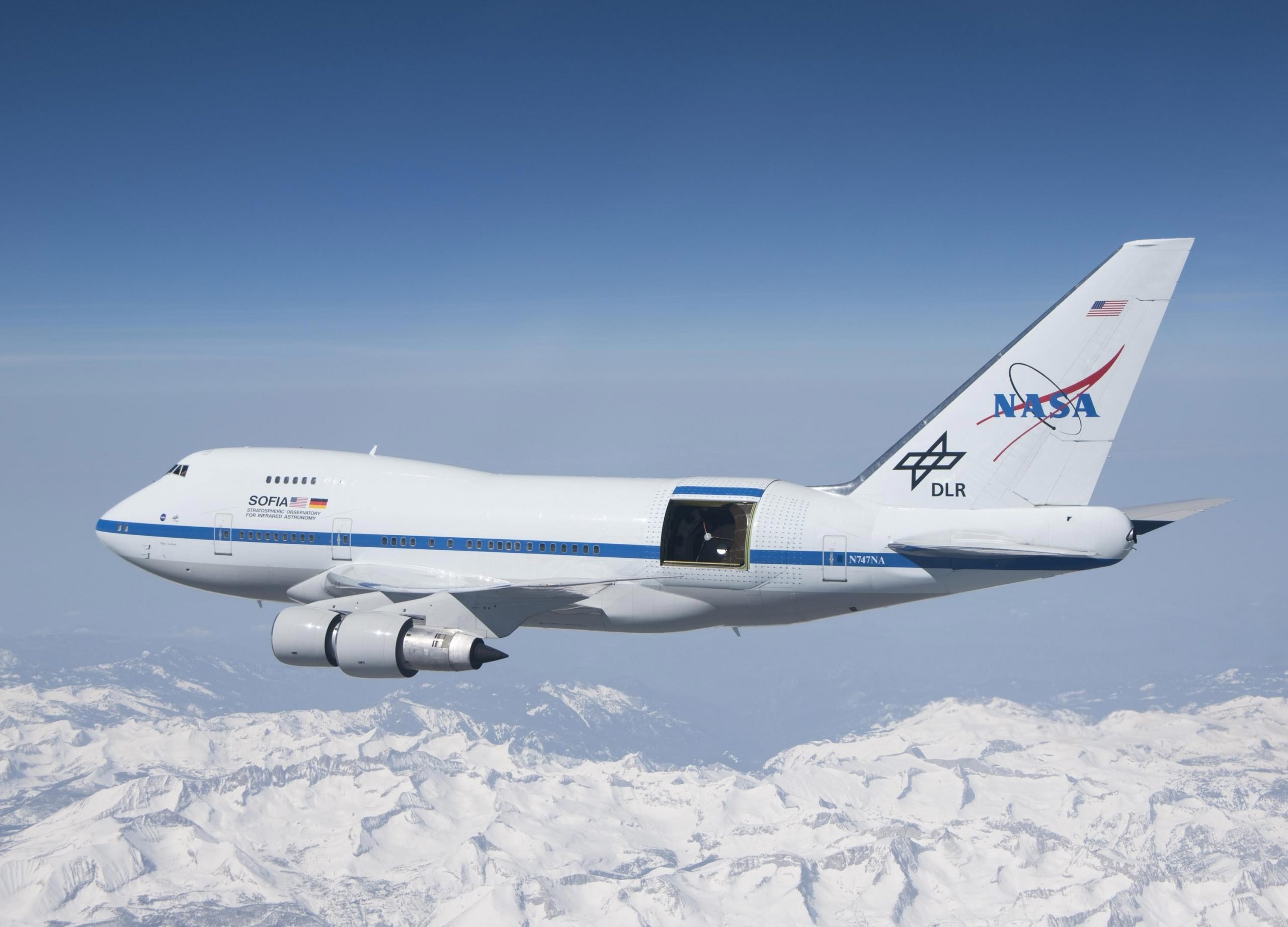
SOFIA, the Stratospheric Observatory for Infrared Astronomy, is a Boeing 747SP jetliner modified to carry a 106-inch diameter telescope. It is a joint project of NASA and the German Aerospace Center (DLR). NASA’s Ames Research Center in California’s Silicon Valley manages the SOFIA program, science and mission operations in cooperation with the Universities Space Research Association headquartered in Columbia, Maryland, and the German SOFIA Institute (DSI) at the University of Stuttgart. The aircraft is maintained and operated from NASA’s Armstrong Flight Research Center Building 703, in Palmdale, California.
JPL manages the Spitzer Space Telescope mission for NASA’s Science Mission Directorate in Washington. Science operations are conducted at the Spitzer Science Center at Caltech in Pasadena, California. Space operations are based at Lockheed Martin Space in Littleton, Colorado. Data are archived at the Infrared Science Archive housed at IPAC at Caltech. Caltech manages JPL for NASA.
Herschel is a European Space Agency mission, with science instruments provided by consortia of European institutes and with important participation by NASA. While the observatory stopped making science observations in April 2013, after running out of liquid coolant as expected, scientists continue to analyze its data. NASA’s Herschel Project Office is based at NASA’s Jet Propulsion Laboratory in Pasadena. JPL contributed mission-enabling technology for two of Herschel’s three science instruments. The NASA Herschel Science Center, part of IPAC, supports the U.S. astronomical community. Caltech manages JPL for NASA.
Never miss a breakthrough: Join the SciTechDaily newsletter.
Follow us on Google and Google News.