
Close Menu
    Facebook X (Twitter) Instagram
    SciTechDaily
    • Biology
    • Chemistry
    • Earth
    • Health
    • Physics
    • Science
    • Space
    • Technology
    Facebook X (Twitter) Pinterest YouTube RSS
    SciTechDaily
    Home»Physics»Space-Time Phase Modulated Metasurface Makes Light Reflect Only in One Direction
    Physics

    Space-Time Phase Modulated Metasurface Makes Light Reflect Only in One Direction

    By Changchun Institute of OpticsDecember 20, 2019No Comments3 Mins Read
    Facebook Twitter Pinterest Telegram LinkedIn WhatsApp Email Reddit
    Share
    Facebook Twitter LinkedIn Pinterest Telegram Email Reddit
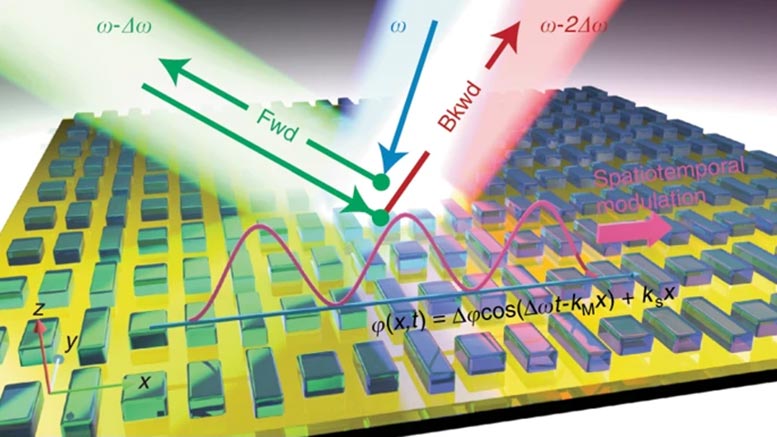
    Schematic Illustration of the Space-Time Metasurface
    An illustration showing the concept of a space-time phase modulated metasurface consisting of resonating dielectric nanoantennas operating in reflection mode. A traveling phase modulation in sinusoidal form is superposed on the designed phase gradient along the horizontal direction. Light impinging on the metasurface with frequency ω is converted to a reflecting beam with frequency ω-Δω due to the parametric process arising from dynamic phase modulation, while the backpropagating beam with frequency ω-Δω is converted to ω -2Δω instead of ω, resulting in a nonreciprocal effect. Credit: Xuexue Guo, Yimin Ding, Yao Duan, and Xingjie Ni

    Light propagation is usually reciprocal, meaning that the trajectory of light traveling in one direction is identical to that in the opposite direction. Breaking reciprocity can make light propagate only in one direction. Optical components that support such unidirectional flow of light, for example, isolators and circulators, are indispensable building blocks in many modern laser and communication systems. They are currently almost exclusively based on the magneto-optic effect, making the devices bulky and difficult to integrate. It is in great demand to have a magnetic-free route to achieve nonreciprocal light propagation in many optical applications.

    Recently, scientists developed a new type of optical metasurface with which phase modulation in both space and time is imposed on the reflected light, leading to different paths for the forward and backward light propagation. For the first time, nonreciprocal light propagation in free space was realized experimentally at optical frequencies with such an ultrathin component.

    “This is the first optical metasurface with controllable ultrafast time-varying properties that is capable of breaking optical reciprocity without a bulky magnet,” said Xingjie Ni, the Charles H. Fetter Assistant Professor in Department of Electrical Engineering at the Pennsylvania State University. The results were published this week in Light: Science and Applications.

    The ultrathin metasurface consists of a silver back-reflector plate supporting block-shaped, silicon nanoantennas with large nonlinear Kerr index at near-infrared wavelengths around 860 nm. Heterodyne interference between two laser lines that are closely spaced in frequency was used to create efficient traveling-wave refractive index modulation upon the nanoantennas, which leads to ultrafast space-time phase modulation with unprecedentedly large temporal modulation frequency of about 2.8 THz. This dynamic modulation technique exhibits great flexibility in tuning both spatial and temporal modulation frequencies. Completely asymmetric reflections in forward and backward light propagations were achieved experimentally with a wide bandwidth of around 5.77 THz within a sub-wavelength interaction length of 150 nm.

    Light reflected by the space-time metasurface acquires a momentum shift induced by the spatial phase gradient as well as a frequency shift arising from the temporal modulation. It exhibits asymmetric photonic conversions between forward and backward reflections. In addition, by exploiting unidirectional momentum transfer provided by the metasurface geometry, selective photonic conversions can be freely controlled by designing an undesired output state to lie in the forbidden, i.e. non-propagative, region.

    This approach exhibits excellent flexibility in controlling light both in momentum and energy space. It will provide a new platform for exploring interesting physics arising from time-dependent material properties and will open a new paradigm in the development of scalable, integrable, magnet-free nonreciprocal devices.

    Reference: “Nonreciprocal metasurface with space–time phase modulation” by Xuexue Guo, Yimin Ding, Yao Duan and Xingjie Ni, 18 December 2019, Light: Science & Applications.
    DOI: 10.1038/s41377-019-0225-z

    Never miss a breakthrough: Join the SciTechDaily newsletter.
    Follow us on Google and Google News.

    Chinese Academy of Sciences Optics
    Share. Facebook Twitter Pinterest LinkedIn Email Reddit

    Related Articles

    Quantum Flows in Light: Physicists Discover Optical Analog to Kármán Vortex Streets

    Vectorial Adaptive Optics: A New Horizon in Phase and Polarization Correction

    Unlocking the Future of Nanophotonics – Breaking Symmetry To Excite Polaritons

    Lighting Up Quantum Realms: Terahertz Spectroscopy and Symmetry-Broken Materials

    Scientists Realize Noiseless Photon-Echo Protocol – Key to Long-Distance Quantum Communication

    Photonic Crystal Fiber-Based “Parallel Reactors” Unveil Collective Matter-Light Analogies of Soliton Molecules

    Ultrathin Flat Lenses for High Resolution Imaging Using Monolayer Transition Metal

    Efficient Generation of Relativistic Near-Single-Cycle Mid-Infrared Pulses in Plasmas

    New Ghost Imaging Nanoscopy Approach Captures the Details of Processes Occurring in Living Cells

    Leave A Reply Cancel Reply

    • Facebook
    • Twitter
    • Pinterest
    • YouTube

    Don't Miss a Discovery

    Subscribe for the Latest in Science & Tech!

    Trending News

    The Universe Is Expanding Too Fast and Scientists Can’t Explain Why

    “Like Liquid Metal”: Scientists Create Strange Shape-Shifting Material

    Early Warning Signals of Esophageal Cancer May Be Hiding in Plain Sight

    Common Blood Pressure Drug Shows Surprising Power Against Deadly Antibiotic-Resistant Superbug

    Scientists Uncover Dangerous Connection Between Serotonin and Heart Valve Disease

    Scientists Discover a “Protector” Protein That Could Help Reverse Hair Loss

    Bone-Strengthening Discovery Could Reverse Osteoporosis

    Scientists Uncover Hidden Trigger Behind Stem Cell Aging

    Follow SciTechDaily
    • Facebook
    • Twitter
    • YouTube
    • Pinterest
    • Newsletter
    • RSS
    SciTech News
    • Biology News
    • Chemistry News
    • Earth News
    • Health News
    • Physics News
    • Science News
    • Space News
    • Technology News
    Recent Posts
    • Why Popular Diabetes Drugs Like Ozempic Don’t Work for Everyone: The “Genetic Glitch”
    • Scientists Create Improved Insulin Cells That Reverse Diabetes in Mice
    • Scientists Stunned After Finding Plant Thought Extinct for 60 Years
    • A Common Diabetes Drug May Hold the Key to Stopping HIV From Coming Back
    • Ancient “Syphilis-Like” Disease in Vietnam Challenges Key Scientific Assumptions
    Copyright © 1998 - 2026 SciTechDaily. All Rights Reserved.
    • Science News
    • About
    • Contact
    • Editorial Board
    • Privacy Policy
    • Terms of Use

    Type above and press Enter to search. Press Esc to cancel.