

Close Menu
    Facebook X (Twitter) Instagram
    SciTechDaily
    • Biology
    • Chemistry
    • Earth
    • Health
    • Physics
    • Science
    • Space
    • Technology
    Facebook X (Twitter) Pinterest YouTube RSS
    SciTechDaily
    Home»Physics»Scientists Design “Acoustic Diode” – Device Would Allow Sound Waves to Propagate in Only One Direction
    Physics

    Scientists Design “Acoustic Diode” – Device Would Allow Sound Waves to Propagate in Only One Direction

    By RIKENAugust 17, 2020No Comments3 Mins Read
    Facebook Twitter Pinterest Telegram LinkedIn WhatsApp Email Reddit
    Share
    Facebook Twitter LinkedIn Pinterest Telegram Email Reddit
    Acoustic Diode Concept
    Scientists a principle called “magneto-rotation coupling” to control the transmission of sound waves on a film surface. This breakthrough could lead to the development of “acoustic rectifiers,” devices with applications in communication technology.

    In research published in Science Advances, a group led by scientists from the RIKEN Center for Emergent Matter Science (CEMS) have used a principle, “magneto-rotation coupling,” to suppress the transmission of sound waves on the surface of a film in one direction while allowing them to travel in the other. This could lead to the development of “acoustic rectifiers”—devices that allow waves to propagate preferentially in one direction, with potential applications in communications technology.

    Devices known as “rectifiers,” are extremely important for our technological civilization. The best known are electronic diodes, which are used to convert AC into DC electricity, essentially making electrification possible.
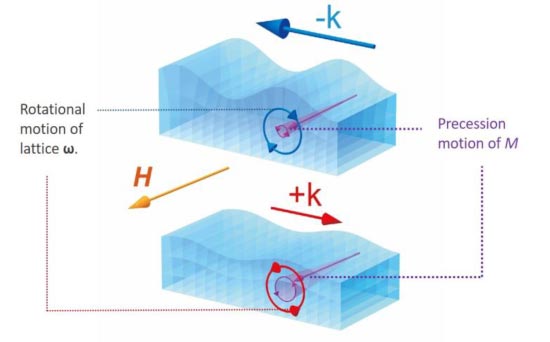
    Magneto-Rotation Coupling Schematics
    Schematics of the magneto-rotation coupling. Credit: Mari Ishida, RIKEN CEMS

    In the current study, the group examined the movement of acoustic surface waves—movements of sound like the propagation of earthquakes over the surface of the earth—in a magnetic film. It is known that there is an interplay between the surface acoustic waves and “spin waves”—disturbances in magnetic fields within the material that can move through the material.

    Acoustic surface waves can excite spin waves in two different ways. One, magneto-elastic coupling, is very well documented. However, a second, magneto-rotation coupling, was proposed more than forty years ago by Sadamichi Maekawa, one of the authors of the current study, but was not experimentally verified until now.

    In the current study, the authors found that the two mechanisms occur at the same time but under different intensities. They found that when the magnetization of the magnetic specimen is rotating in the same direction of the surface acoustic waves, the energy of the acoustic surface waves is more efficiently transferred to the spin waves, increasing the rotation of the magnetization. In fact, the researchers were able to identify a configuration of unidirectional coupling where only the energy of surface acoustic waves in one direction could be transferred to the rotation of the magnetization. They also noticed that this “rectification” effect was more pronounced when the magnetic material contained magnetic anisotropy, meaning there was a preferred direction of internal magnetization even before the application of an external magnetic field.
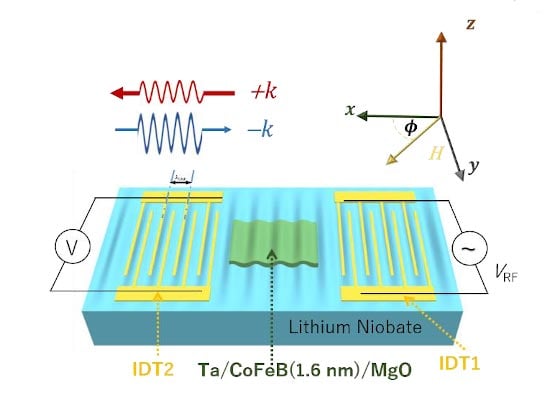
    Nonreciprocal Propagation Acousto-Magnetic Waves
    Nonreciprocal propagation of acousto-magnetic waves in Ta/CoFeB/MgO. Credit: Mari Ishida, RIKEN CEMS

    According to Mingran Xu of RIKEN CEMS, the first author of the paper, “It was very exciting to show that the phenomenon of magneto-rotation coupling actually takes place, and that it can be used to completely suppress the movement of acoustic energy in one direction.”

    Jorge Puebla, also of RIKEN CEMS, says, “We hope that we can use this work to create an “acoustic diode” equivalent to the electronic diodes that are so important. We could relatively easily make a device where the acoustic energy is efficiently transferred in one direction but blocked in the other. This is happening at microwave frequencies, which is the range of interest for 5G communication technology, so surface acoustic waves may be an interesting candidate for this technology.”

    Reference: “Nonreciprocal surface acoustic wave propagation via magneto-rotation coupling” by Mingran Xu, Kei Yamamoto, Jorge Puebla, Korbinian Baumgaertl, Bivas Rana, Katsuya Miura, Hiromasa Takahashi, Dirk Grundler, Sadamichi Maekawa and Yoshichika Otani, 7 August 2020, Science Advances.
    DOI: 10.1126/sciadv.abb1724

    Never miss a breakthrough: Join the SciTechDaily newsletter.
    Follow us on Google and Google News.

    Materials Science RIKEN
    Share. Facebook Twitter Pinterest LinkedIn Email Reddit

    Related Articles

    Unexpected Peaks in Spectrum Upset Conventional Models of Exotic Quantum Material

    Probing the Effects of Light at the Atomic Scale

    New Insights Into How Superconducting Materials Interact With Magnetic Ones

    Path to Magnetic Vortex RAM Might be More Difficult Than Previously Assumed

    Electron-Electron Interactions are Critical to Graphene’s Extraordinary Properties

    SLAC Scientists Complete Terahertz Experiment

    LCLS Low-Energy Test Just Shy of the 284-Electronvolt Carbon Edge

    High-Energy Radiation is Refracted Setting the Stage for Gamma Optics

    Researching the Properties of Relativistic Electron Vortex Beams

    Leave A Reply Cancel Reply

    • Facebook
    • Twitter
    • Pinterest
    • YouTube

    Don't Miss a Discovery

    Subscribe for the Latest in Science & Tech!

    Trending News

    Breakthrough Bowel Cancer Trial Leaves Patients Cancer-Free for Nearly 3 Years

    Natural Compound Shows Powerful Potential Against Rheumatoid Arthritis

    100,000-Year-Old Neanderthal Fossils in Poland Reveal Unexpected Genetic Connections

    Simple “Gut Reset” May Prevent Weight Gain After Ozempic or Wegovy

    2.8 Days to Disaster: Scientists Warn Low Earth Orbit Could Suddenly Collapse

    Common Food Compound Shows Surprising Power Against Superbugs

    5 Simple Ways To Remember More and Forget Less

    The Atomic Gap That Could Cost the Semiconductor Industry Billions

    Follow SciTechDaily
    • Facebook
    • Twitter
    • YouTube
    • Pinterest
    • Newsletter
    • RSS
    SciTech News
    • Biology News
    • Chemistry News
    • Earth News
    • Health News
    • Physics News
    • Science News
    • Space News
    • Technology News
    Recent Posts
    • After 37 Years, the World’s Longest-Running Soil Warming Experiment Uncovers a Startling Climate Secret
    • NASA Satellite Captures First-Ever High-Res View of Massive Pacific Tsunami
    • ADHD Isn’t Just a Deficit: Study Reveals Powerful Hidden Strengths
    • Scientists Uncover “Astonishing” Hidden Property of Light
    • Scientists Discover Stem Cells That Could Regrow Teeth and Bone
    Copyright © 1998 - 2026 SciTechDaily. All Rights Reserved.
    • Science News
    • About
    • Contact
    • Editorial Board
    • Privacy Policy
    • Terms of Use

    Type above and press Enter to search. Press Esc to cancel.