
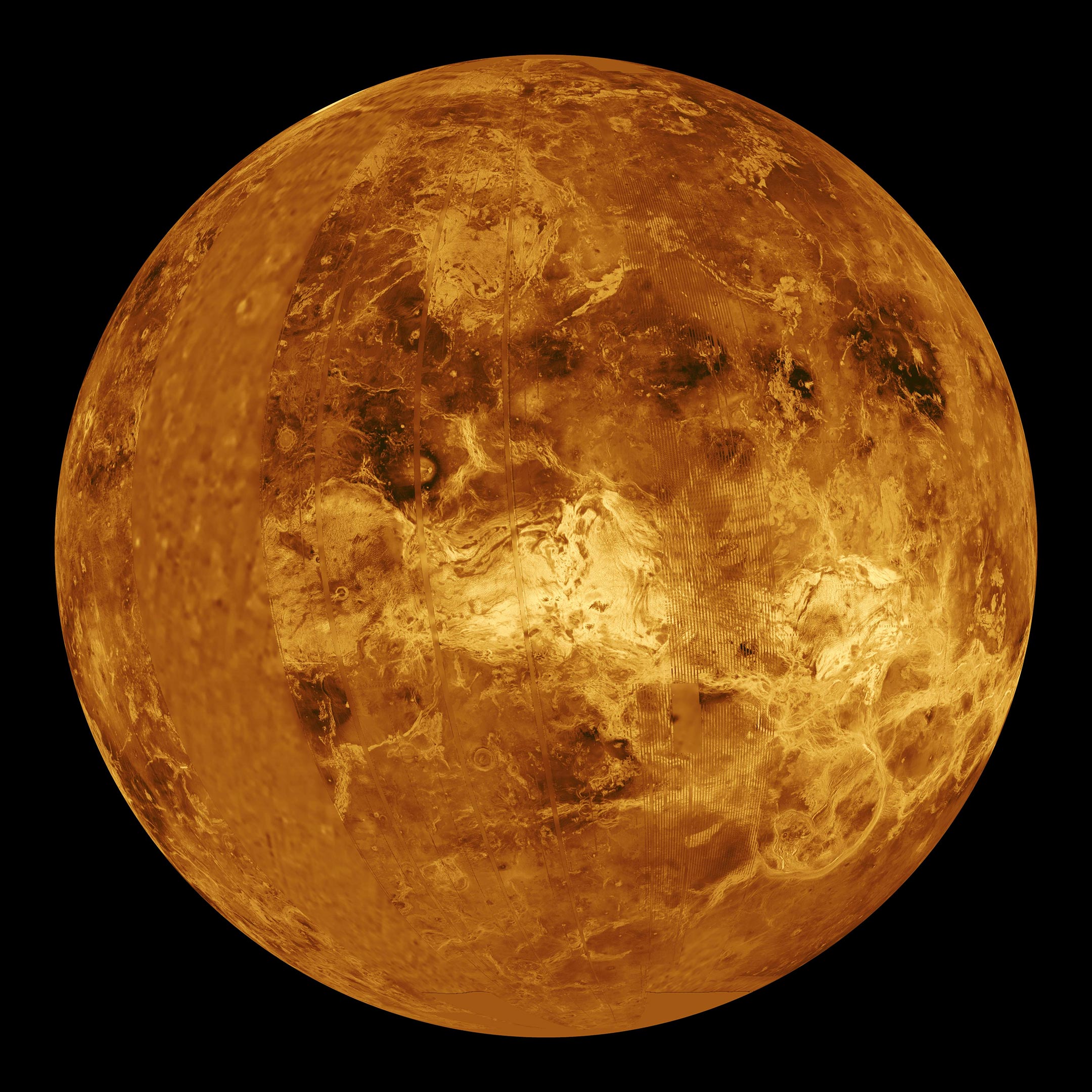
Images from the Akatsuki spacecraft unveil what keeps Venus’s atmosphere rotating much faster than the planet itself.
An international research team led by Takeshi Horinouchi of Hokkaido University has revealed that this ‘super-rotation’ is maintained near the equator by atmospheric tidal waves formed from solar heating on the planet’s dayside and cooling on its nightside. Closer to the poles, however, atmospheric turbulence and other kinds of waves have a more pronounced effect. The study was published online in Science on April 23.
Venus rotates very slowly, taking 243 Earth days to rotate once around its axis. Despite this very slow rotation, Venus’ atmosphere rotates westward 60 times faster than its planetary rotation. This super-rotation increases with altitude, taking only four Earth days to circulate around the entire planet towards the top of the cloud cover. The fast-moving atmosphere transports heat from the planet’s dayside to nightside, reducing the temperature differences between the two hemispheres. “Since the super-rotation was discovered in the 1960s, however, the mechanism behind its forming and maintenance has been a long-standing mystery,” says Horinouchi.
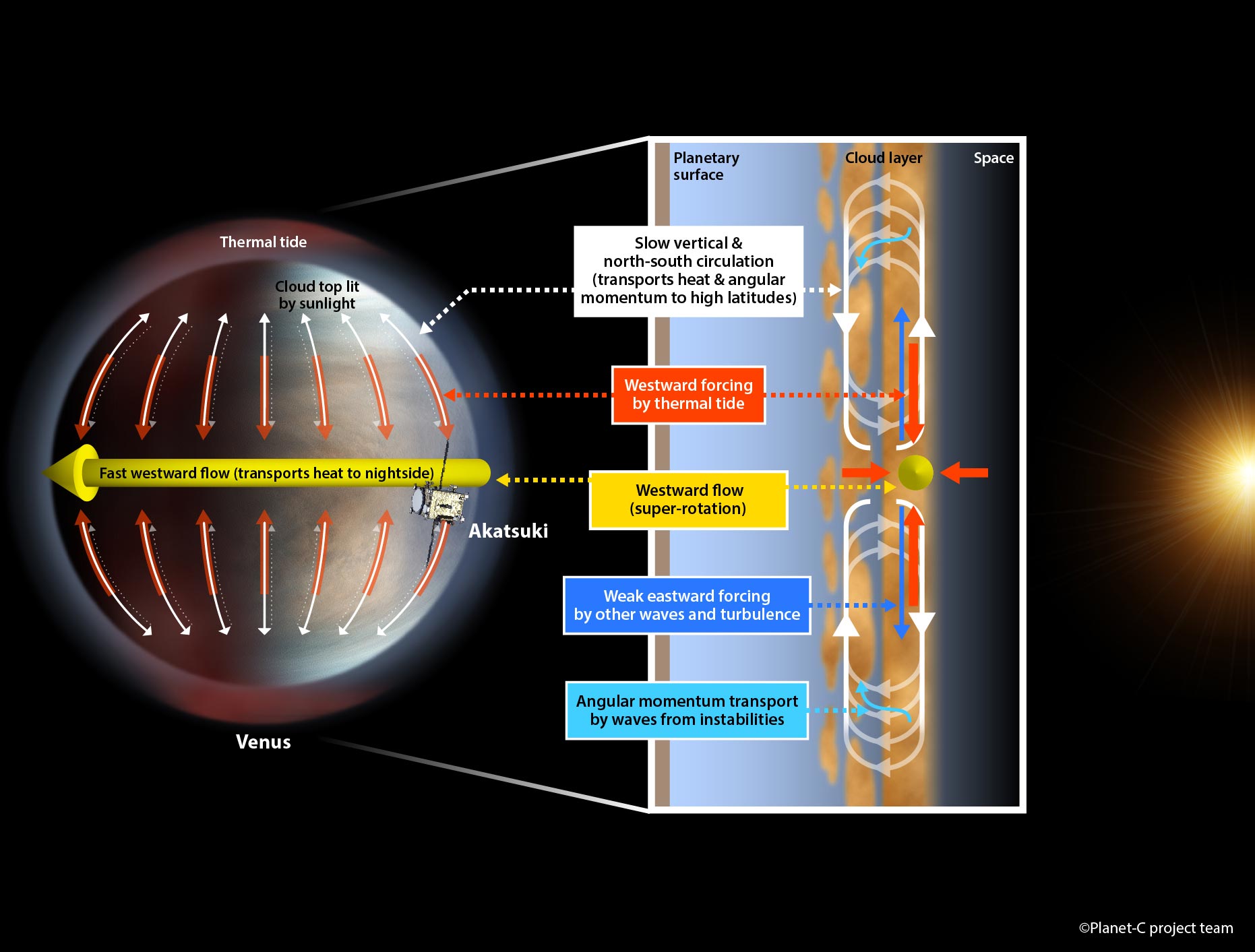
Horinouchi and his colleagues from the Institute of Space and Astronautical Science (ISAS, JAXA) and other institutes developed a new, highly precise method to track clouds and derive wind velocities from images provided by ultraviolet and infrared cameras on the Akatsuki spacecraft, which began its orbit of Venus in December 2015. This allowed them to estimate the contributions of atmospheric waves and turbulence to the super-rotation.
The group first noticed that atmospheric temperature differences between low and high latitudes are as small as it cannot be explained without circulation across latitudes. “Since such circulation should alter the wind distribution and weaken the super-rotation peak, it also implies there is another mechanism which reinforces and maintains the observed wind distribution,” Horinouchi explained. Further analyses revealed that the maintenance is sustained by the thermal tide — an atmospheric wave excited by the solar heating contrast between the dayside and the nightside — which provides the acceleration at low latitudes. Earlier studies proposed that atmospheric turbulence and the waves other than the thermal tide may provide the acceleration. However, the current study showed that they work oppositely to weakly decelerate the super-rotation at low latitude, even though they play an important role at mid- to high-latitudes.
Their findings uncovered the factors that maintain the super-rotation while suggesting a dual circulation system that effectively transports heat across the globe: the meridional circulation that slowly transports heat towards the poles and the super-rotation that rapidly transports heat towards the planet’s nightside.
“Our study could help better understand atmospheric systems on tidally-locked exo-planets whose one side always facing the central stars, which is similar to Venus having a very long solar day,” Horinouchi added.
Read Venus’ Atmosphere Rotates Far Faster Than Its Surface Because of Thermal Tides for more on this research.
References:
“Super-rotating the venusian atmosphere,” by Sebastien Lebonnois at Laboratoire de Météorologie Dynamique (LMD/IPSL) in Paris, France; S. Lebonnois at Sorbonne Université in Paris, France; S. Lebonnois at ENS in Paris, France; S. Lebonnois at PSL Research University in Paris, France; S. Lebonnois at Ecole Polytechnique in Paris, France; S. Lebonnois at Institut Polytechnique de Paris in Paris, France; S. Lebonnois at CNRS in Paris, France.
DOI: 10.1126/science.abb2424
“How waves and turbulence maintain the super-rotation of Venus’ atmosphere,” by Takeshi Horinouchi at Hokkaido University in Sapporo, Japan; Takeshi Horinouchi; Atsushi Yamazaki; Shin-ya Murakami; Javier Peralta; Masato Nakamura; Takehiko Satoh at Japan Aerospace Exploration Agency in Sagamihara, Japan; Yoshi-Yuki Hayashi at Kobe University in Kobe, Japan; Shigeto Watanabe; Takao M. Sato at Hokkaido Information University in Ebetsu, Japan; Manabu Yamada at Chiba Institute of Technology in Narashino, Japan; Toru Kouyama at National Institute of Advanced Industrial Science and Technology in Tokyo, Japan; Makoto Taguchi; Tetsuya Fukuhara at Rikkyo University in Tokyo, Japan; Masahiro Takagi at Kyoto Sangyo University in Kyoto, Japan; Kazunori Ogohara at University of Shiga Prefecture in Hikone, Japan; Sanjay S. Limaye at University of Wisconsin-Madison in Madison, WI; Takeshi Imamura at The University of Tokyo in Kashiwa, Japan; Masato Nakamura; Takehiko Satoh at The Graduate University for Advanced Studies (SOKENDAI) in Tokyo, Japan.
DOI: 10.1126/science.aaz4439
Never miss a breakthrough: Join the SciTechDaily newsletter.
Follow us on Google and Google News.