
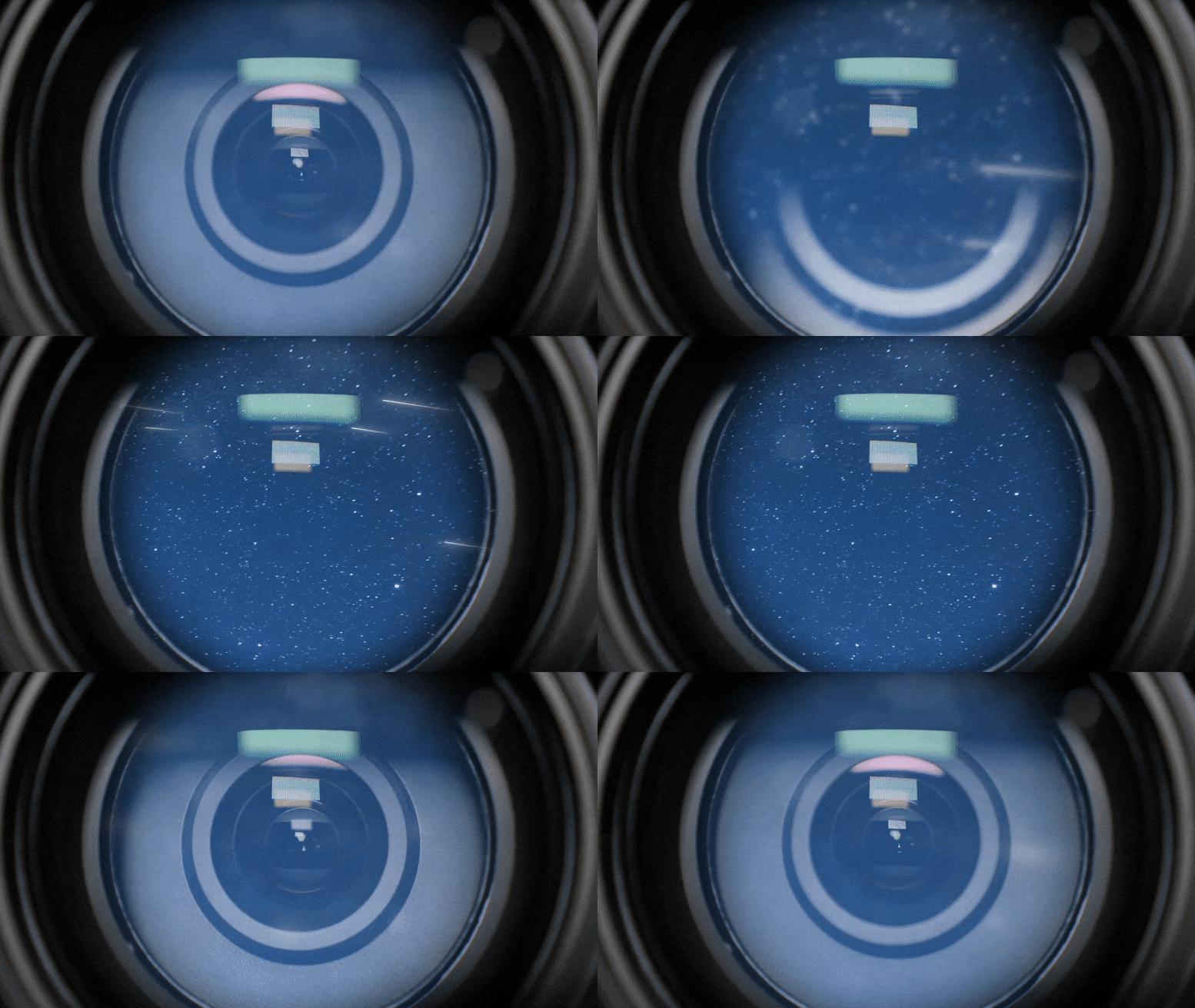
The concept of “spaceplate” is a new avenue for manipulating light that could lead to paper thin cameras, telescopes.
Can you imagine one day using a telescope as thin as a sheet of paper, or a much smaller and lighter high-performance camera? Or no longer having that camera bump behind your smartphone?
In a paper published in Nature Communications, researchers from the University of Ottawa have proposed a new optical element that could turn these ideas into reality by dramatically miniaturizing optical devices, potentially impacting many of the applications in our lives.
To learn more about this project, we talked to lead author Dr. Orad Reshef, a senior postdoctoral fellow in the Robert Boyd Group, and research lead Dr. Jeff Lundeen, who is the Canada Research Chair in Quantum Photonics, Associate Professor in the Department of Physics at the University of Ottawa, and head of the Lundeen Lab.
Can you describe the new optical element your team developed, the spaceplate?
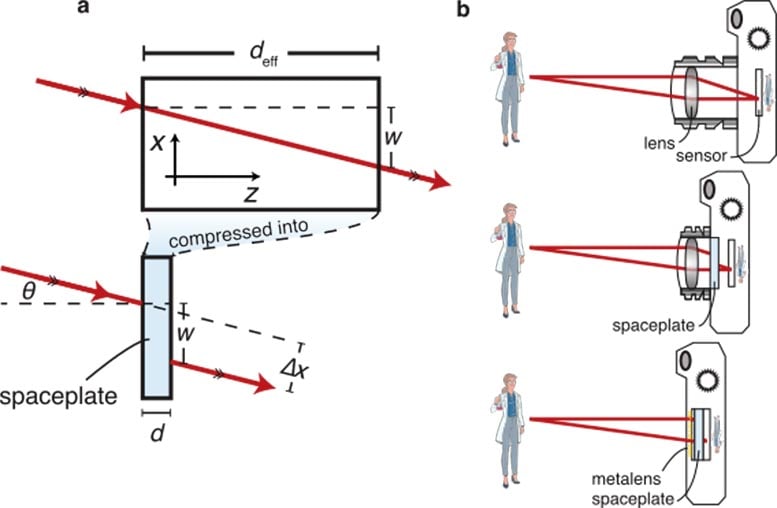
Orad Reshef: “Light naturally “spreads out” when it is traveling and every optical device we know of relies on this spread; we wouldn’t know how to design cameras without it. For example, in every telescope there is a large gap between the eyepiece and the objective lens to give light room to spread.
“A spaceplate simulates the same spreading that light would experience traveling a large distance in a small device. To light, a spaceplate looks like “more space” than it occupies. In a way, the spaceplate is a counterpart to the lens, doing things the lens can’t do to shrink down entire imaging systems.
“We introduced the idea of a spaceplate in our paper, experimentally demonstrating it and showing it is compatible with broadband light in the visible spectrum that we use to see.”
Manipulating Light by Angle, Not Position
Jeff Lundeen: “We considered what would happen if you manipulated light based on the angle rather than the position of a light ray. Lenses act via the position of the ray. Angle is a completely novel domain, and no one had shown that it could be used to make something particularly useful. We identified a useful application, compressing space. And then we showed that we could actually design and experimentally demonstrate plates that do exactly that.”
Orad Reshef: “This is exciting because this device will let us shrink down all sorts of very large devices that we thought were impossible to miniaturize in optics. In order to design it, we need to come up with a new set of rules that is incompatible with that used in lens design. Nobody knows what they are, it’s like the wild west.”
How did you come up with this idea?
Jeff Lundeen: “Orad Reshef is an expert in using nanotechnology for manipulating a ray based on its position (e.g. meta-lenses or, more generally, meta-surfaces). We were casually discussing the limitations of manipulating light with these meta-surfaces and I said it would be cool to instead manipulate light based on its angle.”
“Dr. Reshef was immediately confident that he could design and fabricate something that could do that and I subsequently concluded the easiest goal would be to replace the space needed for spread (i.e. propagation).”
“Over the course of the next few months, in discussions with Dr. Boyd and Dr. Reshef, we slowly realized how amazing and useful such a device would be. Both Dr. Reshef and I came up with viable and completely different designs, which showed there were many ways to create such a device. We studied three in our paper but there are more coming.”
How could this technology be used? What are the applications of the spaceplate in our daily lives?
Cameras, Telescopes, and Beyond
Orad Reshef: “A spaceplate can be used to miniaturize many optical systems, be it a display or a sensor. For example, an advanced spaceplate can enable paper-thin telescopes or cameras; it could be used to remove the “camera bump” on the back of your smartphone.”
Jeff Lundeen: “People lug around large cameras with huge telephoto lenses. If we can sufficiently improve the spaceplate’s performance, I envision the possibility of building smaller, lighter cameras with much better performance. In particular, the spaceplate combined with metalenses would allow us to make the entire back surface of, say, an iPhone Max, into a flat and thin camera. It would have as much as 14 times better resolution and low-light performance than those large and heavy cameras.
“Thin and small cameras would be useful in a wide variety of applications, including in health care where camera pills or endoscopes could look inside arteries or the digestive system.”
What are the next steps?
Orad Reshef: “We are hard at work developing the next generation of this technology. We want to try and increase the compression factor and to improve the overall performance. We already have some designs to increase the compression factor from 5 to over 100 times, and to increase the total transmission. To continue doing this, we need to come up with a completely new design paradigm.”
Any final thoughts?
Orad Reshef: “It’s surprising that optical elements like lenses have been around for a millennium and their design rules have been well understood for over 400 years, and yet we’re still discovering such fundamental new optical elements for imaging.”
Reference: “An optic to replace space and its application towards ultra-thin imaging systems” by Orad Reshef, Michael P. DelMastro, Katherine K. M. Bearne, Ali H. Alhulaymi, Lambert Giner, Robert W. Boyd and Jeff S. Lundeen, 10 June 2021, Nature Communications.
DOI: 10.1038/s41467-021-23358-8
This research is a collaboration between two research groups of two physics professors at uOttawa, Robert Boyd, Canada Research Chair in Quantum Nonlinear Optics, and Jeff Lundeen, Canada Research Chair in Quantum Photonics. Both groups work closely together as part of the Canada Excellence Research Chair Group in Quantum Photonics (CERC) assembled by Robert Boyd (coauthor), CERC Laureate in Quantum Nonlinear Optics.
Never miss a breakthrough: Join the SciTechDaily newsletter.
Follow us on Google and Google News.
3 Comments
WOW, I feel this is on par with Graphene, 3-d printer…
“Thin and small cameras would be useful in a wide variety of applications, including in health care…”
Or smaller, more capable airborne sensors. China interested much?
The lenses haven’t been with us for a milenium; but for almost three.
In the museum of Heraklion -in Greece- There are magnifying glasses rescued from excavations, which were marked with their focal length in a box of 6 units. They are dated in the year 500 BC!
The index said they were to compensate for the loss of visual acuity and to help artisans to make intricate work.