
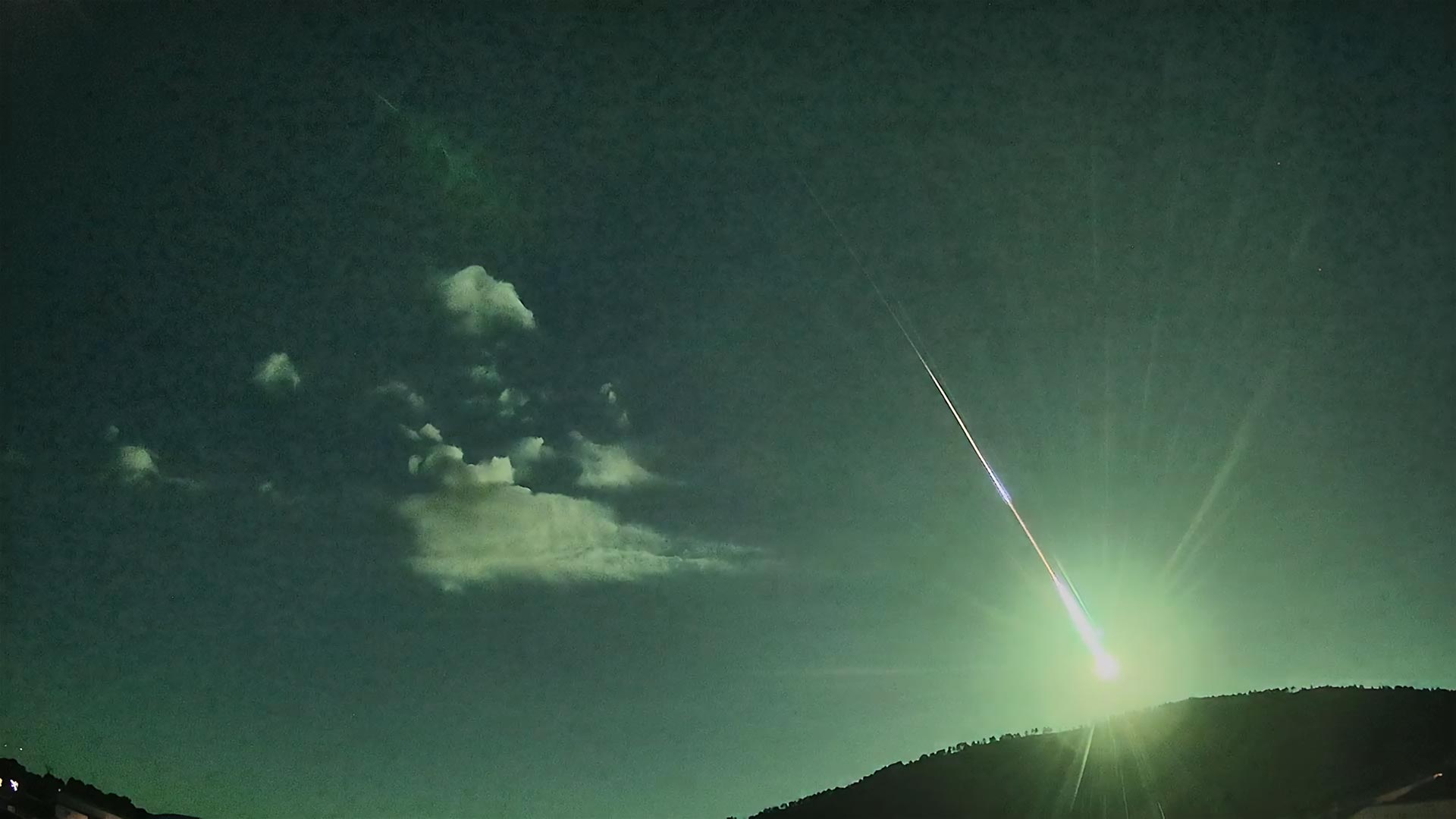
ESA’s fireball camera in Cáceres, Spain, captured a stunning meteor during the night of May 18-19, 2024, at 00:46 CEST on May 19 (22:46 UTC on May 18). This camera is part of the AllSky7 fireball network and is operated by ESA’s Planetary Defence Office.
Investigation and Analysis
Following the initial report of the meteor, ESA’s planetary defenders promptly began their investigation. Their analysis of the object’s trajectory suggested that it was likely a small piece of a comet. They determined that the meteor traveled over Spain and Portugal at approximately 45 km/s or 162,000 km/h (28 miles/s or 100,000 mph) before burning up over the Atlantic Ocean at an altitude of about 60 km (37 miles).
ESA’s fireball camera in Cáceres, Spain, captured this stunning meteor during the night of May 18-19, 2024 (00:46 CEST 19 May / 22:46 UTC 18 May). Credit: ESA/PDO/AMS82 – AllSky7 Fireball Network
Details on the Meteor
Researchers used data on the amount of energy released during the impact to estimate that the meteor was about 1 meter (~3 feet) in size and had a mass of 500-1000 kg (1,100-2,200 pounds). The likelihood of finding any meteorites from this event is very low. The meteor remained undetected before its impact, likely due to its approach from a region of the sky crowded with stars from the Milky Way galaxy, which obscured its visibility.
ESA’s Fireball Cameras
ESA’s fireball cameras are part of a network managed by the European Space Agency (ESA) aimed at detecting and studying meteors that enter the Earth’s atmosphere. These cameras are strategically positioned across Europe to capture high-definition images and data of fireballs—exceptionally bright meteors. By utilizing sensitive detection technology, these cameras can record the trajectory, speed, and light intensity of fireballs, providing valuable insights into their origins and compositions.
The primary goal of this network is to enhance our understanding of near-Earth objects (NEOs) and to assess the potential threat they may pose to Earth. The data gathered helps scientists improve models of meteoroid orbits and their interaction with the Earth’s atmosphere. This research is crucial for developing strategies to mitigate potential impacts from larger celestial objects. Overall, ESA’s fireball cameras are vital tools in the field of planetary defense and contribute significantly to the study of our solar system’s smaller bodies.
AllSky7 Fireball Network
The AllSky7 Fireball Network is an advanced observational system designed to detect and analyze fireballs and meteors in the Earth’s atmosphere. Operated by the American Meteor Society (AMS), the network consists of all-sky cameras equipped with sensitive detection technology. These cameras are distributed across various locations to provide comprehensive coverage and capture high-resolution images and data on meteor activity.
The primary aim of the AllSky7 Fireball Network is to monitor meteoric phenomena with precision, collecting data on the trajectories, velocities, and origins of fireballs. This information is crucial for calculating the orbits of meteoroids, understanding their interactions with the Earth’s atmosphere, and assessing any potential threats posed by larger celestial objects.
The network contributes significantly to both scientific research and public engagement in astronomy by allowing for accurate tracking of meteor showers and the occasional unexpected fireball. By fostering collaborations among professional and amateur astronomers, the AllSky7 Fireball Network enhances our understanding of the cosmos and bolsters planetary defense efforts.
Never miss a breakthrough: Join the SciTechDaily newsletter.
Follow us on Google and Google News.