
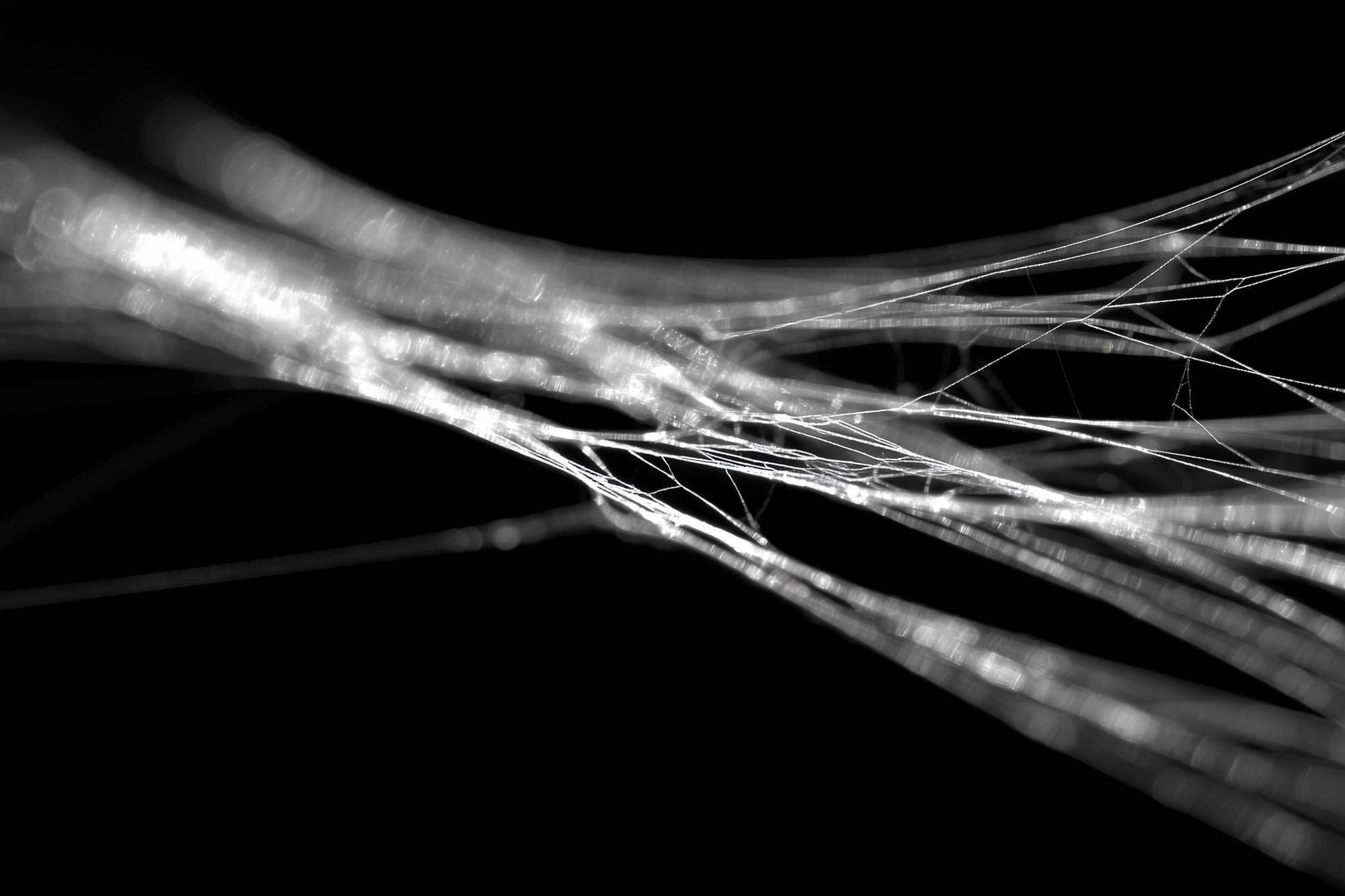
By uncovering the molecular interactions that give spider silk its remarkable properties, researchers have revealed principles that could inspire advanced materials and shed light on biological processes far beyond the spider’s web.
Researchers have pinpointed the tiny chemical attractions that help spider silk pull off its famous balancing act: extreme strength without losing flexibility. By explaining what holds the material together at the molecular scale, the work could make it easier to design bio-inspired fibers for aircraft parts, protective clothing, and medical uses. The same kinds of self-organizing behaviors may also offer clues about neurological diseases, including Alzheimer’s.
The results appear in Proceedings of the National Academy of Sciences from a collaboration between King’s College London and San Diego State University (SDSU).
Instead of treating spider silk as a mystery material to copy outright, the team focused on the underlying “rules” that nature uses, principles that could be applied to build a new generation of high-performance, more sustainable fibers.
Revealing the Molecular Design of Spider Silk
Spider silk is made from proteins, long chains built from amino acids. The study reports that, inside these proteins, certain amino acids interact in a way that behaves like molecular “stickers.” Those repeating, reversible connections help the proteins gather, organize, and ultimately lock into a structure that can handle both stretching and heavy loads.
Chris Lorenz, Professor of Computational Materials Science at King’s College London, who led the UK side of the research, said: “The potential applications are vast – lightweight protective clothing, airplane components, biodegradable medical implants, and even soft robotics could benefit from fibers engineered using these natural principles.”
Spider dragline silk stands out among natural materials because it is stronger than steel by weight and tougher than Kevlar – the material used to fabricate bulletproof vests. Spiders rely on this silk to construct their webs and to support their own movement, and scientists have spent decades trying to replicate its extraordinary characteristics.
This type of silk is created inside a spider’s silk gland, where the proteins are kept in a dense liquid form called “silk dope.” As the spider spins its web, this liquid is transformed into solid fibers.
Although researchers have known that the proteins first gather into liquid-like droplets before turning into fibers, the precise molecular steps that connect this phase change to the final structure of the silk have remained a mystery until now.
Key Amino Acids Drive Silk Formation
The interdisciplinary team of chemists, biophysicists, and engineers used a combination of advanced computational and experimental tools – including molecular dynamics simulations, AlphaFold3 structural modeling, and nuclear magnetic resonance spectroscopy – to demonstrate that the amino acids arginine and tyrosine interact to trigger the initial clustering of the proteins.
Crucially, these same interactions persist as the silk fiber forms, helping to create the complex nanostructure responsible for its exceptional mechanical performance.
“This study provides an atomistic-level explanation of how disordered proteins assemble into highly ordered, high-performance structures,” added Lorenz.
Gregory Holland, SDSU professor of physical and analytical chemistry, who led the US side of the research, said one of the most surprising outcomes was how chemically sophisticated the process turned out to be.
“What surprised us was that silk – something we usually think of as a beautifully simple natural fiber – actually relies on a very sophisticated molecular trick,” Holland said. “The same kinds of interactions we discovered are used in neurotransmitter receptors and hormone signaling.”
He suggested the findings could therefore extend into human health research.
“The way silk proteins undergo phase separation and then form β-sheet–rich structures mirrors mechanisms we see in neurodegenerative diseases such as Alzheimer’s,” Holland said. “Studying silk gives us a clean, evolutionarily-optimized system to understand how phase separation and β-sheet formation can be controlled.”
Reference: “Arg–Tyr cation–π interactions drive phase separation and β-sheet assembly in native spider dragline silk” by Hannah R. Johnson, Kevin Chalek, Nesreen Elathram, Andy T. Chau, Anikin Rae Domingo, Julian E. Aldana, Hieu Nguyen, Alexia de Loera, Brianna A. Duarte, Lado Shapakidze, David Onofrei, Galia T. Debelouchina, Christian D. Lorenz and Gregory P. Holland, 23 December 2025, Proceedings of the National Academy of Sciences.
DOI: 10.1073/pnas.2523198122
Never miss a breakthrough: Join the SciTechDaily newsletter.
Follow us on Google and Google News.
1 Comment
making a stablize metal out of this alloy could be possible. using a pressurized heat source and using cold fusion as the base. using a pressurized compound different materials are obtainable as long as it does not become unstable. the least difficult could be leather and we all know how many uses this could have. plastic with hydrogen, pyrex with helium. you could even use a CO2 alloy to discard ailments from the body as long as you use properties that pressurize the skin such as scuba suits