

A major breakthrough in organic semiconductors has been achieved, potentially transforming display technology and even future computing.
By designing a material that forces electrons to spiral, researchers have developed a chiral semiconductor that naturally emits circularly polarized light. This could make screens significantly more energy-efficient and lead to advancements in spintronics and quantum computing.
Breaking a Semiconductor Barrier
Researchers have tackled a long-standing challenge in organic semiconductors, paving the way for new advancements in electronics.
A team from the University of Cambridge and the Eindhoven University of Technology has developed an organic semiconductor that forces electrons to move in a spiral pattern. This breakthrough could enhance the efficiency of OLED screens in TVs and smartphones while also enabling next-generation technologies like spintronics and quantum computing.
The Role of Chirality in Electronics
Their semiconductor emits circularly polarized light, meaning the light carries information about the “handedness” of electrons. In contrast, traditional inorganic semiconductors like silicon have a symmetrical internal structure, allowing electrons to move without a preferred direction.
In nature, however, many molecules have a chiral structure—either left- or right-handed—similar to how human hands are mirror images of each other. Chirality is crucial in biological processes like DNA formation, but controlling it in electronic materials has remained a significant challenge.
Nature-Inspired Molecular Design
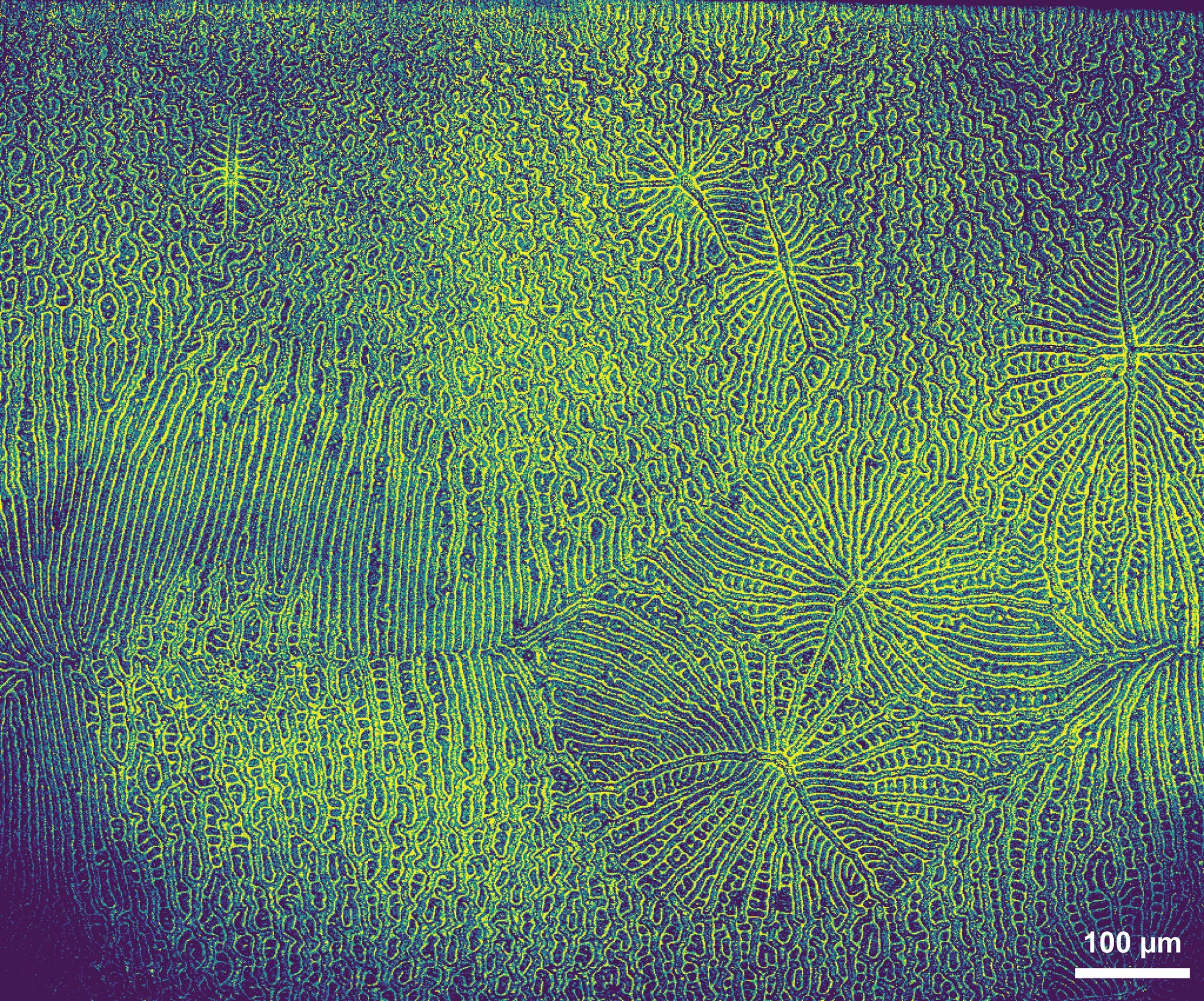
But by using molecular design tricks inspired by nature, the researchers were able to create a chiral semiconductor by nudging stacks of semiconducting molecules to form ordered right-handed or left-handed spiral columns. Their results are reported in the journal Science.
One promising application for chiral semiconductors is in display technology. Current displays often waste a significant amount of energy due to the way screens filter light. The chiral semiconductor developed by the researchers naturally emits light in a way that could reduce these losses, making screens brighter and more energy-efficient.
Reimagining Semiconductor Flexibility
“When I started working with organic semiconductors, many people doubted their potential, but now they dominate display technology,” said Professor Sir Richard Friend from Cambridge’s Cavendish Laboratory, who co-led the research. “Unlike rigid inorganic semiconductors, molecular materials offer incredible flexibility—allowing us to design entirely new structures, like chiral LEDs. It’s like working with a Lego set with every kind of shape you can imagine, rather than just rectangular bricks.”
A Self-Assembling, Light-Emitting Breakthrough
The semiconductor is based on a material called triazatruxene (TAT) that self-assembles into a helical stack, allowing electrons to spiral along its structure, like the thread of a screw.
“When excited by blue or ultraviolet light, self-assembled TAT emits bright green light with strong circular polarisation—an effect that has been difficult to achieve in semiconductors until now,” said co-first author Marco Preuss, from the Eindhoven University of Technology. “The structure of TAT allows electrons to move efficiently while affecting how light is emitted.”
The Future of OLEDs is Circular
By modifying OLED fabrication techniques, the researchers successfully incorporated TAT into working circularly polarised OLEDs (CP-OLEDs). These devices showed record-breaking efficiency, brightness, and polarisation levels, making them the best of their kind.
“We’ve essentially reworked the standard recipe for making OLEDs like we have in our smartphones, allowing us to trap a chiral structure within a stable, non-crystallizing matrix,” said co-first author Rituparno Chowdhury, from Cambridge’s Cavendish Laboratory. “This provides a practical way to create circularly polarised LEDs, something that has long eluded the field.”
Decades of Research Lead to a Breakthrough
The work is part of a decades-long collaboration between Friend’s research group and the group of Professor Bert Meijer from the Eindhoven University of Technology. “This is a real breakthrough in making a chiral semiconductor,” said Meijer. “By carefully designing the molecular structure, we’ve coupled the chirality of the structure to the motion of the electrons and that’s never been done at this level before.”
The chiral semiconductors represent a step forward in the world of organic semiconductors, which now support an industry worth over $60 billion. Beyond displays, this development also has implications for quantum computing and spintronics—a field of research that uses the spin, or inherent angular momentum, of electrons to store and process information, potentially leading to faster and more secure computing systems.
Reference: “Circularly polarized electroluminescence from chiral supramolecular semiconductor thin films” by Rituparno Chowdhury, Marco D. Preuss, Hwan-Hee Cho, Joshua J. P. Thompson, Samarpita Sen, Tomi K. Baikie, Pratyush Ghosh, Yorrick Boeije, Xian Wei Chua, Kai-Wei Chang, Erjuan Guo, Joost van der Tol, Bart W. L. van den Bersselaar, Andrea Taddeucci, Nicolas Daub, Daphne M. Dekker, Scott T. Keene, Ghislaine Vantomme, Bruno Ehrler, Stefan C. J. Meskers, Akshay Rao, Bartomeu Monserrat, E. W. Meijer and Richard H. Friend, 13 March 2025, Science.
DOI: 10.1126/science.adt3011
The research was supported in part by the European Union’s Marie Curie Training Network and the European Research Council. Richard Friend is a Fellow of St John’s College, Cambridge. Rituparno Chowdhury is a member of Fitzwilliam College, Cambridge.
Never miss a breakthrough: Join the SciTechDaily newsletter.
Follow us on Google and Google News.