
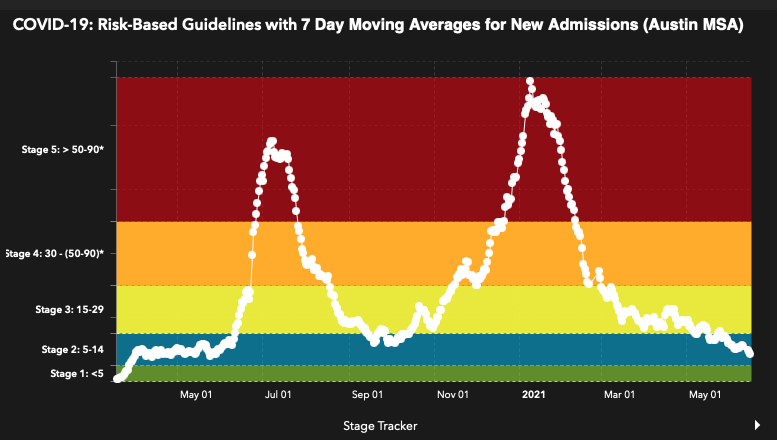
Austin’s data-driven COVID-19 alert system prevented hospital overloads and minimized lockdowns.
A staged alert system, designed by scientists and public health officials to guide local policies, helped one city prevent hospital surges and long lockdowns, according to new research published in the journal Nature Communications.
In a new study led by The University of Texas at Austin COVID-19 Modeling Consortium in collaboration with Northwestern University, researchers describe the system that has guided COVID-19 policies in Austin, Texas, for more than a year, helping to safeguard the health care system and avoid costly measures. It tracks the number of new daily COVID-19 hospital admissions and triggers changes in guidance when admissions cross specific threshold values. While using this staged alert system, the Austin metropolitan area has sustained the lowest per capita COVID-19 death rate among all large Texas cities.
“Austin’s alert system was optimized to balance the city’s public health and socioeconomic goals,” said Lauren Ancel Meyers, a professor of integrative biology and director of The University of Texas COVID-19 Modeling Consortium. “For over a year, it has helped our community adapt to rapidly changing risks, protected the integrity of our hospital systems, and limited the economic damage.”
Throughout the COVID-19 pandemic, policymakers struggled to combat COVID-19 while minimizing social and economic consequences. Governments worldwide enacted a variety of alert systems that trigger lockdowns when cases or hospitalizations reach critical levels. According to the paper, Austin’s system was better at preventing overwhelming hospital surges than the ICU-based triggers used in France and better at avoiding lockdowns than widely cited recommendations from Harvard Global Health.
Versatility for Global and Future Use
“Our flexible method can design adaptive policies to combat COVID-19 worldwide and prepare for future pandemic threats,” Meyers said. “When we compared Austin’s optimized triggers to other similar alert systems, we found that it does a much better job of balancing competing public health and economic goals.”
Northwestern University’s David Morton designed the study with Meyers and Haoxiang Yang, a postdoctoral research associate at the Center for Nonlinear Studies (CNLS) at Los Alamos National Lab.
“The success of Austin’s system stems partly from its reliance on hospital admission data, which provides a more reliable signal of COVID-19 transmission than reported cases, and partly from our rigorous optimization of the alert triggers,” Morton said. The researchers derived thresholds that provided a 95% guarantee that hospitals would not be overrun.
The three Austin-area hospital systems, Ascension Seton, St. David’s HealthCare, and Baylor Scott & White Health, provided key data that were not available in most other U.S. cities in the early months of the pandemic, including estimates for ICU and hospital capacity and daily reports of new COVID-19 hospital admissions.
“The pandemic motivated a level of cooperation among the various health players across this community in a very special and effective way,” said Clay Johnston, dean of Dell Medical School at UT Austin. “Together, we created a system of triggers based on the latest local data, which was central to a coordinated response that helped prevent ICUs from exceeding capacity and ultimately saved lives.”
“The staged alert system was developed by working with the hospital systems, and members of the UT COVID-19 Modeling Consortium in Austin,” said Dr. Desmar Walkes of the Austin-Travis County Health Authority. “It resulted from a unique partnership between city leaders, the three hospital systems, and academics. This is proof that communicating behavioral change is most effective when it is driven by science and data.”
Reference: “Design of COVID-19 staged alert systems to ensure healthcare capacity with minimal closures” by Haoxiang Yang, Özge Sürer, Daniel Duque, David P. Morton, Bismark Singh, Spencer J. Fox, Remy Pasco, Kelly Pierce, Paul Rathouz, Victoria Valencia, Zhanwei Du, Michael Pignone, Mark E. Escott, Stephen I. Adler, S. Claiborne Johnston and Lauren Ancel Meyers, 18 June 2021, Nature Communications.
DOI: 10.1038/s41467-021-23989-x
In addition to Chief Medical Officer Mark Escott, Austin’s Mayor Steve Adler, Johnson, Meyers, Morton and Yang, authors of the new paper are Özge Sürer, Daniel Duque, Bismark Singh, Spencer J. Fox, Rémy Pasco, Kelly Pierce, Paul Rathouz, Zhanwei Du and Michael Pignone.
This work was supported by the National Institutes of Health, the Texas Department of Human Services, the Centers for Disease Control and Prevention, CNSL, the Bavarian-Czech Academic Agency and the Texas Advanced Computing Center at The University of Texas at Austin. The UT COVID-19 Modeling Consortium is made possible, in part, by the generous support of Tito’s Handmade Vodka. Meyers holds the Denton A. Cooley Centennial Professorship at The University of Texas at Austin.
Never miss a breakthrough: Join the SciTechDaily newsletter.
Follow us on Google and Google News.