
Close Menu
    Facebook X (Twitter) Instagram
    SciTechDaily
    • Biology
    • Chemistry
    • Earth
    • Health
    • Physics
    • Science
    • Space
    • Technology
    Facebook X (Twitter) Pinterest YouTube RSS
    SciTechDaily
    Home»Space»Stars Strip Away the Atmosphere of Super-Earths
    Space

    Stars Strip Away the Atmosphere of Super-Earths

    By Jim Shelton, Yale UniversityApril 13, 20161 Comment2 Mins Read
    Facebook Twitter Pinterest Telegram LinkedIn WhatsApp Email Reddit
    Share
    Facebook Twitter LinkedIn Pinterest Telegram Email Reddit
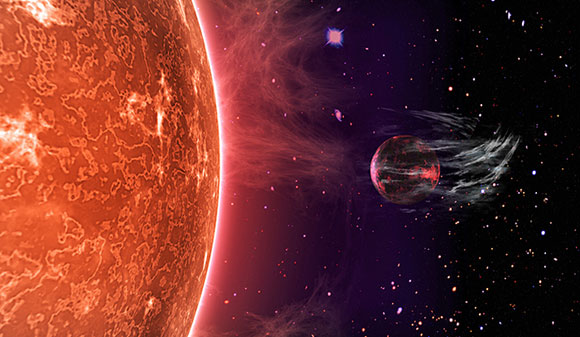
    Stars Strip Away the Atmosphere of Nearby Super-Earths
    Artist’s conception of a planet’s atmosphere being stripped. (Illustration by Peter Devine)

    Even a super-Earth can fly too close to the sun, according to a new study from Yale University.

    An international team of astronomers has found a new category of planets beyond our solar system whose atmosphere has been stripped bare by the radiation from their own sun. The findings will appear in the journal Nature Communications.

    “It is as though they are standing very close to a blow-dryer set at maximum speed and heat,” said Yale astronomy professor Sarbani Basu, a co-author of the study. “All that is loose gets blown away. In this case it is the planet’s atmosphere.”

    The study uses data from NASA’s Kepler mission to look at super-Earths, which are planets outside our solar system with a mass 1-10 times the mass of Earth. In particular, the researchers focused on super-Earths that receive more than 650 times the radiation from their host star that Earth receives from the Sun.

    “This violent stripping occurs in planets that are made up of a rocky core with a gaseous out layer,” Basu said. “Due to the planets’ proximity to the star, the heat that they suffer means that their envelopes have been blown away by the intense radiation.”

    The first author of the paper is Mia Lundkvist of Aarhus University in Denmark and Universität Heidelberg. Co-authors of the study represent more than a dozen other institutions in the United States, Australia, Denmark, and Germany.

    The researchers said they used asteroseismology — which uses the natural resonances of stars to reveal their properties and inner structures — to characterize the host stars and their planets to levels of accuracy not achieved previously for these planetary systems. This, in turn, allowed the researchers to characterize the sizes of the extra-solar planets precisely.

    “Our results have important implications for understanding how stellar systems, like our own solar system, and their planets evolve over time and the crucial role that the host star plays in the evolution of a planetary system,” Basu said.

    Never miss a breakthrough: Join the SciTechDaily newsletter.
    Follow us on Google and Google News.

    Asteroseismology Astronomy Astrophysics Planetary Science Yale University
    Share. Facebook Twitter Pinterest LinkedIn Email Reddit

    Related Articles

    Kepler-444: An Ancient Extrasolar System with Five Sub-Earth-Size Planets

    Astronomers Discover a Low-Mass Planet with a Highly Inconsistent Orbit

    Study Reveals That Diamond Planets May Be More Common Than Prevoiusly Thought

    Scientists Determine the Interior Rotation of a Sun-Like Star

    The Triangulum Stream, Remnant of a Star Cluster Being Ingested by the Milky Way

    New Study Revives Doubted Exoplanet Fomalhaut b

    NASA’s Kepler Mission Discovers Multiple Transiting Planets Orbiting Two Suns

    Vaporization Simulation of Earth Helps Explain the Atmospheres of Super-Earths

    Two Planets Separated by Less Than 5 Earth Moon Distances

    1 Comment

    1. Eric on April 13, 2016 1:42 pm

      Super-Earth with no atmosphere? Wouldn’t super-Mercury be better as seeing our Mercury has nothing due to its proximity to Sun??

      Reply
    Leave A Reply Cancel Reply

    • Facebook
    • Twitter
    • Pinterest
    • YouTube

    Don't Miss a Discovery

    Subscribe for the Latest in Science & Tech!

    Trending News

    Could Low Vitamin D Be Making Your Pain Worse?

    Scientists Discover Once-Weekly Workout That Melts Belly Fat Surprisingly Effectively

    Scientists Just Tested a Thruster Powerful Enough for Human Missions to Mars

    Doctors Say Your Ice Pack Might Be Making Injuries Worse

    Scientists Discover 43-Foot Sea Reptile Twice the Size of a Great White Shark

    Bees and Birds Are Drinking Alcohol From Flowers

    Scientists Discover How Obesity May Trigger Alzheimer’s Disease

    Scientists Confirm Alcohol Causes Widespread Health Damage

    Follow SciTechDaily
    • Facebook
    • Twitter
    • YouTube
    • Pinterest
    • Newsletter
    • RSS
    SciTech News
    • Biology News
    • Chemistry News
    • Earth News
    • Health News
    • Physics News
    • Science News
    • Space News
    • Technology News
    Recent Posts
    • Scientists Stop Pancreatic Cancer Before It Starts in Landmark Preclinical Study
    • Scientists Discover Surprising Anti-Aging Power Hidden in Aged Garlic
    • Just Minutes of Intense Exercise Could Slash Disease Risk by 50%
    • People Who Stop Ozempic Often Don’t Gain the Weight Back
    • Why More People in Their 30s Are Suddenly Getting Colon Cancer
    Copyright © 1998 - 2026 SciTechDaily. All Rights Reserved.
    • Science News
    • About
    • Contact
    • Editorial Board
    • Privacy Policy
    • Terms of Use

    Type above and press Enter to search. Press Esc to cancel.