
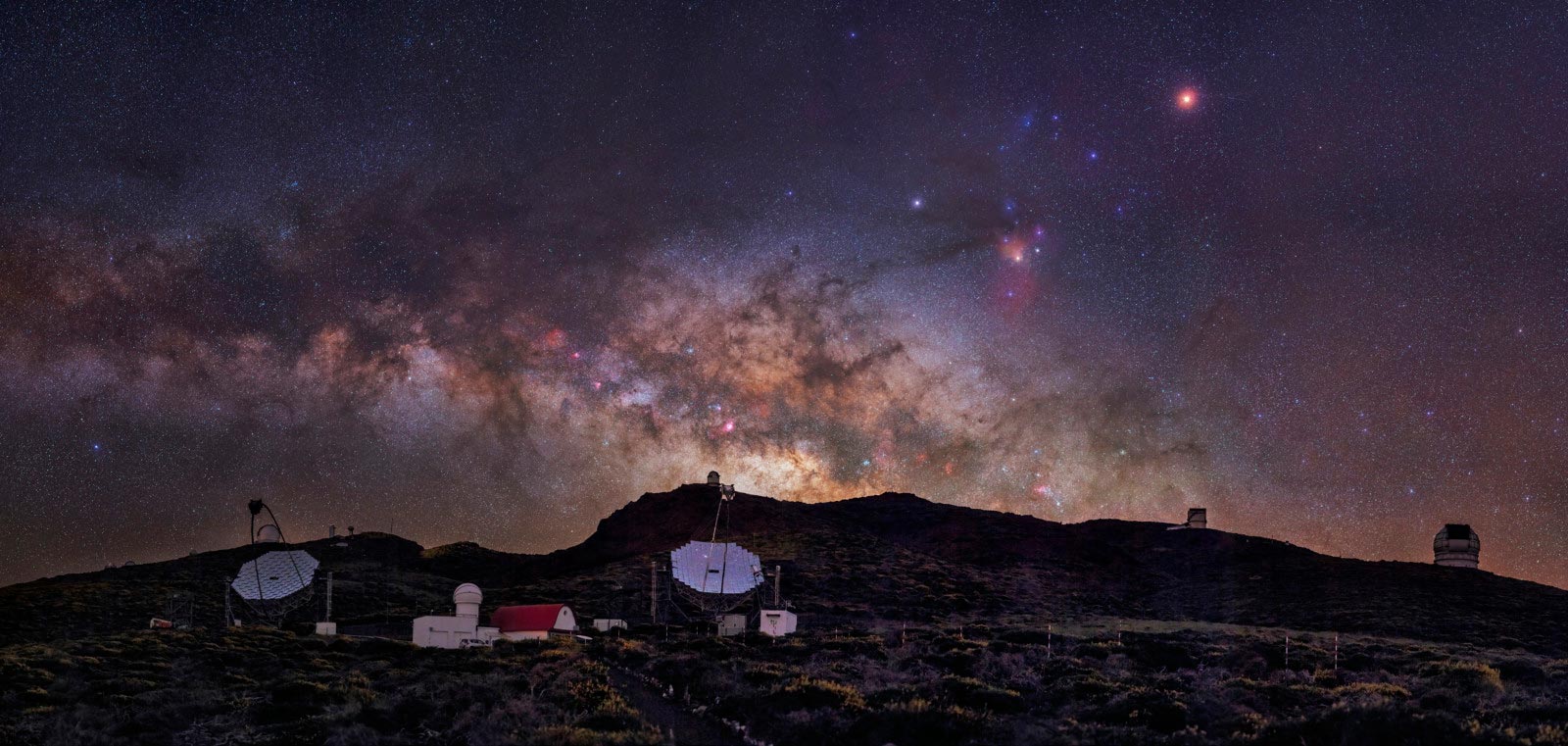
Clemson team collaborates to quantify one of the most fundamental laws of the cosmos.
Wielding state-of-the-art technologies and techniques, a team of Clemson University astrophysicists has added a novel approach to quantifying one of the most fundamental laws of the universe.
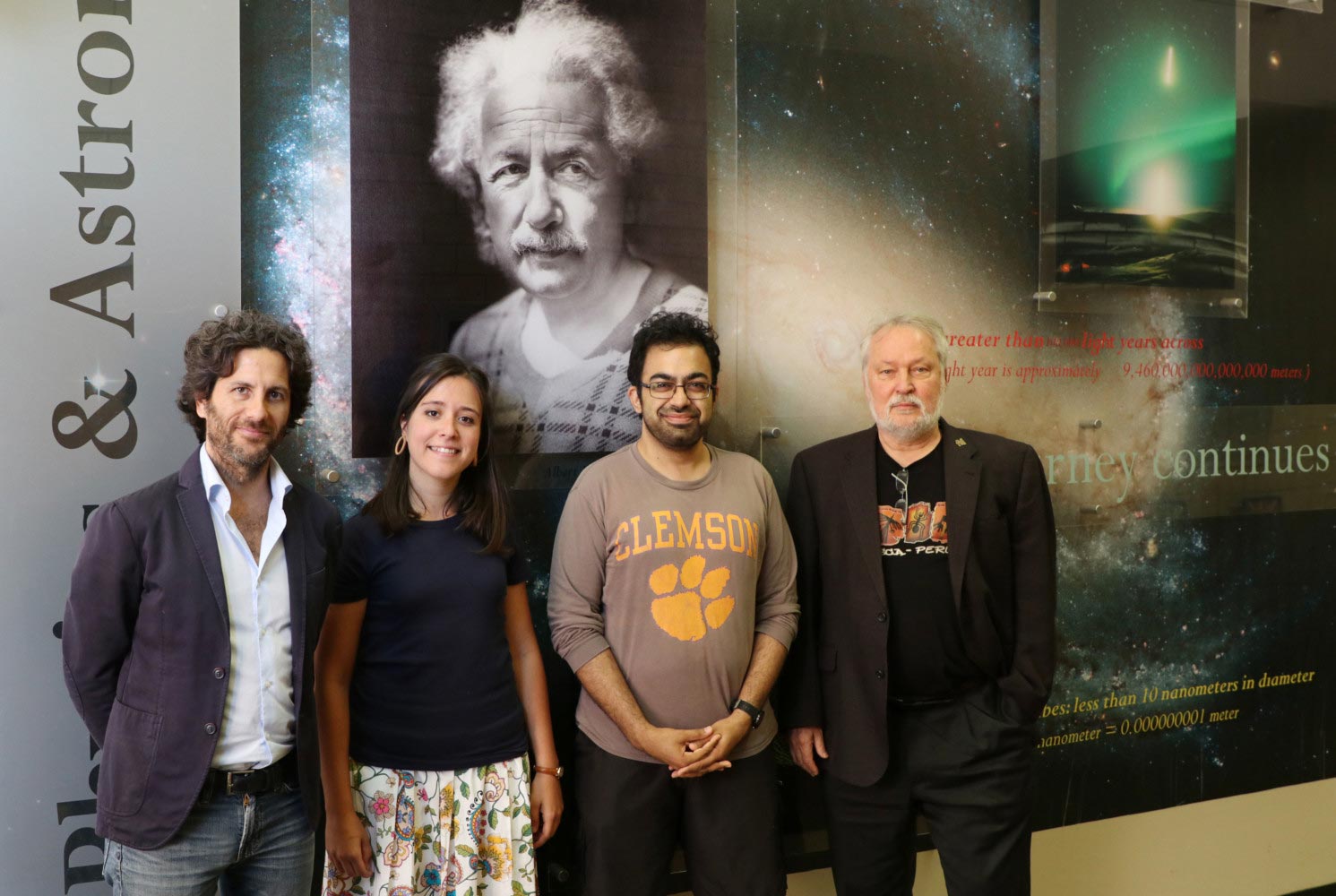
In a paper published Friday, November 8, 2019, in The Astrophysical Journal, Clemson scientists Marco Ajello, Abhishek Desai, Lea Marcotulli and Dieter Hartmann have collaborated with six other scientists around the world to devise a new measurement of the Hubble Constant, the unit of measure used to describe the rate of expansion of the universe.
“Cosmology is about understanding the evolution of our universe – how it evolved in the past, what it is doing now and what will happen in the future,” said Ajello, an associate professor in the College of Science’s department of physics and astronomy. “Our knowledge rests on a number of parameters – including the Hubble Constant – that we strive to measure as precisely as possible. In this paper, our team analyzed data obtained from both orbiting and ground-based telescopes to come up with one of the newest measurements yet of how quickly the universe is expanding.”
The concept of an expanding universe was advanced by the American astronomer Edwin Hubble (1889-1953), who is the namesake for the Hubble Space Telescope. In the early 20th century, Hubble became one of the first astronomers to deduce that the universe was composed of multiple galaxies. His subsequent research led to his most renowned discovery: that galaxies were moving away from each other at a speed in proportion to their distance.
Credit: College of Science
Hubble originally estimated the expansion rate to be 500 kilometers (310 miles) per second per megaparsec, with a megaparsec being equivalent to about 3.26 million light years. Hubble concluded that a galaxy two megaparsecs away from our galaxy was receding twice as fast as a galaxy only one megaparsec away. This estimate became known as the Hubble Constant, which proved for the first time that the universe was expanding. Astronomers have been recalibrating it – with mixed results – ever since.
With the help of skyrocketing technologies, astronomers came up with measurements that differed significantly from Hubble’s original calculations – slowing the expansion rate down to between 50 and 100 kilometers (31 to 62 miles) per second per megaparsec. And in the past decade, ultra-sophisticated instruments, such as the Planck satellite, have increased the precision of Hubble’s original measurements in a relatively dramatic fashion.
“Cosmology is about understanding the evolution of our universe – how it evolved in the past, what it is doing now and what will happen in the future.” – Marco Ajello
In a paper titled “A New Measurement of the Hubble Constant and Matter Content of the Universe using Extragalactic Background Light-Gamma Ray Attenuation,” the collaborative team compared the latest gamma-ray attenuation data from the Fermi Gamma-ray Space Telescope and Imaging Atmospheric Cherenkov Telescopes to devise their estimates from extragalactic background light models. This novel strategy led to a measurement of approximately 67.5 kilometers per second per megaparsec.
Gamma rays are the most energetic form of light. Extragalactic background light (EBL) is a cosmic fog composed of all the ultraviolet, visible, and infrared light emitted by stars or from dust in their vicinity. When gamma rays and EBL interact, they leave an observable imprint – a gradual loss of flow – that the scientists were able to analyze in formulating their hypothesis.

“The astronomical community is investing a very large amount of money and resources in doing precision cosmology with all the different parameters, including the Hubble Constant,” said Dieter Hartmann, a professor in physics and astronomy. “Our understanding of these fundamental constants has defined the universe as we now know it. When our understanding of laws becomes more precise, our definition of the universe also becomes more precise, which leads to new insights and discoveries.”
A common analogy of the expansion of the universe is a balloon dotted with spots, with each spot representing a galaxy. When the balloon is blown up, the spots spread farther and farther apart.
“Some theorize that the balloon will expand to a particular point in time and then re-collapse,” said Desai, a graduate research assistant in the department of physics and astronomy. “But the most common belief is that the universe will continue to expand until everything is so far apart there will be no more observable light. At this point, the universe will suffer a cold death. But this is nothing for us to worry about. If this happens, it will be trillions of years from now.”
But if the balloon analogy is accurate, what is it, exactly, that is blowing up the balloon?
“Matter – the stars, the planets, even us – is just a small fraction of the universe’s overall composition,” Ajello explained. “The large majority of the universe is made up of dark energy and dark matter. And we believe it is dark energy that is ‘blowing up the balloon.’ Dark energy is pushing things away from each other. Gravity, which attracts objects toward each other, is the stronger force at the local level, which is why some galaxies continue to collide. But at cosmic distances, dark energy is the dominant force.”
The other contributing authors are lead author Alberto Dominguez of the Complutense University of Madrid; Radek Wojtak of the University of Copenhagen; Justin Finke of the Naval Research Laboratory in Washington, D.C.; Kari Helgason of the University of Iceland; Francisco Prada of the Instituto de Astrofisica de Andalucia; and Vaidehi Paliya, a former postdoctoral researcher in Ajello’s group at Clemson who is now at Deutsches Elektronen-Synchrotron in Zeuthen, Germany.
“It is remarkable that we are using gamma rays to study cosmology. Our technique allows us to use an independent strategy – a new methodology independent of existing ones – to measure crucial properties of the universe,” said Dominguez, who is also a former postdoctoral researcher in Ajello’s group. “Our results show the maturity reached in the last decade by the relatively recent field of high-energy astrophysics. The analysis that we have developed paves the way for better measurements in the future using the Cherenkov Telescope Array, which is still in development and will be the most ambitious array of ground-based high-energy telescopes ever.”
Many of the same techniques used in the current paper correlate to previous work conducted by Ajello and his counterparts. In an earlier project, which appeared in the journal Science, Ajello and his team were able to measure all of the starlight ever emitted in the history of the universe.
“What we know is that gamma-ray photons from extragalactic sources travel in the universe toward Earth, where they can be absorbed by interacting with the photons from starlight,” Ajello said. “The rate of interaction depends on the length that they travel in the universe. And the length that they travel depends on expansion. If the expansion is low, they travel a small distance. If the expansion is large, they travel a very large distance. So the amount of absorption that we measured depended very strongly on the value of the Hubble Constant. What we did was turn this around and use it to constrain the expansion rate of the universe.”
Reference: “A New Measurement of the Hubble Constant and Matter Content of the Universe Using Extragalactic Background Light γ-Ray Attenuation” by A. Domínguez, R. Wojtak, J. Finke, M. Ajello, K. Helgason, F. Prada, A. Desai, V. Paliya, L. Marcotulli and D. H. Hartmann, 8 November 2019, The Astrophysical Journal.
DOI: 10.3847/1538-4357/ab4a0e
Never miss a breakthrough: Join the SciTechDaily newsletter.
Follow us on Google and Google News.
41 Comments
Is this the path to heaven? Is the essential energy of the universe grown in many forms in many worlds across the vastness of the cosmos? Is this where we finally end up in a blissful interconnected place as the soul of time in the eternity of creation, after leaving here?
In physics, energy is never destroyed it is only changed in nature. Kind of fits; How many souls does the earth generate? How many would it take to fill the void of expanding space? What is a soul? And what does or does not represent one? I kind of see this in my minds eye and have wondered about it for some time. It’s all connected in the vortex of time and space and so are we.
very nice thank you
My hope in simplified terms:
Time passes faster in total vacuum. That’s what is “expanding the balloon”.
Lets imagine two solar systems, one lightyear apart. To cross the void between them at light speed, you would need to spend a year from our time perspective, but due to time passing faster in the void of space than in our frame of reference the traversing takes longer, one year plus 105seconds/2 (the combined extra passage of time taking place in the void traversed over the year) (for the traversing photon the passage is still instantaneous).
0,00033%
Making the long tail towards the absolute void the most powerful force in the universe, from our frame of reference! Of course the other way to look at it is that the passage of time in the void is the natural arrow of time and gravity is a negative vector to that arrow, making massive things effectively time-brake into a time-well along with their frames of reference where everything outside the wells seems to be expanding due to a faster passage of time.
Velocity of time.
Really this topic of my interests thank you.
this is a fantastic blog article.
Amazing! Its really awesome piece of writing, I have got much clear idea about from this post.
Your choice of topics is always beautiful.
Merci pour tous les partages précieux.
Nice post. I learn something totally new and challenging on websites I stumbleupon every day.
Beautiful article. thank you
Beautiful article. thank you
Thanks alot for the nice article.
Really useful. I really enjoyed reading this post.
Nice article.. thank you very much for spending the time to write this post.
Really useful. I really enjoyed reading this post. thanks
Digitlism rated as best Website Designing Company and Digital Marketing Agency In Delhi, offer Custom web design & development, Ecommerce Website, SEO, SMO, PPC Services, B2B And B2C Portals
Le sujet d’un nouveau et passionnant
Un bon sujet
thanks This post is really amazing.
thanks for this
I like such topics.
Really this topic of my interests thank you.
Valuable information. Well worth the thanks.
thaks for this
Topic is really excellent.
Really informative post. I read some post of the site and find those very much helpful like this post.
merci pour les informations
Really informative post. I read some post of the site and find those very much helpful like this post.
Topic is really excellent.
Topic is really excellent…………..;.
Vous avez tout compris.
Je note, et je surveille votre salafisme
Beautiful article i never had that !!!
This is a exceptionally worth post. Thankyou for keeping us informed.
forex tips
This is a exceptionally worth post. Thankyou for keeping us informed.
forex tips
It is always a treat to read your blog. You write such amazing content with so much amazing information, I never want to leave your website.
All the information which have you shared with us is very useful for my business. Thanks
Thanks a lot for this article . I interested with this, thanks………………
Thanks a lot for this article . I interested with this, thanks……………
Thank you very much for the information!
Thanks for sharing your thoughts on judi online. Regards
that is very informative post