
Want to promote your new product or trigger a shift in thinking? Steer clear of the influencers.
Imagine you’re a CEO who wants to promote an innovative new product — a time management app or a fitness program. Should you send the product to Kim Kardashian in the hope that she’ll love it and spread the word to her legions of Instagram followers? The answer would be ‘yes’ if successfully transmitting new ideas or behavior patterns was as simple as showing them to as many people as possible.
However, a forthcoming study in the journal Nature Communications finds that as prominent and revered as social influencers seem to be, in fact, they are unlikely to change a person’s behavior by example — and might actually be detrimental to the cause.
Why?
“When social influencers present ideas that are dissonant with their followers’ worldviews — say, for example, that vaccination is safe and effective — they can unintentionally antagonize the people they are seeking to persuade because people typically only follow influencers whose ideas confirm their beliefs about the world,” says Damon Centola, Elihu Katz Professor of Communication, Sociology, and Engineering at Penn, and senior author on the paper.
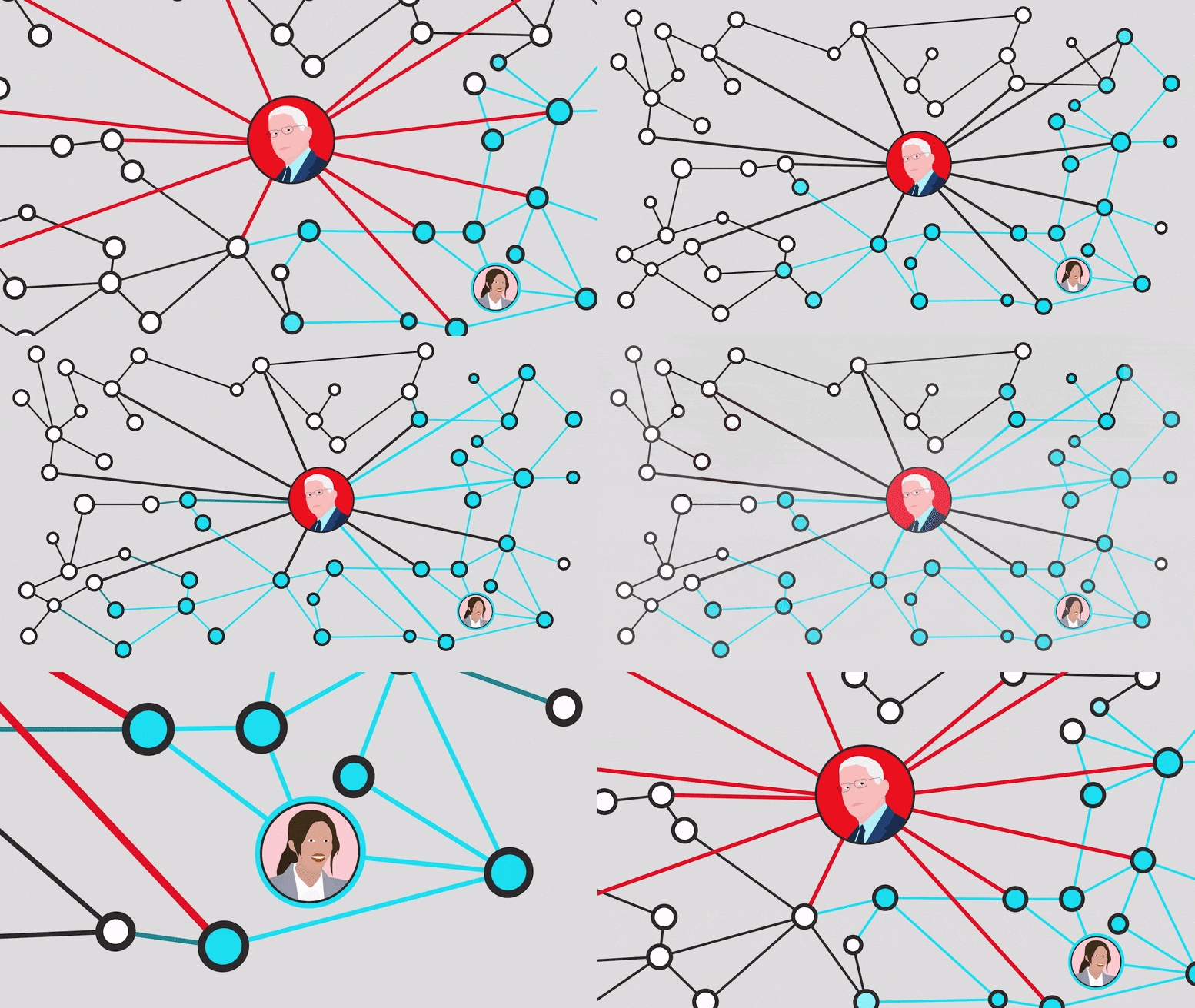
As prominent and revered as social influencers seem to be, in fact, they are unlikely to change a person’s behavior by example — and might actually be detrimental to the cause. Credit: Annenberg School for Communication, University of Pennsylvania
A New Playbook: Look to the Fringes
So what strategy do we take if we want to use an online or real world neighborhood network to ‘plant’ a new idea? Is there anyone in a social network who is effective at transmitting new beliefs? The new study delivers a surprising answer: yes, and it’s the people you’d least expect to have any pull. To stimulate a shift in thinking, target small groups of people in the “outer edge” or fringe of a network.
Centola and Douglas Guilbeault, Ph.D., a recent Annenberg graduate, studied over 400 public health networks to discover which people could spread new ideas and behaviors most effectively. They tested every possible person in every network to determine who would be most effective for spreading everything from celebrity gossip to vaccine acceptance.
“Dozens of algorithms that are currently used by enterprises seeking to spread new ideas are based on the fallacy that everything spreads virally,” says Centola. “But this study shows that the ability for information to pass through a social network depends on what type of information it is.”
So, if you want to spread gossip — easily digestible, uncontroversial bits of information — go ahead and tap an influencer. But if you want to transmit new ways of thinking that challenge an existing set of beliefs, seek out hidden locations in the periphery and plant the seed there.
How to Trigger Social Tipping Points
“Our big discovery,” Centola added, “is that every network has a hidden social cluster in the outer edges that is perfectly poised to increase the spread of a new idea by several hundred percent. These social clusters are ground zero for triggering tipping points in society.”
Centola and Guilbeault applied their findings to predicting the spread of a new microfinance program across dozens of communities in India. By considering what was being spread through the networks, they were able to predict where it should originate from, and whether it would spread to the rest of the population. Their predictions identified the exact people who were most influential for increasing the adoption of the new program.
Guilbeault, now an assistant professor at the University of California, Berkeley, noted, “in a sense, we found that the center of the network changed depending on what was spreading. The more uncertain people were about a new idea, the more that social influence moved to the people who only had parochial connections, rather than people with many far-reaching social connections.” Guilbeault added, “the people in the edges of the network suddenly had the greatest influence across the entire community.”
Rethinking Influence in a Networked World
The findings “turn our notions about social influence for marketing, sales, and social movements upside down,” says Centola. “Not everything spreads through a network in the same way,” he adds, “and we can use this knowledge to pinpoint hotspots in the social graph. This can allow us to accurately tailor our network strategies for effecting positive social change.”
Centola is the author of the new book, Change: How to Make Big Things Happen (Little Brown, 2021).
Reference: “Topological measures for identifying and predicting the spread of complex contagions” by Douglas Guilbeault and Damon Centola, 20 July 2021, Nature Communications.
DOI: 10.1038/s41467-021-24704-6
Never miss a breakthrough: Join the SciTechDaily newsletter.
Follow us on Google and Google News.
1 Comment
Hi! I see that you are good at Instagram. Then maybe you can help me with my question? I have been running my business page on Instagram for a long time, but my audience is still the same. I can not increase the number of my subscribers in any way. What should I do? Thanks in advance for your answers!