
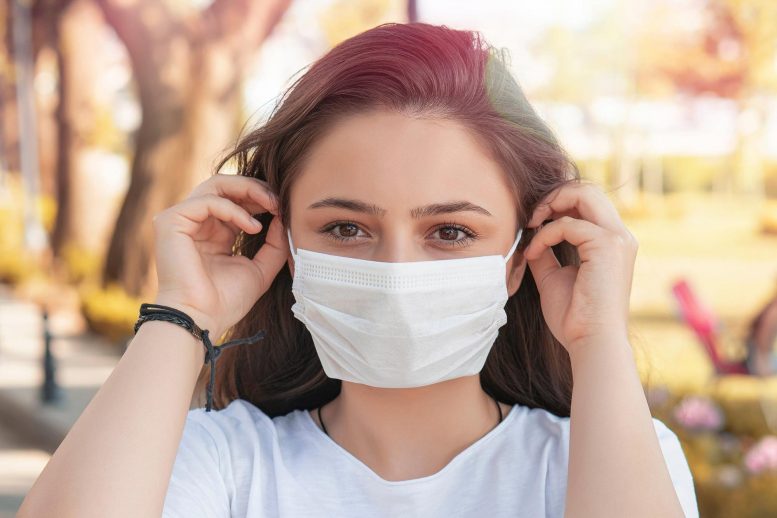
Research from the University of Central Florida confirms that wearing face masks reduces the spread of airborne pathogens from coughs and speech, potentially decreasing the need for strict social distancing if masks are worn.
The effectiveness of face masks has been a hotly debated topic since the emergence of COVID-19. However, a new study by researchers at the University of Central Florida offers more evidence that they work.
In a study appearing today (January 12, 2022) in the Journal of Infectious Diseases, the researchers found that face masks reduce the distance airborne pathogens could travel, when speaking or coughing, by more than half compared to not wearing a mask.
Study Findings on Airborne Pathogen Transmission
The findings are important as airborne viral pathogens, such as SARS-CoV-2, can be encapsulated and transmitted through liquid droplets and aerosols formed during human respiratory functions such as speaking and coughing.
Knowing ways to reduce this transmission distance can help keep people safe and aid in managing responses to pandemics, such as COVD-19, which has resulted in global-scale infection, healthcare system overloads, and economic damage.
These responses could include relaxing some social distancing guidelines when masks are worn.
“The research provides clear evidence and guidelines that 3 feet of distancing with face coverings is better than 6 feet of distancing without face coverings,” says study co-author Kareem Ahmed, an associate professor in UCF’s Department of Mechanical and Aerospace Engineering.
Research Methodology and Participant Details
Using diagnostic tools commonly used for understanding how fluids move through air, the researchers measured the distance in all directions that droplets and aerosols travel from people speaking and coughing, when wearing different types of masks and when not.
Fourteen people participated in the study, 11 males and 3 females, ages 21 to 31.
Each participant recited a phrase and simulated a cough for 5 minutes without a face-covering, with a cloth face covering, and with a three-layered disposable surgical mask.
Detailed Analysis of Mask Types and Their Effects
Planar particle imaging was used to measure particle velocity; a phase doppler interferometer was used to measure droplet size, velocity, and volume flux at points within a spray plume; and an aerodynamic particle sizer was used to determine airborne particle behavior.
The instruments measured the characteristics, behaviors, and direction of the airborne particles as they traveled outward from participants’ mouths.
Implications of Research and Future Directions
The researchers found that a cloth face covering reduced emissions in all directions to about two feet compared to the four feet of emissions produced when coughing or speaking with no mask on.
The reduction was even greater when wearing a surgical mask, which reduced the distance coughing and speaking emissions traveled to only about half a foot.
The researchers got the idea for the study from the jet propulsion research they do.
“The principles are the same,” Ahmed says. “Our cough and speech are exhausted propulsion plumes.”
The study is part of the researchers’ larger overall effort to control airborne disease transmission, including through food ingredients, a better understanding of factors related to being a super-spreader; and the modeling of airborne disease transmission in classrooms.
Next, researchers are going to expand the study with more participants. The work is funded in part by the National Science Foundation.
Reference: “Human Research Study of Particulate Propagation Distance from Human Respiratory Function” by Jonathan Reyes, Bernhard Stiehl, Juanpablo Delgado, Michael Kinzel and Kareem Ahmed, 12 January 2022, The Journal of Infectious Diseases.
DOI: 10.1093/infdis/jiab609
Study co-authors were Jonathan Reyes, lead author and a postdoctoral researcher; Bernhard Stiehl, a postdoctoral researcher; Juanpablo Delgado, a master’s student; and Michael Kinzel, an assistant professor. All are with UCF’s Department of Mechanical and Aerospace Engineering.
Ahmed joined UCF’s Department of Mechanical and Aerospace Engineering, part of UCF’s College of Engineering and Computer Science, in 2014. He is also a member of the Center for Advanced Turbomachinery and Energy Research and the Florida Center for Advanced Aero-Propulsion. He served more than three years as a senior aero/thermo engineer at Pratt & Whitney military engines working on advanced engine programs and technologies. He also served as a faculty member at Old Dominion University and Florida State University.
At UCF, he is leading research in propulsion and energy with applications for power generation and gas-turbine engines, propulsion-jet engines, hypersonics, and fire safety, as well as research related to supernova science and COVID-19 transmission control.
He earned his doctoral degree in mechanical engineering from the State University of New York at Buffalo. He is an American Institute of Aeronautics and Astronautics associate fellow and a U.S. Air Force Research Laboratory and Office of Naval Research faculty fellow.
Never miss a breakthrough: Join the SciTechDaily newsletter.
Follow us on Google and Google News.
5 Comments
I note that the mask in the headling picture is not being worm properly as it is not sealed around the nose, a very comman mistake.
I note that the mask in the headling picture is not being worm properly as it is not sealed around the nose, a very comman mistake.
surgical masks block 10% of aerosols at best. Respiratory viruses are spread by aerosols. Look up TB and its spread. This is pseudoscience “masquerading” as science. Gee..14 people. Blocking particles doesn’t mean reduces infection rates.
I wonder why the GOP has made this a political issue. When their health is what should be their main concern. To believe a politician or a right-wing radio or tv host has more knowledge than a medical doctor about a medical issue, and how to make them better.
Perhaps it’s because there are other societal considerations beyond infectious disease control. For instance, brain development in children insofar reading nonverbal communication. Or perhaps it’s as simple as there are worse things in life, for the vast majority of Americans, contracting COVID.