
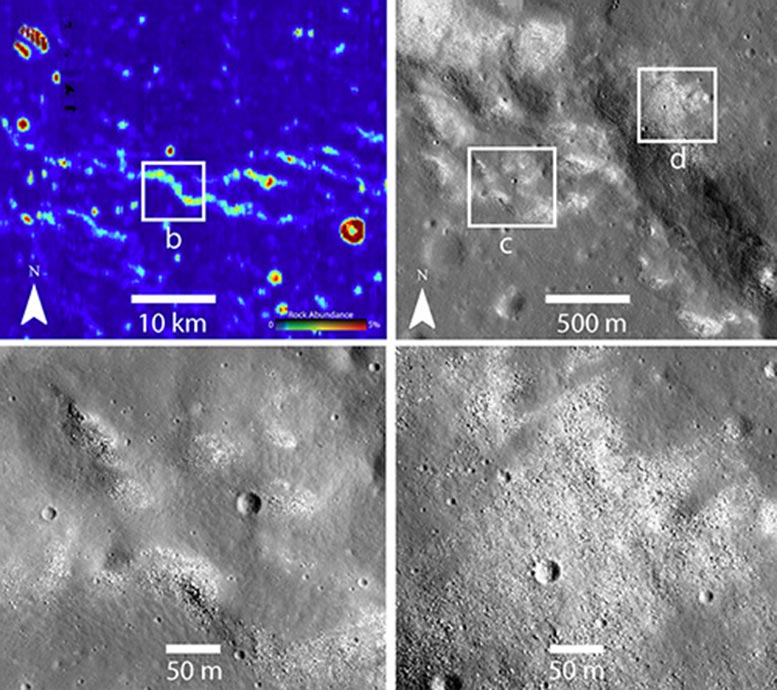
Strange spots scattered across the Moon’s nearside where bedrock is conspicuously exposed are evidence of seismic activity set in motion 4.3 billion years ago that could be ongoing today, the researchers say.
Researchers have discovered a system of ridges spread across the nearside of the Moon topped with freshly exposed boulders. The ridges could be evidence of active lunar tectonic processes, the researchers say, possibly the echo of a long-ago impact that nearly tore the Moon apart.
“There’s this assumption that the Moon is long dead, but we keep finding that that’s not the case,” said Peter Schultz, a professor in Brown University’s Department of Earth, Environmental and Planetary Sciences and co-author of the research, which is published in the journal Geology. “From this paper it appears that the Moon may still be creaking and cracking — potentially in the present day — and we can see the evidence on these ridges.”
Most of the Moon’s surface is covered by regolith, a powdery blanket of ground-up rock created by the constant bombardment of tiny meteorites and other impactors. Areas free of regolith where the Moon’s bedrock is exposed are vanishingly rare. But Adomas Valantinas, a graduate student at the University of Bern who led the research while a visiting scholar at Brown, used data from NASA’s Lunar Reconnaissance Orbiter (LRO) to spot strange bare spots within and surrounding the lunar maria, the large dark patches on the Moon’s nearside.
“Exposed blocks on the surface have a relatively short lifetime because the regolith buildup is happening constantly,” Schultz said. “So when we see them, there needs to be some explanation for how and why they were exposed in certain locations.”
For the study, Valantinas used the LRO’s Diviner instrument, which measures the temperature of the lunar surface. Just as concrete-covered cities on Earth retain more heat than the countryside, exposed bedrock and blocky surfaces on the Moon stays warmer through the lunar night than regolith-covered surfaces. Using nighttime observations from Diviner, Valantinas turned up more than 500 patches of exposed bedrock on narrow ridges following a pattern across the lunar nearside maria.
A few ridges topped with exposed bedrock had been seen before, Schultz says. But those ridges were on the edges of ancient lava-filled impact basins and could be explained by continued sagging in response to weight caused by the lava fill. But this new study discovered that the most active ridges are related to a mysterious system of tectonic features (ridges and faults) on the lunar nearside, unrelated to both lava-filled basins and other young faults that crisscross the highlands.
“The distribution that we found here begs for a different explanation,” Schultz said.
Valantinas and Schultz mapped out all of the exposures revealed in the Diviner data and found an interesting correlation. In 2014, NASA’s GRAIL mission found a network of ancient cracks in the Moon’s crust. Those cracks became channels through which magma flowed to the Moon’s surface to form deep intrusions. Valantinas and Schultz showed that the blocky ridges seemed to line up just about perfectly with the deep intrusions revealed by GRAIL.
“It’s almost a one-to-one correlation,” Schultz said. “That makes us think that what we’re seeing is an ongoing process driven by things happening in the Moon’s interior.”
Schultz and Valantinas suggest that the ridges above these ancient intrusions are still heaving upward. The upward movement breaks the surface and enables regolith to drain into cracks and voids, leaving the blocks exposed. Because bare spots on the Moon get covered over fairly quickly, this cracking must be quite recent, possibly even ongoing today. They refer to what they’ve found as ANTS, for Active Nearside Tectonic System.
The researchers believe that the ANTS was actually set in motion billions of years ago with a giant impact on the Moon’s farside. In previous studies, Schultz and a co-worker proposed this impact, which formed the 1500-mile South Pole Aitken Basin, shattered the interior on the opposite side, the nearside facing the Earth. Magma then filled these cracks and controlled the pattern of dikes detected in the GRAIL mission. The blocky ridges comprising the ANTS now trace the continuing adjustments along these ancient weaknesses.
“This looks like the ridges responded to something that happened 4.3 billion years ago,” Schultz said. “Giant impacts have long-lasting effects. The Moon has a long memory. What we’re seeing on the surface today is testimony to its long memory and secrets it still holds.”
Reference: “The origin of neotectonics on the lunar nearside” by A. Valantinas and P.H. Schultz, 13 April 2020, Geology.
DOI: 10.1130/G47202.1
Never miss a breakthrough: Join the SciTechDaily newsletter.
Follow us on Google and Google News.