
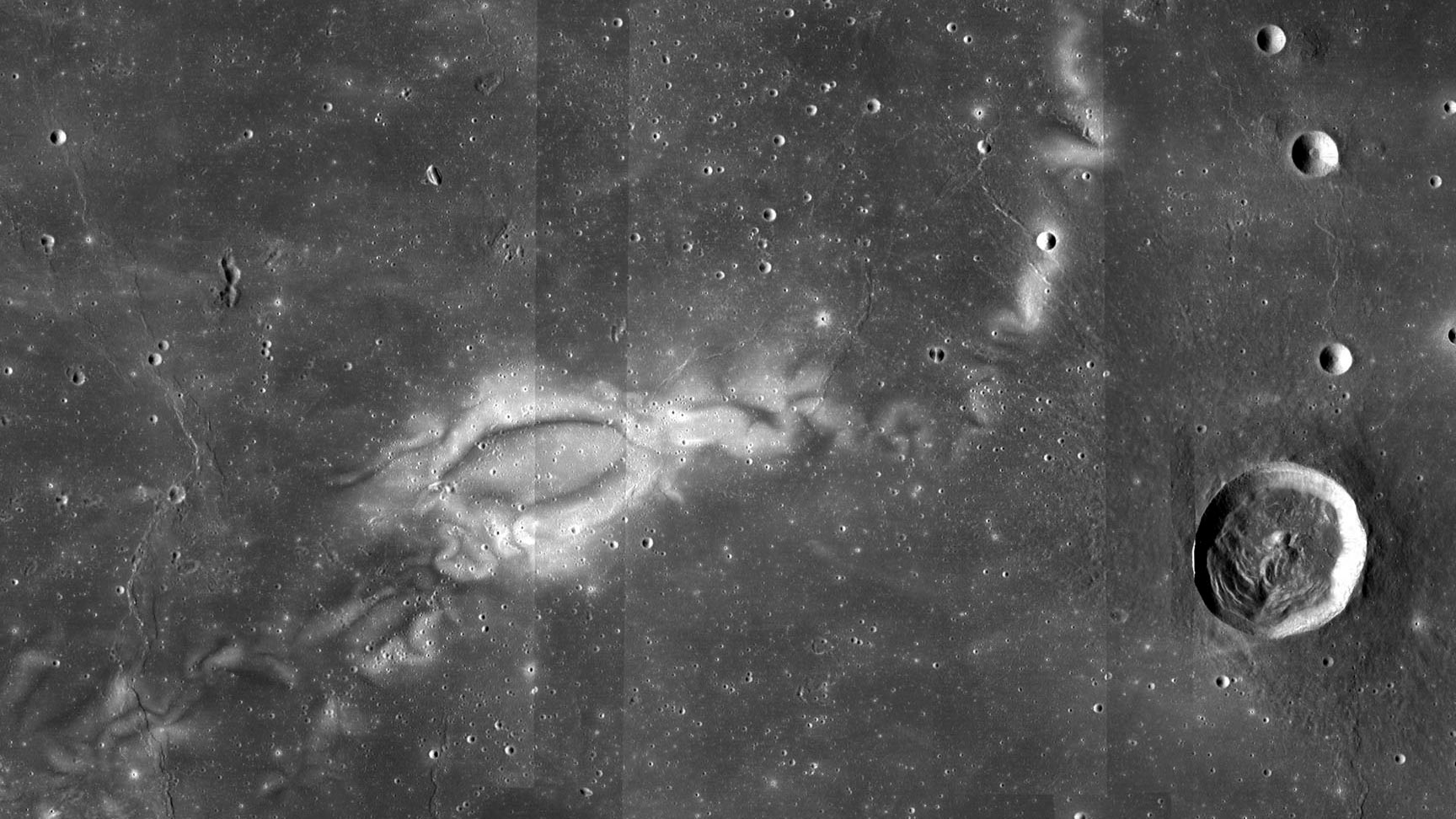
Mysterious, light-colored swirls on the Moon’s surface could be rocks magnetized by magma activity underground.
Lunar swirls, visible through simple backyard telescopes, have puzzled scientists with their mysterious, light-colored patterns on the Moon’s surface. Recent studies suggest these swirls are caused by magnetized rocks that deflect solar winds, keeping the swirls lighter while nearby areas darken over time. Understanding these swirls could provide insights into the Moon’s magnetic history and surface processes.
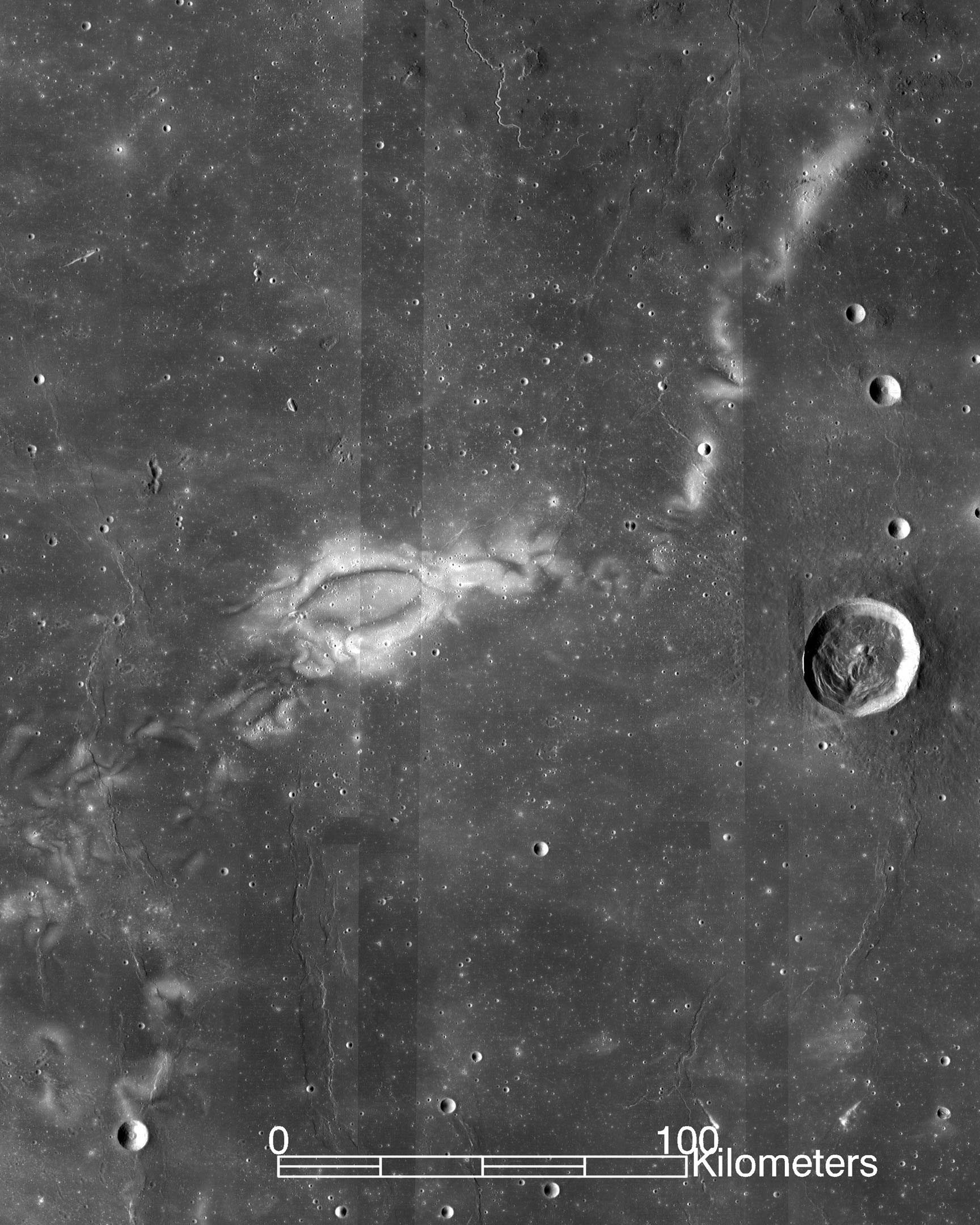
Lunar swirls are light-colored, sinuous features on the Moon’s surface, bright enough to be visible from a backyard telescope. Some people think they look like the brushstrokes in an abstract painting. But these are not mere artistic flourishes: NASA images, such as the one above, show that the tendrils from some lunar swirls extend for hundreds of miles.
Investigating the Mystery of Lunar Swirls
Lunar swirls have defied easy explanation, but recent modeling and spacecraft data shed light on the twisty mystery. The data shows that rocks in the swirls are magnetized, and these rocks deflect or redirect solar wind particles that constantly bombard the Moon. Nearby rocks take the hit instead. Over time, neighboring rocks become darkened by chemical reactions caused by the collisions, while the swirls remain light-colored.
Theories on Magnetic Anomalies in Lunar Swirls
But how did the rocks in lunar swirls get magnetized? The Moon does not have a magnetic field today. No astronaut or rover has yet visited a lunar swirl to investigate.
“Impacts could cause these types of magnetic anomalies,” said Michael J. Krawczynski, an associate professor of earth, environmental, and planetary sciences in Arts & Sciences at Washington University in St. Louis. He notes that meteorites regularly deliver iron-rich material to areas on the Moon’s surface. “But there are some swirls where we’re just not sure how an impact could create that shape and that size of thing.”
Krawczynski believes it’s more likely that something else has locally magnetized the swirls.
Experimental Insights into Lunar Swirl Magnetization
“Another theory is that you have lavas underground, cooling slowly in a magnetic field and creating the magnetic anomaly,” said Krawczynski, who designed experiments to test this explanation. His results were published in the Journal of Geophysical Research: Planets.
Krawczynski and study first author Yuanyuan Liang, who recently earned her PhD in earth, environmental and planetary sciences in Arts & Sciences, measured the effects of different combinations of atmospheric chemistry and magmatic cooling rates on a mineral called ilmenite to see if they could produce a magnetizing effect.
“Earth rocks are very easily magnetized because they often have tiny bits of magnetite in them, which is a magnetic mineral,” Krawczynski said. “A lot of the terrestrial studies that have focused on things with magnetite are not applicable to the Moon, where you don’t have this hyper-magnetic mineral.”
But ilmenite, which is abundant on the Moon, can also react and form particles of iron metal, which can be magnetized under the right conditions, Krawczynski and his team found.
“The smaller grains that we were working with seemed to create stronger magnetic fields because the surface area to volume ratio is larger for the smaller grains compared to the larger grains,” Liang said. “With more exposed surface area, it is easier for the smaller grains to undergo the reduction reaction.”
“Our analog experiments showed that at lunar conditions, we could create the magnetizable material that we needed. So, it’s plausible that these swirls are caused by subsurface magma,” said Krawczynski, who is a faculty fellow in the university’s McDonnell Center for the Space Sciences.
Implications of Magnetization for Lunar Science
Determining the origin of lunar swirls is considered key in understanding what processes have shaped the lunar surface, the history of a magnetic field on the Moon, and even how the surfaces of planets and moons generally affect the space environment surrounding them.
Future Exploration and Experiments
This study will help interpret data acquired by future missions to the Moon, especially those that explore magnetic anomalies on the lunar surface. NASA intends to send a rover to the lunar swirl area known as Reiner Gamma in 2025 as part of the Lunar Vertex mission.
“If you’re going to make magnetic anomalies by the methods that we describe, then the underground magma needs to have high titanium,” Krawczynski said. “We have seen hints of this reaction creating iron metal in lunar meteorites and in lunar samples from Apollo. But all of those samples are surface lava flows, and our study shows cooling underground should significantly enhance these metal-forming reactions.”
For now, his experimental approach is the best way to test predictions about how unseen lava may be driving the magnetic effects of the mysterious lunar swirls.
“If we could just drill down, we could see if this reaction was happening,” Krawczynski said. “That would be great, but it’s not possible yet. Right now, we’re stuck with the surface.”
Reference: “Possibility of Lunar Crustal Magmatism Producing Strong Crustal Magnetism” by Y. Liang, S. M. Tikoo and M. J. Krawczynski, 20 May 2024, Journal of Geophysical Research: Planets.
DOI: 10.1029/2023JE008179
Never miss a breakthrough: Join the SciTechDaily newsletter.
Follow us on Google and Google News.
1 Comment
In High School we learnt about Magnetism and how Iron Filings Line up and get Magnetized when subjected to a magnetic Field.
In College we learnt about the Periodic Table and the Elements in the same arranged thanks to a Russian Scientist named Mendeleev. In fact we called it the Mendeleev Periodic Table. This was the list of Elements arranged in Rows and Columns based on their Properties and Chemical / Physical characteristics. There were a number of Scientists who postulated the internals of such elements and Atoms of the Atomic/Periodic Table of Elements.
Last I heard we humans had discovered 118 Elements in the Periodic Table. Iron , Atomic No. 26 appears in Column 8 of the 18 Column Periodic Table. In Column 8 we also have the following elements. Ruthenium Atomic No. 44, Osmium Atomic No. 76 and Hassium Atomic No. 108.
I also learnt over time that not just Ferrous and Ferrous based minerals have Magnetic Properties but Others like Titanium, Zirconium and others have such properties.
Coming to the Swirling Moon Dust, I am not sure which theory postulated above will pan out, but best of luck to the Research Team doing Research on the Moon. Some lunatics ( Moon Lovers ) like us Moon- Crossed and Star-Crossed worshipers hope that the Romantic Association with the ” Chanda Mamma Doooor KE” lullaby Moms used to sing to their little babies is not lost in the translation.