
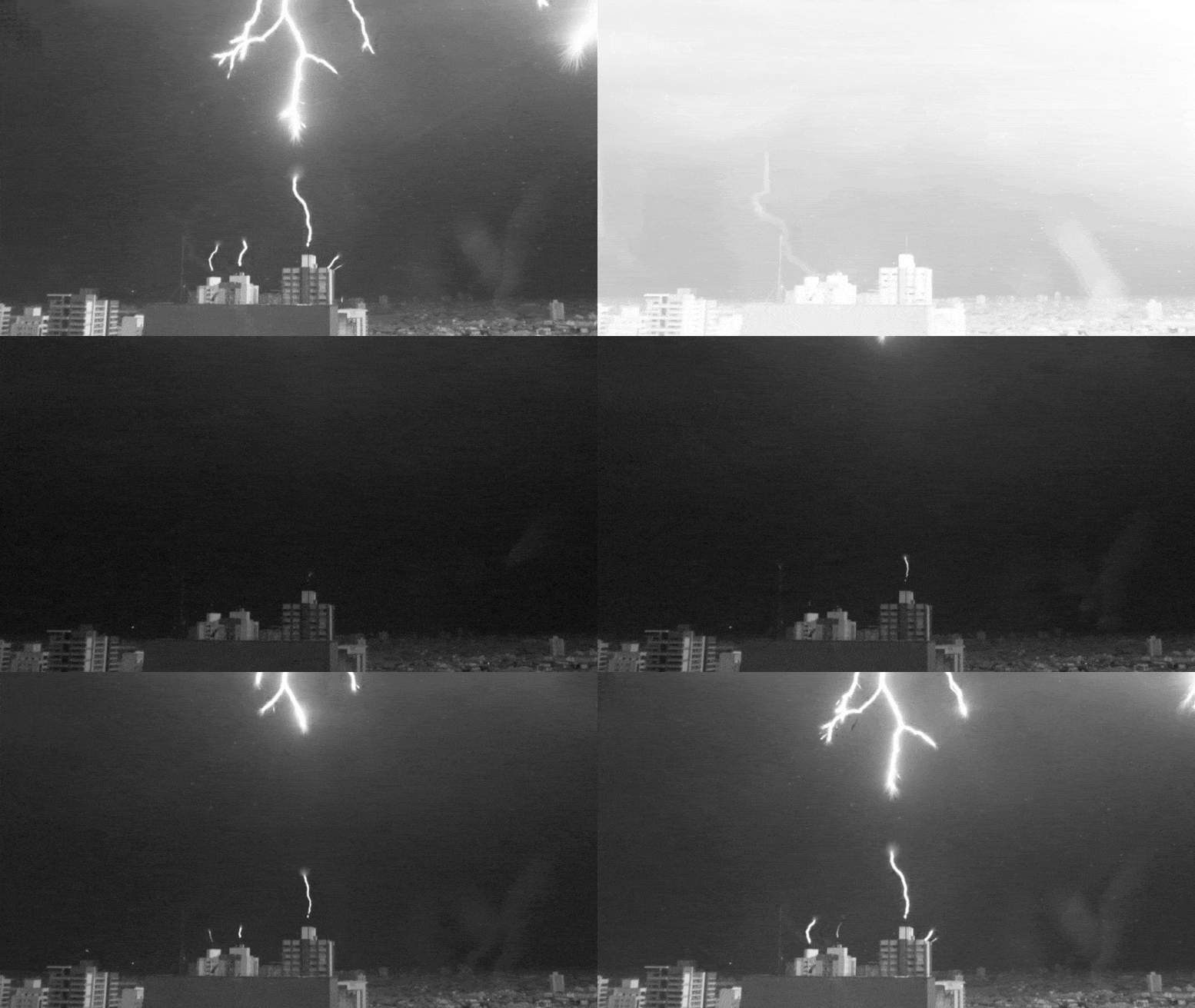
The high-speed camera captured an image displaying multiple lightning rods attempting to connect to the downward discharge. The two descending branches visible in the image are part of the same lightning strike that ultimately struck the building on the right.
With a high-speed camera and some luck by being in the right place at the right moment, physicist Marcelo Saba and Ph.D. candidate Diego Rhamon from the National Space Research Institute (INPE) in Brazil were able to obtain a rare image of lightning strikes that displays the connections to nearby buildings in intricate detail.
The image is so unique that it was featured on the cover of the December 28, 2022 issue of Geophysical Research Letters (GRL), a prominent scientific journal in the field. The issue also included an article with Saba as the first author. Saba’s research on this topic was supported by FAPESP.
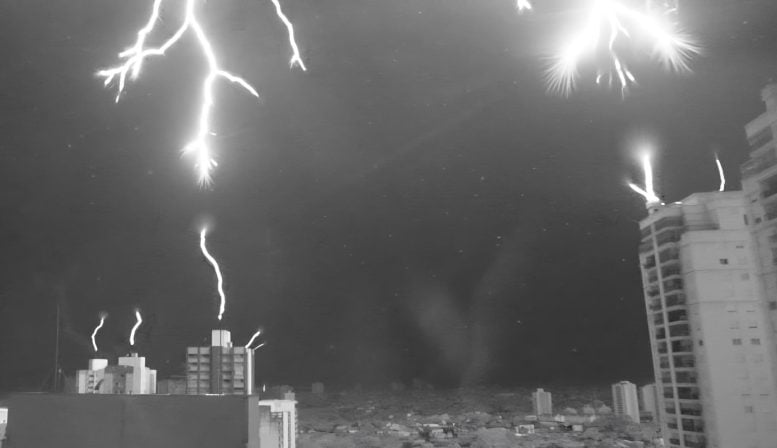
“The image was captured on a summer evening in São José dos Campos [in São Paulo state] while a negatively charged lightning bolt was nearing the ground at 370 km per second. When it was a few dozen meters from ground level, lightning rods and tall objects on the tops of nearby buildings produced positive upward discharges, competing to connect to the downward strike. The final image prior to the connection was obtained 25 thousandths of a second before the lightning hit one of the buildings,” Saba said. This is the spectacular image featured on the cover of the journal.
He used a camera that takes 40,000 frames per second. When the video is played back in slow motion, it shows how lightning discharges behave and also how dangerous they can be if the protection system is not properly installed: although there are more than 30 lightning rods in the vicinity, the strike connected not to them but to a smokestack on top of one of the buildings.
“A flaw in the installation left the area unprotected. The impact of a 30,000-amp discharge did enormous damage,” he said.
Very close video of lightning attachment to a building lightning rod. Credit: Marcelo Saba/ Diego Rhamon
On average, 20% of all lightning strikes involve an exchange of electrical discharges between clouds and the ground. The other 80% occur inside clouds. Almost all strikes that touch the soil are cloud-to-ground discharges. Upward strikes also occur but are rare and start at the top of tall structures such as mountains, skyscrapers, towers, and antennas. Lightning strikes can also be classified as negative or positive depending on the charge transferred to the ground.
“Lightning strikes can be as long as 100 km and transport currents as strong as 30,000 amps, equivalent to the current used simultaneously by 30,000 100-watt bulbs. In some cases, the current can reach 300,000 amps. The temperature of a typical lightning strike is 30,000 °C, five times the Sun’s surface temperature,” Saba said.
How Lightning Strikes Are Formed
It all begins with cloud electrification, he explained. The mechanism is poorly understood but basically involves friction between particles of ice, water drops, and hail, releasing charges and creating polarities between different cloud regions, with differences in electrical potential ranging from 100 million volts to 1 billion volts.
“Bear in mind that storm clouds are huge structures. The bottom is 2 km to 3 km from the ground, the top can reach 20 km in altitude, and the diameter can be 10 km to 20 km,” he said.
Lightning strikes branch out as the electrical charges seek the path of least resistance, rather than the shortest path, which would be a straight line. The path of least resistance, usually a zigzag, is determined by different electrical characteristics of the atmosphere, which is not homogeneous. “A lightning strike made up of several discharges can last up to 2 seconds. However, each discharge lasts only fractions of milliseconds,” Saba said.
Lightning rods neither attract nor repel strikes, he added. Nor do they “discharge” clouds, as used to be believed. They simply offer lightning an easy and safe route to the ground.
Because it is not always possible to rely on the protection of a lightning rod, and most atmospheric discharges occur in summer in the tropics, it is worth considering Saba’s advice. “Storms are more frequent in the afternoon than in the morning, so be careful about outdoor activities on summer afternoons. Find shelter if you hear thunder, but never under a tree or pole, and never under a rickety roof,” he said. “If you can’t find a safe place to shelter, stay in the car and wait for the storm to blow over. If no car or other shelter is available, squat down with your feet together. Don’t stand upright or lie flat. Indoors, avoid contact with appliances and fixed-line telephones.”
It is possible to survive being struck by lightning, and there are many examples. The odds increase if the person receives care quickly. “Cardiac arrest is the only cause of death. In this case, cardiopulmonary resuscitation is the recommended treatment,” he said.
Saba began systematically studying lightning with high-speed cameras in 2003, ever since building a collection of videos of lightning filmed at high speed that has become the world’s largest. Between them, he and his students have been awarded 17 grants and scholarships by FAPESP.
Reference: “Close View of the Lightning Attachment Process Unveils the Streamer Zone Fine Structure” by Marcelo M. F. Saba, Diego Rhamon R. da Silva, John G. Pantuso and Caitano L. da Silva, 14 December 2022, Geophysical Research Letters.
DOI: 10.1029/2022GL101482
The study was funded by the São Paulo Research Foundation.
Never miss a breakthrough: Join the SciTechDaily newsletter.
Follow us on Google and Google News.
2 Comments
So if there are places where lightning strikes constantly and there is that much energy in just the air… Why is no one trying to harness lightning as a power source?
Because, while the voltage is very high (which is a problem), and the currents are very high, the duration is so very short that each strike isn’t equivalent to very many kilowatt-hours.