
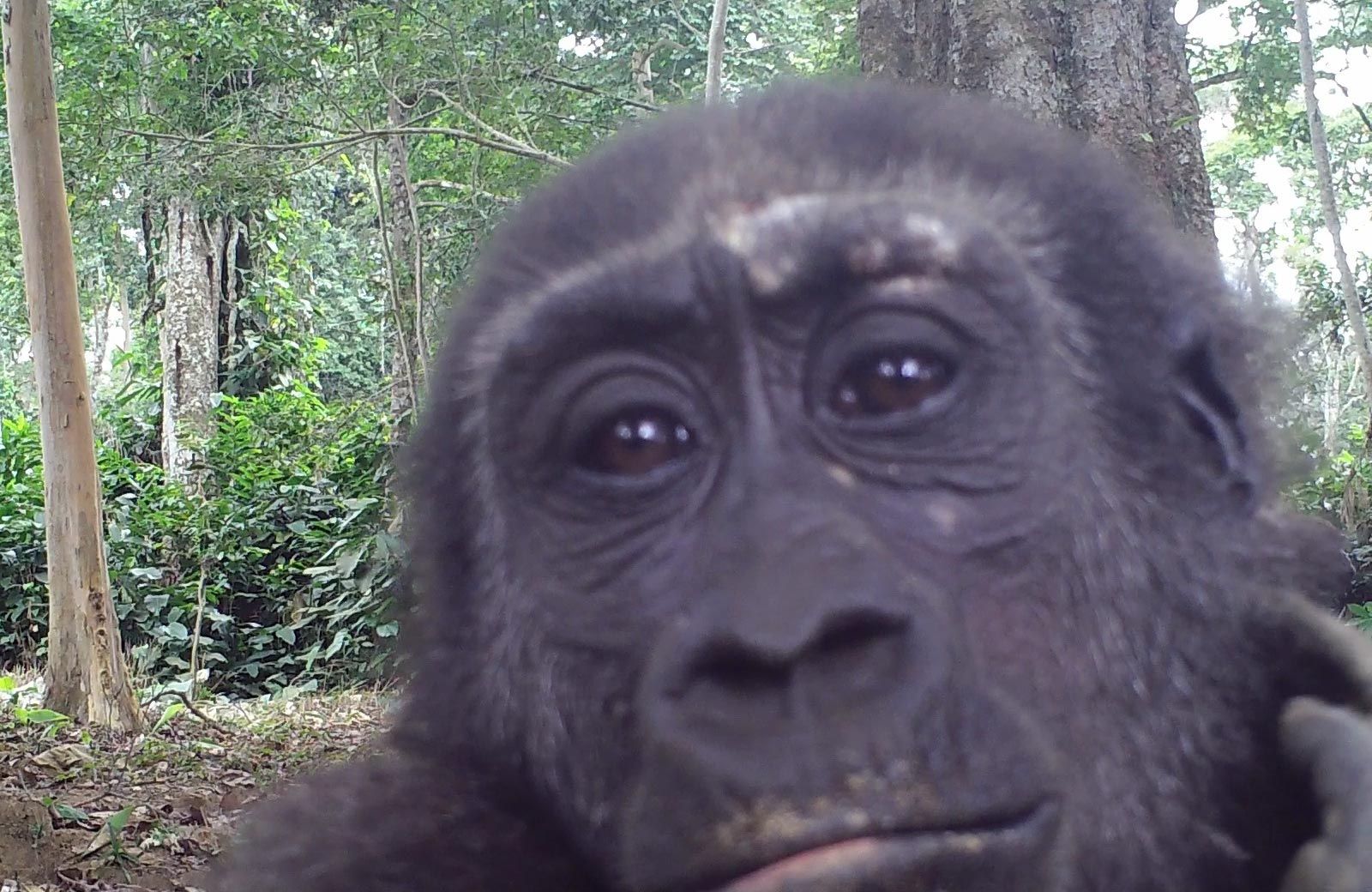
New research provides important clues for the evolution of human behavior.
Scientists have discovered that gorillas really are territorial — and their behavior is very similar to our own.
Published in the journal Scientific Reports, the research shows for the first time that groups of gorillas recognize “ownership” of specific regions. They are also more likely to avoid contact with other groups the closer they are to the center of their neighbors’ home range, for fear of conflict.
The study, which was carried out by academics from the University of Cambridge, Anglia Ruskin University (ARU), the University of Barcelona, SPAC Scientific Field Station Network, and the University of Vienna, involved monitoring the movements of groups of western lowland gorillas (Gorilla gorilla gorilla).
Western lowland gorillas are difficult to track on foot because they live in dense forests. Instead, the scientists followed eight groups of gorillas using a network of cameras placed at 36 feeding “hotspots” across a 60km² area of the Odzala-Kokoua National Park in the Republic of Congo.
It was previously thought that gorillas were non-territorial, due to the overlap of home ranges and their tolerance of other groups. This is markedly different from chimpanzees, which display extreme territorial-based violence.
However, this new research discovered that gorillas display more nuanced behaviors, and their movements are strongly influenced by the location of their neighbors — they are less likely to feed at a site visited by another group that day — and the distance from the center of their neighbors’ home range.
Lead author Dr. Robin Morrison, who carried out the study during her Ph.D. at the University of Cambridge, said: “Our findings indicate that there is an understanding among gorillas of ‘ownership’ of areas and the location of neighboring groups restricts their movement.
“Gorillas don’t impose hard boundaries like chimpanzees. Instead, gorilla groups may have regions of priority or even exclusive use close to the center of their home range, which could feasibly be defended by physical aggression.
“At the same time groups can overlap and even peacefully co-exist in other regions of their ranges. The flexible system of defending and sharing space implies the presence of a complex social structure in gorillas.”
Co-author Dr. Jacob Dunn, Reader in Evolutionary Biology at Anglia Ruskin University (ARU), said: “This new research changes what we know about how groups of gorillas interact and has implications for what we understand about human evolution.
“Almost all comparative research into human evolution compares us to chimpanzees, with the extreme territorial violence observed in chimpanzees used as evidence that their behavior provides an evolutionary basis for warfare among humans.
“Our research broadens this out and shows instead just how closely we compare to our next nearest relatives. Gorillas’ core areas of dominance and large zones of mutual tolerance could help with our understanding of the social evolution of early human populations, showing both the capacity for violence in defending a specific territory and the between-group affiliations necessary for wider social cooperation.”
Reference: “Western gorilla space use suggests territoriality” by Robin E. Morrison, Jacob C. Dunn, Germán Illera, Peter D. Walsh and Magdalena Bermejo, 12 March 2020, Scientific Reports.
DOI: 10.1038/s41598-020-60504-6
Never miss a breakthrough: Join the SciTechDaily newsletter.
Follow us on Google and Google News.
1 Comment
So the scientific name for a Western lowland gorilla is “gorilla gorilla gorilla”??? Am I actually reading that correctly?