
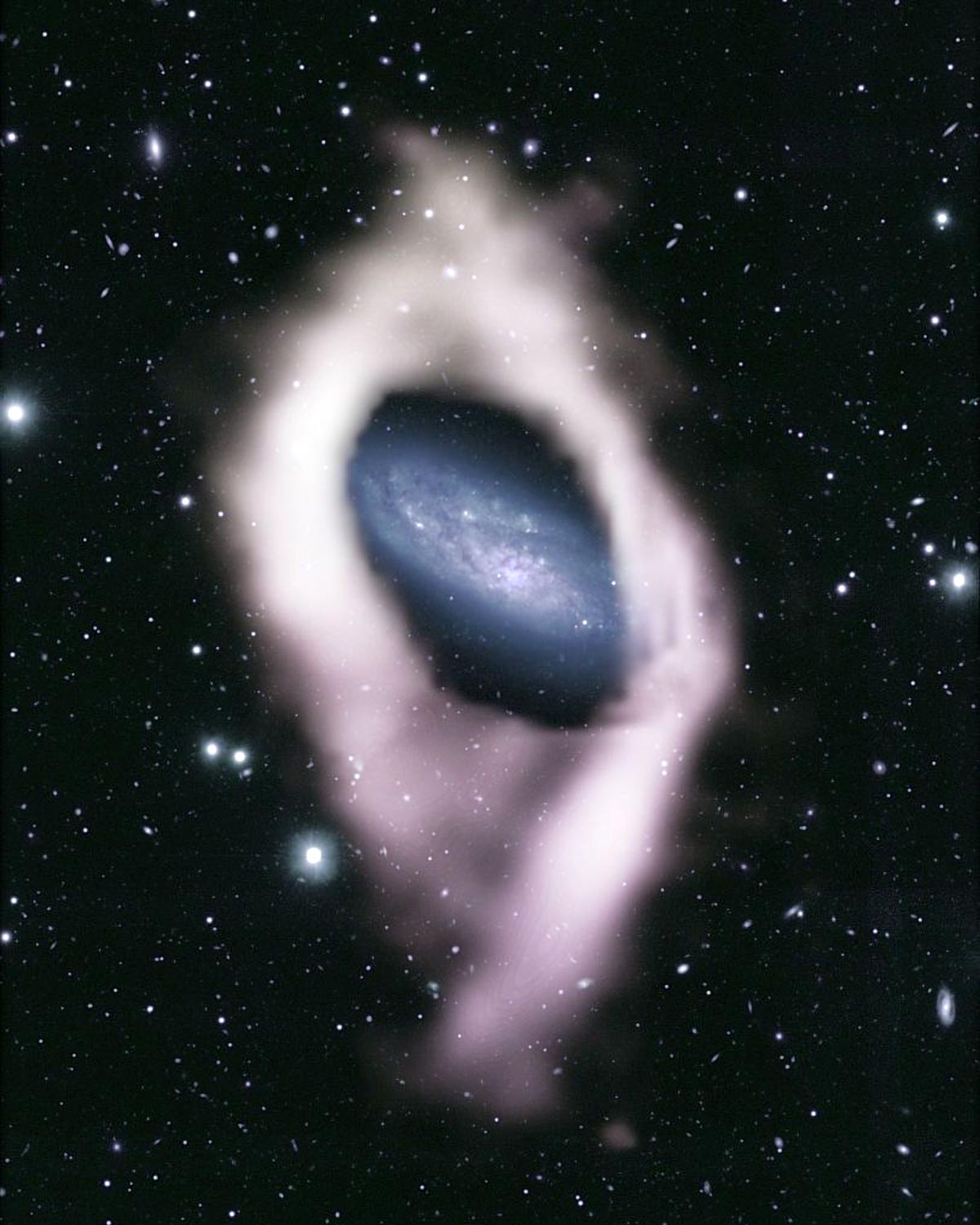
Queen’s researchers lead the discovery of two potential polar ring galaxies.
A group of international astronomers, including researchers from Queen’s University, has identified two potential polar ring galaxies, according to results published on September 13 in the Monthly Notices of the Royal Astronomical Society.
Queen’s researchers Nathan Deg and Kristine Spekkens (Physics, Engineering Physics & Astronomy) led the analysis of data obtained using a telescope owned and operated by CSIRO, Australia’s national science agency. Looking at sky maps of hydrogen gas in over 600 galaxies as part of CSIRO’s ASKAP radio telescope’s WALLABY survey, they identified two potential polar ring galaxies, a type of galaxy that exhibits a ring of stars and gas perpendicular to its main spiral disk.
“Polar ring galaxies are some of the most spectacular looking galaxies in the Universe. These findings suggest that one to three percent of nearby galaxies may have gaseous polar rings, which is much higher than suggested by optical telescopes.”
Dr. Nathan Deg, researcher, Department of Physics, Engineering Physics & and Astronomy, Queen’s University, Canada, and lead author on the study
Historical Context and Implications
Although this is not the first time that astronomers have observed polar ring galaxies, they are the first observed using the ASKAP telescope located at Inyarrimanha Ilgari Bundara, CSIRO’s Murchison radio astronomy observatory on Wajarri Yamaji Country in Western Australia.
These new detections in gas alone suggest polar ring galaxies might be more common than previously believed.
“These results are a really nice illustration of the tremendous value of mapping the sky more deeply and more widely than has ever been done before. This is serendipity at its best: we found things we certainly didn’t expect to find.”
Dr. Kristine Spekkens, Professor (cross-appointed from Royal Military College), Department of Physics, Engineering Physics & and Astronomy, Queen’s University, Canada
Understanding How Galaxies Evolve
Further investigation of polar ring structures can help us better understand how galaxies evolve. For example, one of the main hypotheses to explain the origin of polar rings is a merger where a larger galaxy ‘swallows’ a smaller one. If polar ring galaxies are more common than previously thought, this could mean that these mergers are more frequent.
In the future, polar ring galaxies can also be used to deepen our understanding of the universe, with potential applications in dark matter research. It is possible to use polar rings to probe the shape of dark matter of the host galaxy, which could lead to new clues about the mysterious properties of the elusive substance.
“These new ASKAP observations, which reveal astonishing ring-like structures around otherwise normal looking spiral galaxies, suggest that the accretion of gas through interactions with gas-rich companion galaxies is much more common than we previously believed. WALLABY will be an amazing resource to uncover many more of such systems in the future.”
Professor Lister Staveley-Smith, WALLABY Co-Principal Investigator and Interim Executive Director. ICRAR
Visualizing Polar Ring Galaxies
Jayanne English, a member of the WALLABY research team and also an expert in astronomy image-making at the University of Manitoba, developed the first images of these gaseous polar ring galaxies using a combination of optical and radio data from the different telescopes. First, optical and infrared data from the Subaru telescope in Hawaii provided the image for the spiral disk of the galaxy. Then, the gaseous ring was added based on data obtained from the WALLABY survey, an international project using CSIRO’s ASKAP radio telescope to detect atomic hydrogen emission from about half a million galaxies.
“Our ASKAP radio telescope is delivering a flood of data and we are ready for it. Using ASKAP, full WALLABY will deliver more than 200,000 hydrogen-rich galaxies among them many unusual objects like polar rings, which can be used to probe the shape and distribution of the dark matter halos.”
Dr. Bärbel Koribalski, Senior Principal Research Scientist, CSIRO
The creation of this and other astronomical images are all composite because they include information that our eyes can’t capture. In this particular case, the cold hydrogen gas component, invisible to the human eye, is seen in radio “light” using CSIRO’s ASKAP. The subtle color gradient of this ring represents the orbital motions of the gas, with purple-ish tints at the bottom tracing gas that moves toward the viewer while the top portion moves away. The emission from the ring was separated from the radio emission emanating from the galaxy’s disk using virtual reality tools, in collaboration with Professor Tom Jarrett (University of Cape Town, South Africa).
“I’m excited to work with such a diverse and collaborative team. We were able to work with data that showed a fine grid of velocity channels, which are equivalent to the radio stations on your old-fashioned radio receiver. The richness of the velocity data meant I could assign multiple colours to this composite to subtly convey the motion happening within the polar ring. The dance and choreography of the gas are beautiful, and that motion of the gas gives us some clues as to how galaxies evolve over time.”
Dr. Jayanne English, Department of Physics and Astronomy, University of Manitoba
Over 25 global collaborators from Canada, Australia, South Africa, Ecuador, Burkina Faso, Germany, China, and beyond worked together to analyze the data from the first public data release of the WALLABY survey, resulting in the newly published paper.
The next step for the team is to confirm the polar ring galaxies finding through additional observations using different telescopes, including the MeerKAT radio telescope in South Africa.
“One of the most exciting outcomes of a large survey such as WALLABY, which will scan most of the Southern sky to carry out the largest census of neutral atomic hydrogen ever done, is discovering the unexpected — these unusual galaxies with beautiful gas rings are perfect examples of this.”
Assistant Professor Barbara Catinella, WALLABY Co-Principal Investigator and co-author of this study. ICRAR, The University of Western Australia
Reference: ” WALLABY pilot survey: the potential polar ring galaxies NGC 4632 and NGC 6156″ by N Deg, R Palleske, K Spekkens, J Wang, T Jarrett, J English, X Lin, J Yeung, J R Mould, B Catinella, H Dénes, A Elagali, B -Q For, P Kamphuis, B S Koribalski, K Lee-Waddell, C Murugeshan, S Oh, J Rhee, P Serra, T Westmeier, O I Wong, K Bekki, A Bosma, C Carignan, B W Holwerda and N Yu, 13 September 2023, Monthly Notices of the Royal Astronomical Society.
DOI: 10.1093/mnras/stad2312
Never miss a breakthrough: Join the SciTechDaily newsletter.
Follow us on Google and Google News.
1 Comment
Got to apply Einstein’s living legacies to gravitationally spin this “obvious radial zone of repulsion” gravity issue into a new concentric yeah/nah halo of clumpy dark matter.