
Close Menu
    Facebook X (Twitter) Instagram
    SciTechDaily
    • Biology
    • Chemistry
    • Earth
    • Health
    • Physics
    • Science
    • Space
    • Technology
    Facebook X (Twitter) Pinterest YouTube RSS
    SciTechDaily
    Home»Space»Stunning Images From Juno’s Close Flyby of Jupiter Unveil Hidden Surprise
    Space

    Stunning Images From Juno’s Close Flyby of Jupiter Unveil Hidden Surprise

    By Jet Propulsion LaboratoryMay 16, 20241 Comment3 Mins Read
    Facebook Twitter Pinterest Telegram LinkedIn WhatsApp Email Reddit
    Share
    Facebook Twitter LinkedIn Pinterest Telegram Email Reddit
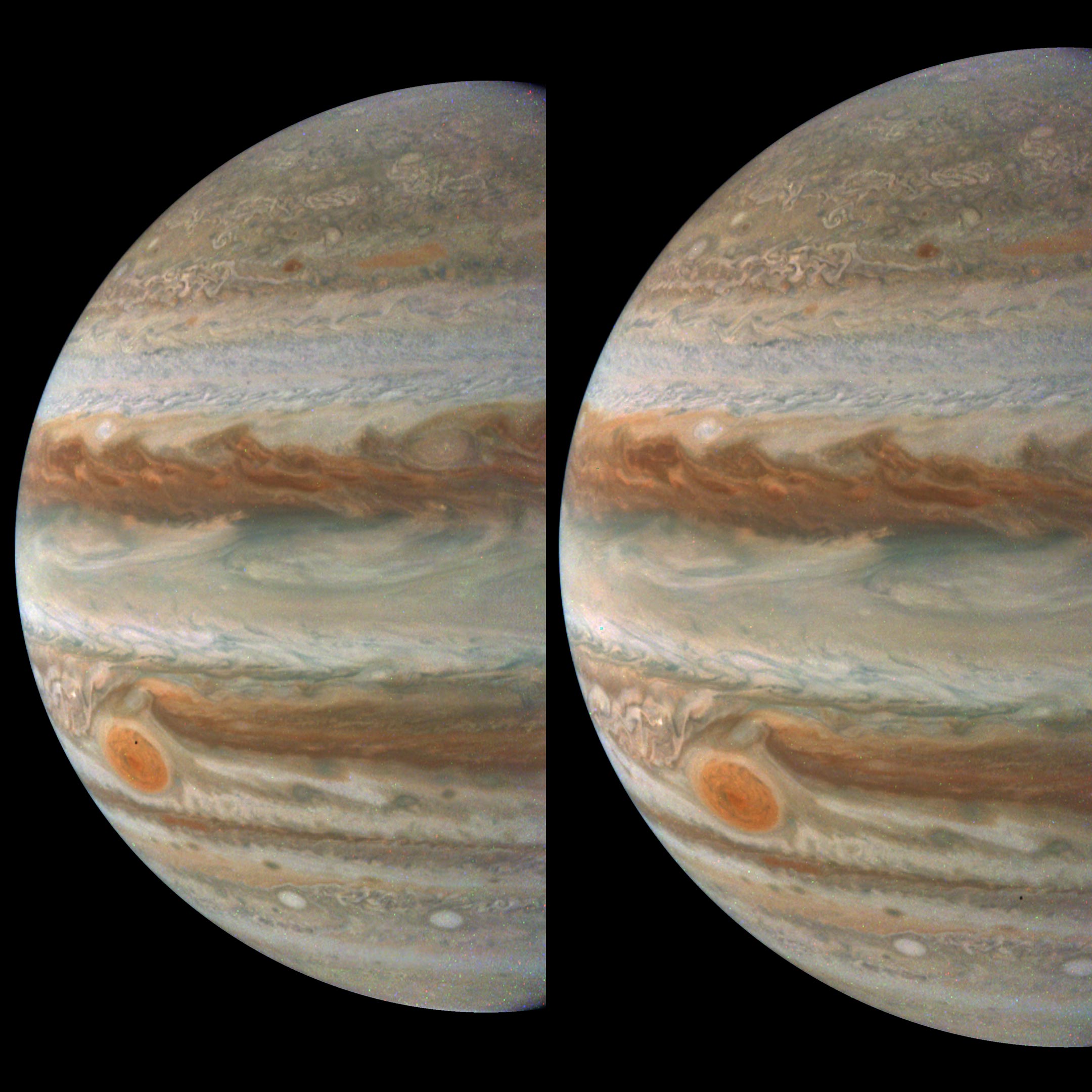
    NASA Juno Jupiter 59th Close Flyby
    NASA’s Juno mission captured these views of Jupiter during its 59th close flyby of the giant planet on March 7, 2024. They provide a good look at Jupiter’s colorful belts and swirling storms, including the Great Red Spot. A meticulous examination reveals something more: two glimpses of the tiny moon Amalthea (see image below). Credit: NASA/JPL-Caltech/SwRI/MSSS, Gerald Eichstädt

    NASA’s Juno mission captured detailed images of Jupiter during its 59th close flyby, revealing the planet’s colorful belts, swirling storms, and the tiny moon Amalthea. Amalthea, with its potato-like shape and reddish hue, orbits inside Io’s orbit and emits more heat than it receives from the Sun, possibly due to electric currents induced by Jupiter’s magnetic field or tidal stresses.

    On March 7, 2024, during its 59th close flyby of Jupiter, NASA’s Juno mission captured these views of the giant planet. The images provide a detailed look at Jupiter’s colorful belts and swirling storms, including the famous Great Red Spot. A thorough examination reveals a hidden surprise: two glimpses of the tiny moon Amalthea (see image below).

    With a radius of just 52 miles (84 kilometers), Amalthea has a potato-like shape, lacking the mass to pull itself into a sphere. In 2000, NASA’s Galileo spacecraft revealed some surface features, including impact craters, hills, and valleys. Amalthea circles Jupiter inside Io’s orbit, which is the innermost of the planet’s four largest moons, taking 0.498 Earth days to complete one orbit.

    NASA Juno Jupiter 59th Close Flyby Moon Amalthea
    NASA’s Juno mission captured these views of Jupiter during its 59th close flyby of the giant planet on March 7, 2024. They provide a good look at Jupiter’s colorful belts and swirling storms, including the Great Red Spot. Close examination reveals something more: two glimpses of the tiny moon Amalthea. Credit: NASA/JPL-Caltech/SwRI/MSSS, Gerald Eichstädt

    Amalthea is the reddest object in the solar system, and observations indicate it gives out more heat than it receives from the Sun. This may be because, as it orbits within Jupiter’s powerful magnetic field, electric currents are induced in the moon’s core. Alternatively, the heat could be from tidal stresses caused by Jupiter’s gravity.

    At the time that the first of these two images was taken, the Juno spacecraft was about 165,000 miles (265,000 kilometers) above Jupiter’s cloud tops, at a latitude of about 5 degrees north of the equator.

    Citizen scientist Gerald Eichstädt made these images using raw data from the JunoCam instrument, applying processing techniques to enhance the clarity of the images.

    JunoCam’s raw images are available for the public to peruse and process into image products at https://missionjuno.swri.edu/junocam/processing. More information about NASA citizen science can be found at https://science.nasa.gov/citizenscience and https://www.nasa.gov/solve/opportunities/citizenscience.

    Never miss a breakthrough: Join the SciTechDaily newsletter.
    Follow us on Google and Google News.

    JPL Juno Spacecraft Jupiter Moons NASA Popular
    Share. Facebook Twitter Pinterest LinkedIn Email Reddit

    Related Articles

    NASA’s Juno Exposes Sizzling Lava Lakes Beneath Io and Cyclonic Chaos on Jupiter

    NASA’s Juno Unlocks Secrets of Io’s Volcanic Fury and Jupiter’s Storms

    Juno’s Close Encounter: Unveiling the Secrets of Jupiter’s Fiery Moon Io

    Fiery Flyby: Juno’s Close Encounter With Jupiter’s Volcanic Moon, Io

    NASA’s Juno Spacecraft Makes Closest-Ever Flyby of Jupiter’s Volcanic Moon Io

    Enhance! Citizen Scientists’ Awe-Inspiring New Europa Images From NASA’s Juno

    Hear the Eerie Radio Emissions NASA’s Juno Spacecraft Recorded From Jupiter and Its Moon Io

    “Beautiful!” – Ride With NASA’s Juno Spacecraft As It Flies Past the Solar System’s Biggest Moon and Jupiter

    Close Encounters of the Jovian Kind: NASA’s Juno to Get a Close Look at Jupiter’s Moon Ganymede

    1 Comment

    1. david w. ferrin on May 16, 2024 5:43 pm

      WOW, that is COOL….

      Reply
    Leave A Reply Cancel Reply

    • Facebook
    • Twitter
    • Pinterest
    • YouTube

    Don't Miss a Discovery

    Subscribe for the Latest in Science & Tech!

    Trending News

    New Study Reveals Why Ozempic Works Better for Some People Than Others

    Climate Change Is Altering a Key Greenhouse Gas in a Way Scientists Didn’t Expect

    New Study Suggests Gravitational Waves May Have Created Dark Matter

    Scientists Discover Why the Brain Gets Stuck in Schizophrenia

    Scientists Engineer “Tumor-Eating” Bacteria That Devour Cancer From Within

    Even “Failed” Diets May Deliver Long-Term Health Gains, Study Finds

    NIH Scientists Discover Powerful New Opioid That Relieves Pain Without Dangerous Side Effects

    Collapsing Plasma May Hold the Key to Cosmic Magnetism

    Follow SciTechDaily
    • Facebook
    • Twitter
    • YouTube
    • Pinterest
    • Newsletter
    • RSS
    SciTech News
    • Biology News
    • Chemistry News
    • Earth News
    • Health News
    • Physics News
    • Science News
    • Space News
    • Technology News
    Recent Posts
    • The Surprising Reason You Might Want To Sleep Without a Pillow
    • Household Cats Could Hold the Secret to Fighting Breast Cancer
    • Scientists Say This Natural Hormone Reverses Obesity by Targeting the Brain
    • This 15,000-Year-Old Discovery Changes What We Know About Early Human Creativity
    • 35-Million-Year-Old Mystery: Strange Arachnid Discovered Preserved in Amber
    Copyright © 1998 - 2026 SciTechDaily. All Rights Reserved.
    • Science News
    • About
    • Contact
    • Editorial Board
    • Privacy Policy
    • Terms of Use

    Type above and press Enter to search. Press Esc to cancel.