

New data confirms Hubble’s finding and refutes current theories of planet formation in the universe’s early days.
Thanks to its incredible sensitivity and sharp resolution, NASA’s Webb Space Telescope just cracked a cosmic mystery that has puzzled astronomers for over two decades. Back in 2003, the Hubble Space Telescope spotted signs of a massive planet orbiting an ancient star. This discovery didn’t add up — such old stars from the early universe were thought to lack the heavier elements needed to build planets. According to existing models, the disks around these stars should vanish quickly, leaving no time for planets to grow—or even form. But there it was!
To investigate further, astronomers turned their gaze to NGC 346, a nearby star-forming region resembling conditions in the early universe. Hubble found evidence suggesting planet-forming disks still existed around stars 20 to 30 million years old — far older than models predicted such disks could survive.
While Hubble’s findings were compelling, the telescope couldn’t capture the detailed spectra needed to confirm if those disks were still actively forming planets. Enter Webb. With its unmatched power, Webb confirmed that planet-forming disks in NGC 346 not only exist but are surprisingly long-lived. This groundbreaking discovery supports Hubble’s earlier observations and forces scientists to rethink how — and when — planets form in the universe.
Webb Space Telescope Finds Planet-Forming Disks Lived Longer in Early Universe
NASA’s James Webb Space Telescope has resolved a decades-old space mystery, confirming a controversial finding first made by the Hubble Space Telescope over 20 years ago.
In 2003, Hubble detected evidence of a massive planet orbiting an ancient star almost as old as the universe itself. Stars from that era contain only trace amounts of heavier elements — critical building blocks for planets. This hinted that planet formation began surprisingly early in the universe’s history. Somehow, planets managed to form and grow — some even larger than Jupiter — despite the scarcity of these elements. But how was this possible?
To investigate, researchers used Webb to study stars in a nearby galaxy similar to the early universe, where heavy elements are also scarce. Webb’s powerful instruments revealed that not only do some of these stars still have planet-forming disks, but their disks also last far longer than those found around younger stars in our Milky Way galaxy. This unexpected discovery challenges existing theories about how and when planets can form.
“With Webb, we have a really strong confirmation of what we saw with Hubble, and we must rethink how we model planet formation and early evolution in the young universe,” said study leader Guido De Marchi of the European Space Research and Technology Centre in Noordwijk, Netherlands.

A Different Environment in the Early Universe
In the early universe, stars formed from mostly hydrogen and helium, and very few heavier elements such as carbon and iron, which came later through supernova explosions.
“Current models predict that with so few heavier elements, the disks around stars have a short lifetime, so short in fact that planets cannot grow big,” said the Webb study’s co-investigator Elena Sabbi, chief scientist for Gemini Observatory at the National Science Foundation’s NOIRLab in Tucson. “But Hubble did see those planets, so what if the models were not correct and disks could live longer?”
Challenging Previous Theories
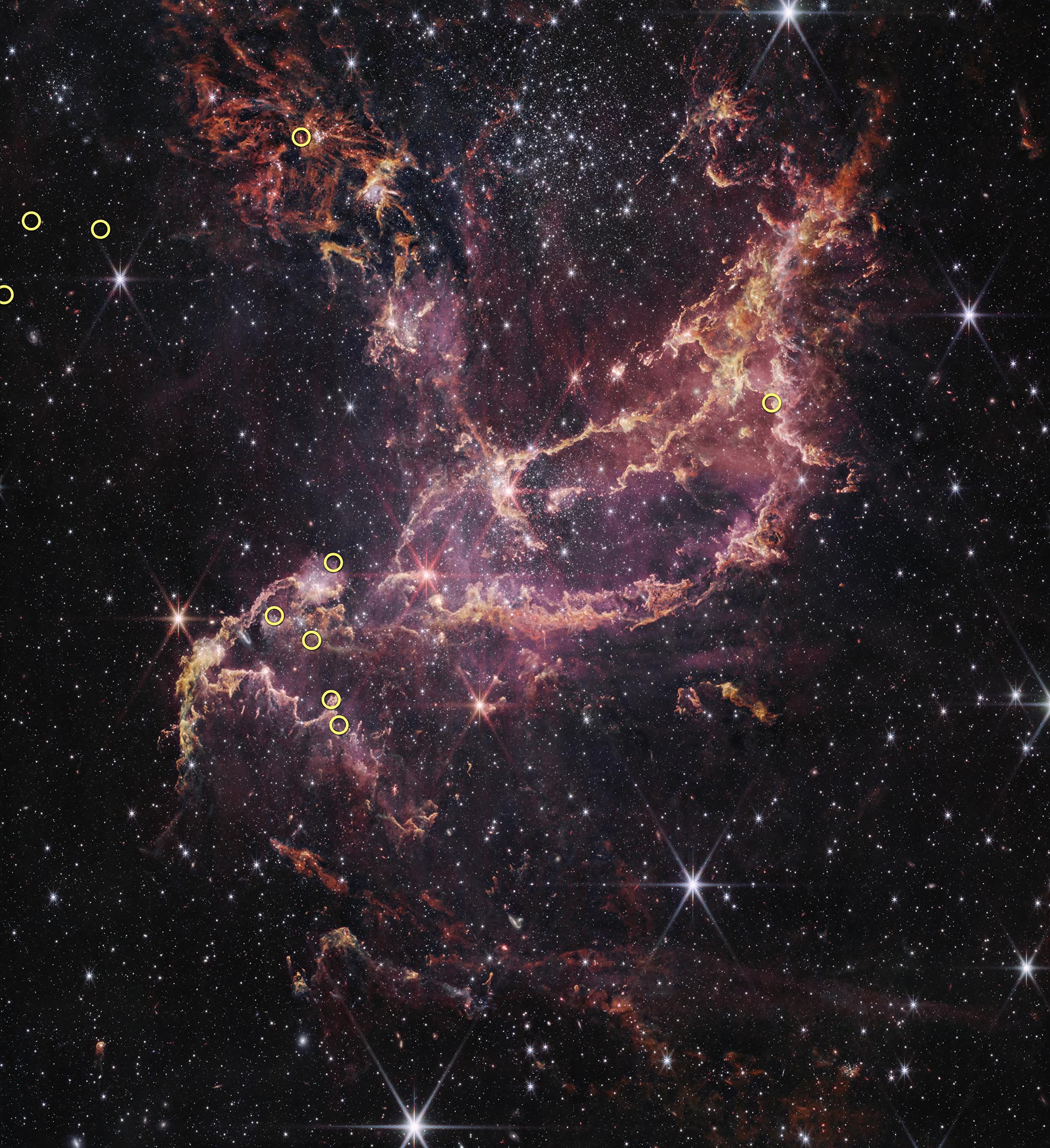
To test this idea, scientists trained Webb on the Small Magellanic Cloud, a dwarf galaxy that is one of the Milky Way’s nearest neighbors. In particular, they examined the massive, star-forming cluster NGC 346, which also has a relative lack of heavier elements. The cluster served as a nearby proxy for studying stellar environments with similar conditions in the early, distant universe.
Hubble observations of NGC 346 from the mid 2000s revealed many stars about 20 to 30 million years old that seemed to still have planet-forming disks around them. This went against the conventional belief that such disks would dissipate after 2 or 3 million years.
“The Hubble findings were controversial, going against not only empirical evidence in our galaxy but also against the current models,” said De Marchi. “This was intriguing, but without a way to obtain spectra of those stars, we could not really establish whether we were witnessing genuine accretion and the presence of disks, or just some artificial effects.”

On the right is the comparison of the top and bottom lines. This comparison shows a large peak in the cold molecular hydrogen coming from the star but not its nebular environment. Also, atomic hydrogen shows a larger peak from the star. This indicates the presence of a protoplanetary disk immediately surrounding the star. The data was taken with the microshutter array on the James Webb Space Telescope’s NIRSpec (Near-Infrared Spectrometer) instrument. Credit: NASA, ESA, CSA, Joseph Olmsted (STScI)
Webb’s Spectral Analysis Reveals New Insights
Now, thanks to Webb’s sensitivity and resolution, scientists have the first-ever spectra of forming, Sun-like stars and their immediate environments in a nearby galaxy.
“We see that these stars are indeed surrounded by disks and are still in the process of gobbling material, even at the relatively old age of 20 or 30 million years,” said De Marchi. “This also implies that planets have more time to form and grow around these stars than in nearby star-forming regions in our own galaxy.”

The north and east compass arrows show the orientation of the image on the sky. Note that the relationship between north and east on the sky (as seen from below) is flipped relative to direction arrows on a map of the ground (as seen from above).
At the lower right is a scale bar labeled 50 light-years, 15 parsecs. The length of the scale bar is approximately one-fifth the total width of the image. Below the image is a color key showing which NIRCam filters were used to create the image and which visible-light color is assigned to each filter. From left to right, NIRCam filters are: F200W is blue; F277W is green; F335M is orange; and F444W is red. Credit: NASA, ESA, CSA, STScI, Olivia C. Jones (UK ATC), Guido De Marchi (ESTEC), Margaret Meixner (USRA)
A New Way of Thinking
This finding refutes previous theoretical predictions that when there are very few heavier elements in the gas around the disk, the star would very quickly blow away the disk. So the disk’s life would be very short, even less than a million years. But if a disk doesn’t stay around the star long enough for the dust grains to stick together and pebbles to form and become the core of a planet, how can planets form?
The researchers explained that there could be two distinct mechanisms, or even a combination, for planet-forming disks to persist in environments scarce in heavier elements.
First, to be able to blow away the disk, the star applies radiation pressure. For this pressure to be effective, elements heavier than hydrogen and helium would have to reside in the gas. But the massive star cluster NGC 346 only has about ten percent of the heavier elements that are present in the chemical composition of our Sun. Perhaps it simply takes longer for a star in this cluster to disperse its disk.
The second possibility is that, for a Sun-like star to form when there are few heavier elements, it would have to start from a larger cloud of gas. A bigger gas cloud will produce a bigger disk. So there is more mass in the disk and therefore it would take longer to blow the disk away, even if the radiation pressure were working in the same way.
“With more matter around the stars, the accretion lasts for a longer time,” said Sabbi. “The disks take ten times longer to disappear. This has implications for how you form a planet, and the type of system architecture that you can have in these different environments. This is so exciting.”
The science team’s paper was published in the December 16 issue of The Astrophysical Journal.
Reference: “Protoplanetary Disks around Sun-like Stars Appear to Live Longer When the Metallicity is Low*” by Guido De Marchi, Giovanna Giardino, Katia Biazzo, Nino Panagia, Elena Sabbi, Tracy L. Beck, Massimo Robberto, Peter Zeidler, Olivia C. Jones, Margaret Meixner, Katja Fahrion, Nolan Habel, Conor Nally, Alec S. Hirschauer, David R. Soderblom, Omnarayani Nayak, Laura Lenkić, Ciaran Rogers, Bernhard Brandl and Charles D. Keyes, 16 December 2024, The Astrophysical Journal.
DOI: 10.3847/1538-4357/ad7a63
The James Webb Space Telescope is the world’s leading space science observatory, designed to explore the universe’s deepest mysteries. Equipped with advanced instruments, Webb studies our solar system, distant exoplanets, and the origins of galaxies, stars, and cosmic structures. Its groundbreaking discoveries are reshaping our understanding of the universe and our place in it. Webb is a collaborative project led by NASA, with key contributions from the European Space Agency (ESA) and the Canadian Space Agency (CSA).
The Hubble Space Telescope has been exploring the universe for over three decades, making groundbreaking discoveries that continue to shape our understanding of space. As a collaborative project between NASA and the European Space Agency (ESA), Hubble has captured stunning images and provided critical data on galaxies, stars, and distant planets. NASA’s Goddard Space Flight Center manages the telescope and its mission operations, with support from Lockheed Martin Space. Hubble’s science operations are conducted by the Space Telescope Science Institute in Baltimore, operated by the Association of Universities for Research in Astronomy.
Never miss a breakthrough: Join the SciTechDaily newsletter.
Follow us on Google and Google News.
3 Comments
I love reading about science n astronomy !!! I’ve been following outerspace articles since I was a child!
Researchers *always* are “rethinking”/I.e. LEARNING – about everything. This idea of everything being earth shaking gets used by anti-science folks to “SEE they *don’t* everything! Ha!” — not thinking deeply enough on the subject, that people get into ****Research**** not because they just want to memorize facts. But to discover new things, and refine old ideas. The idea that every new piece of the puzzle is “SUPERCHARGED AMAZING WORLD-CHANGING EXPLOSIVE UNKNOWN FINDING – and that means . . *see science is dumb, they always change their mind!*. This is not the way hellp
– Then again, I’m realizing I’ve seen “science” about everything homeopathy to psychics on here! So . . . ah . . . got it. But please, please, try to make people realize that science = reality. If something cannot be replicated, it’s either false – or irrelevant.
P0l