
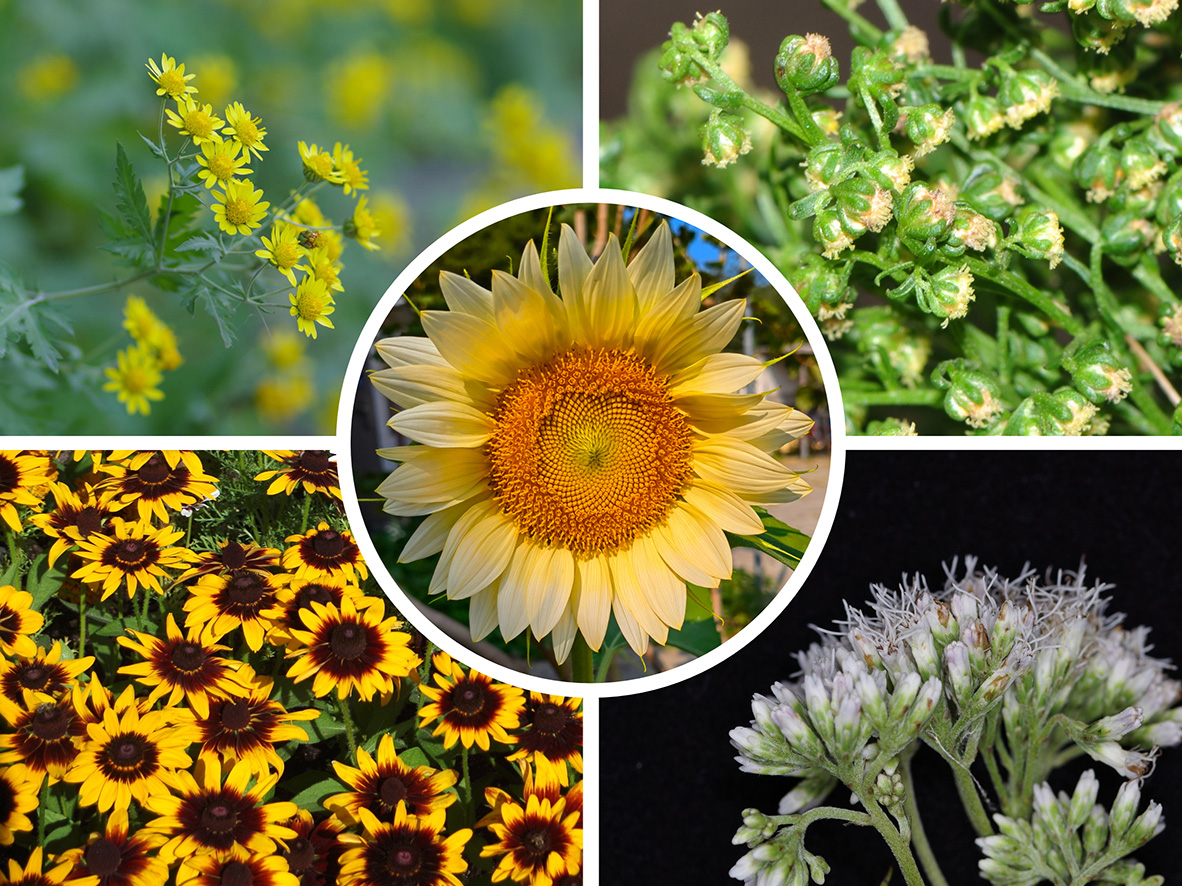
The sunflower family tree revealed that flower symmetry evolved multiple times independently, a process called convergent evolution, among the members of this large plant family, according to a new analysis. The research team, led by a Penn State biologist, resolved more of the finer branches of the family tree, providing insight into how the sunflower family — which includes asters, daisies, and food crops like lettuce and artichoke — evolved.
A paper describing the analysis and findings, which researchers said may help identify useful traits to selectively breed plants with more desirable characteristics, appeared online in the journal Plant Communication.
“Convergent evolution describes the independent evolution of what appears to be the same trait in different species, like wings in birds and bats,” said Hong Ma, Huck Chair in Plant Reproductive Development and Evolution, professor of biology in the Eberly College of Science at Penn State and the leader of the research team. “This can make it difficult to determine how closely related two species are by comparing their traits, so having a detailed family tree based on DNA sequence is crucial to understanding how and when these traits evolved.”
Advances in Sunflower Family Genealogy
The sunflower head, for example, is actually a composite composed of multiple much smaller flowers. While the head is generally radially symmetric — it can be divided into two equal halves in multiple directions like a starfish or a pie — the individual flowers can have different forms of symmetry. According to the new study, bilateral symmetry — where there is only one line that divides the flower into two equal halves — has evolved and been lost multiple times independently in sunflowers over evolutionary history. The researchers found that this convergent evolution is likely related to changes in the number of copies and the expression patterns of the floral regulatory gene, CYC2.
In recent years, many family trees for a group of related species have been built by extensively using transcriptomes, which are the genetic sequences of essentially all of the genes expressed by a species, the researchers explained. Transcriptomes are easier to acquire than high-quality whole-genome sequences for a species but are still difficult and costly to prepare and require fresh plant samples. To increase the number of species available for comparison the team turned to low-coverage genome sequences, which are produced through a process called genome skimming and are relatively inexpensive and easy to prepare, even from dried plant samples.
“To get an accurate whole-genome sequence for a species, each letter of its DNA alphabet must be read — or covered — multiple times to minimize errors,” Ma said. “For the purposes of building a family tree, we show in this paper that we can get away with lower coverage genome sequences. This allowed us to increase the number of species in our analysis, which, in turn, allowed us to resolve more of the finer branches on the sunflower family tree.”
The team used a combination of publicly available and newly generated transcriptomes, along with a large number of newly obtained skimmed genomes, for a total of 706 species with representatives from 16 subfamilies, 41 tribes, and 144 subtribe-level groups in the sunflower family. The subfamilies are major subdivisions of the family, while the tribes and subtribe can contain one or more of genera, which is the classification level just above the species.
“Previous versions of the sunflower family tree had established the relationships among most of the subfamilies and many tribes, which are equivalent to the main branches of a tree,” Ma said. “With our increased sample size, we were able to resolve more of the smaller branches and twigs at the subtribe and genus level. This higher-resolution tree allowed us to reconstruct where and when traits like flower symmetry evolved, demonstrating that bilateral symmetry must have evolved many times independently.”
Molecular Insights and Future Directions
The team also studied the molecular evolution of genes involved in flower development among sunflowers. They found that one of these genes, CYC2, which is found in multiple copies in the genomes of each species, was activated in species with bilaterally symmetric flowers, suggesting that it might be part of the molecular basis for the convergent evolution of this trait. To further test this, the team performed experiments to quantify CYC2 gene expression in the flowers of species with different types of symmetry.
“Our analysis showed a clear relationship between CYC2 expression and flower symmetry, suggesting that changes in how these genes are used in various sunflower species is likely involved in the convergent evolution observed in the family,” Ma said. “The sunflower family is one of the two largest families of flowering plants containing over 28,000 species, including many economically important agricultural and horticultural species. Understanding how these species are related to one another allows us to determine how and when their traits evolved. This knowledge could also be used to identify useful traits that could be bred into domesticated species from closely related wild ones.”
Reference: “Nuclear phylogenomics of Asteraceae with increased sampling provides new insights into convergent morphological and molecular evolution” by Guojin Zhang, Junbo Yang, Caifei Zhang, Bohan Jiao, Jose L. Panero, Jie Cai, Zhi-Rong Zhang, Lian-Ming Gao, Tiangang Gao and Hong Ma, 25 February 2024, Plant Communications.
DOI: 10.1016/j.xplc.2024.100851
In addition to Ma, the research team includes Guojin Zhang at Penn State; Junbo Yang, Jie Cai, Zhi-Rong Zhang, and Lian-Ming Gao at the Kunming Institute of Botany in Kunming, China; Caifei Zhang at the Wuhan Botanical Garden and Sino-Africa Joint Research Centre in Wuhan, China; Bohan Jiao and Tiangang Gao at the State Key Laboratory of Plant Diversity and Specialty Crops in Beijing, China; and Jose L. Panero at the University of Texas, Austin.
Funding from the Eberly College of Science and the Huck Institutes of the Life Sciences at Penn State, the Strategic Priority Research Program of the Chinese Academy of Sciences, the Large-scale Scientific Facilities of the Chinese Academy of Sciences, and the National Natural Science Foundation of China supported this research.
Never miss a breakthrough: Join the SciTechDaily newsletter.
Follow us on Google and Google News.