
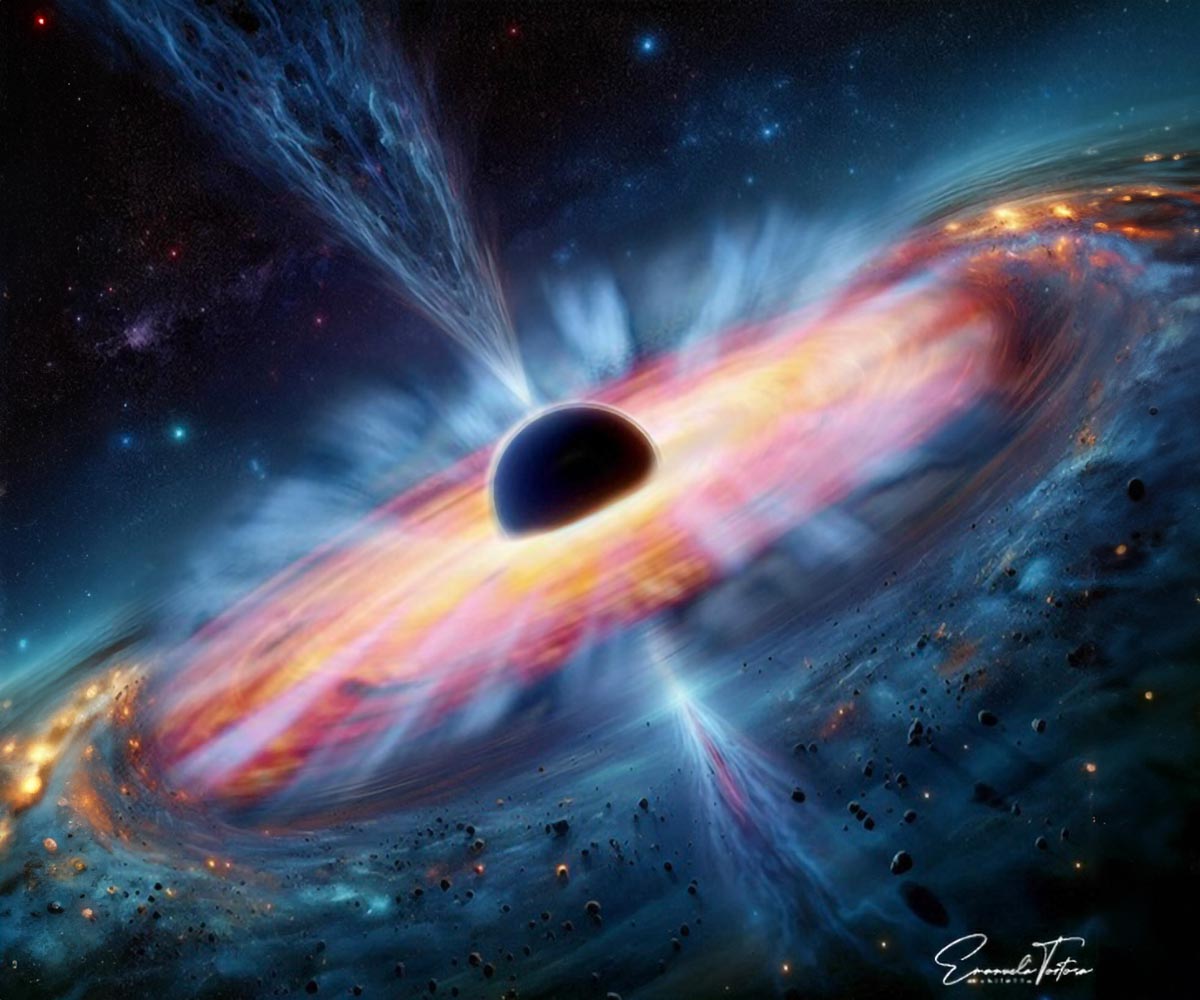
Researchers using XMM-Newton and Chandra telescopes have linked X-ray emissions from 21 distant quasars to rapid supermassive black hole growth in the early Universe, challenging conventional physics with findings of super-Eddington accretion rates.
A recent study published in Astronomy & Astrophysics sheds light on how supermassive black holes, with masses billions of times that of our Sun, managed to form so quickly—within less than a billion years after the Big Bang.
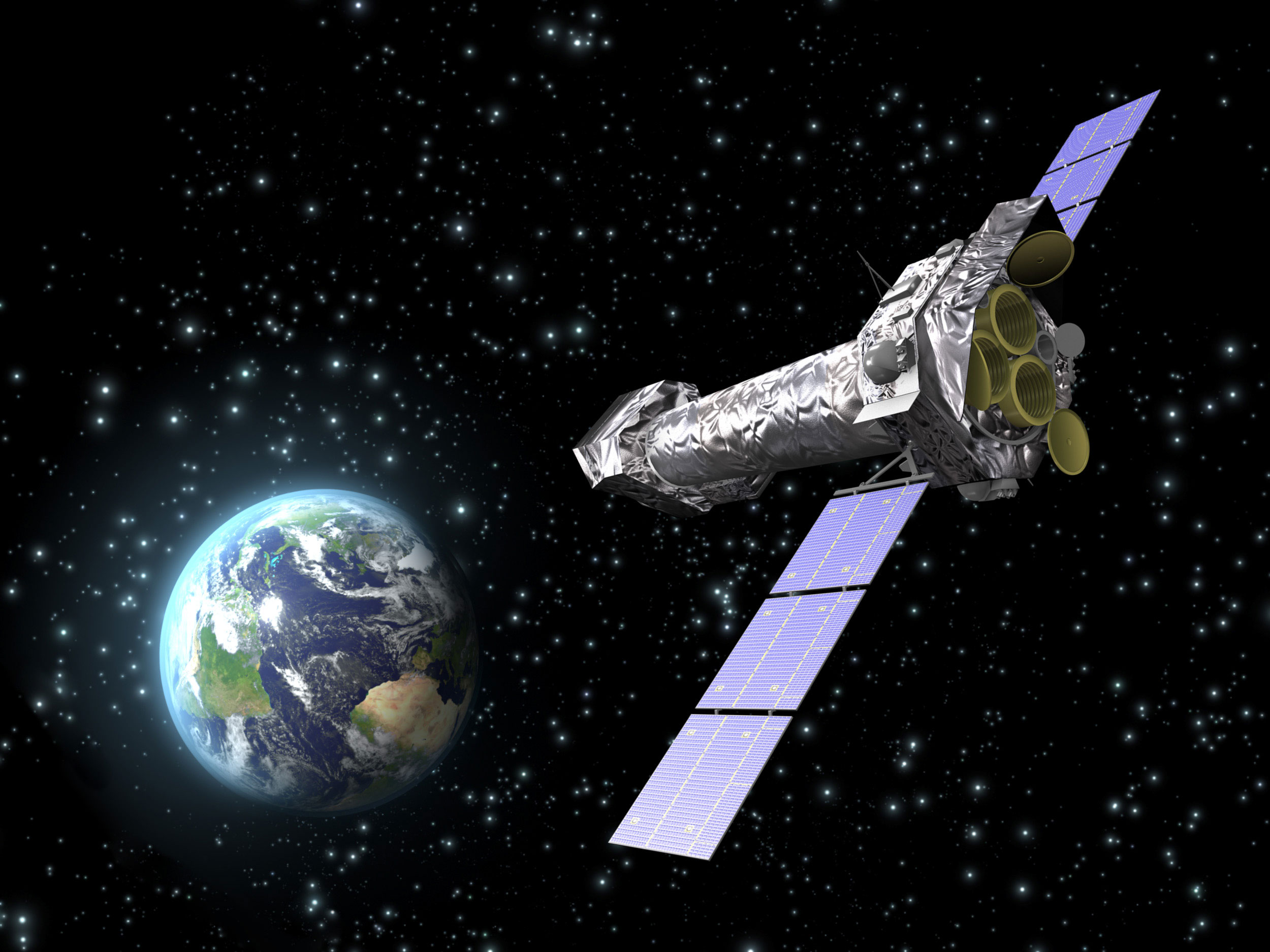
Conducted by researchers from the National Institute for Astrophysics (INAF), the study analyzed 21 of the most distant quasars ever discovered. These quasars were observed in X-ray wavelengths using the XMM-Newton and Chandra space telescopes
The findings suggest that the supermassive black holes at the centers of these quasars, formed during the Universe’s “cosmic dawn,” likely grew through extremely rapid and intense accretion, offering a compelling explanation for their enormous masses in the early Universe.
Quasars are highly luminous active galaxies, powered by supermassive black holes at their centers—also known as active galactic nuclei. These black holes emit vast amounts of energy as they pull in matter, making quasars some of the brightest and most distant objects in the Universe. The quasars studied in this research date back to a period when the Universe was less than a billion years old, placing them among the earliest cosmic structures ever observed.
X-ray Insights and Black Hole Accretion
In this work, the analysis of X-ray emissions from these objects revealed an entirely unexpected behavior of the supermassive black holes at their centers: a connection emerged between the shape of the X-ray emission and the speed of the winds of matter ejected by the quasars. This relationship links the wind speed, which can reach thousands of kilometers per second, to the temperature of the gas in the corona, the region that emits X-rays closest to the black hole. Thus, the corona turned out to be connected to the powerful accretion mechanisms of the black hole itself.
Quasars with low-energy X-ray emission, and thus a lower temperature in the corona, show faster winds. This indicates a highly rapid growth phase that exceeds a physical limit for the accretion of matter called the Eddington limit, which is why this phase is called “super-Eddington.” Conversely, quasars with higher-energy X-ray emissions tend to exhibit slower winds.
“Our work suggests that the supermassive black holes at the center of the first quasars formed within the first billion years of the Universe’s life may have actually increased their mass very rapidly, challenging the limits of physics,” says Alessia Tortosa, lead author of the study and researcher at INAF in Rome. “The discovery of this connection between X-ray emission and winds is crucial for understanding how such large black holes could have formed in such a short time, thus providing a concrete clue to solve one of the greatest mysteries of modern astrophysics.”
HYPERION Project and Observational Campaigns
The result was achieved mainly by analyzing data collected with the XMM-Newton space telescope of the European Space Agency (ESA), which allowed for approximately 700 hours of observations of the quasars. Most of the data, collected between 2021 and 2023 as part of the Multi-Year XMM-Newton Heritage Programme, under the direction of Luca Zappacosta, a researcher at INAF in Rome, is part of the HYPERION project, which aims at studying hyperluminous quasars during the cosmic dawn of the Universe. The extensive observation campaign was led by a team of Italian scientists and received crucial support from INAF, which funded the program, thereby supporting cutting-edge research on the evolutionary dynamics of the early structures of the Universe.
“In the HYPERION program, we focused on two key factors: on the one hand, the careful selection of quasars to observe, choosing the titans, meaning those that had accumulated as much mass as possible, and on the other hand, the in-depth study of their properties in X-rays, something never attempted before on such a large number of objects from the cosmic dawn,” says Luca Zappacosta, a researcher at INAF in Rome. We hit the jackpot! The results we’re getting are genuinely unexpected, and they all point to a super-Eddington growth mechanism of the black holes.”

Future Implications for X-ray Astronomy
This study provides important insights for future X-ray missions, such as ATHENA (ESA), AXIS, and Lynx (NASA), which are scheduled for launch between 2030 and 2040. In fact, the results obtained will be useful for refining the next-generation observational instruments and for defining better strategies for investigating black holes and active galactic nuclei in X-rays at more distant cosmic epochs. These are key elements for understanding the formation of the first galactic structures in the primordial Universe.
Reference: “HYPERION. Shedding light on the first luminous quasars: A correlation between UV disc winds and X-ray continuum” by A. Tortosa, L. Zappacosta, E. Piconcelli, M. Bischetti, C. Done, G. Miniutti, I. Saccheo, G. Vietri, A. Bongiorno, M. Brusa, S. Carniani, I. V. Chilingarian, F. Civano, S. Cristiani, V. D’Odorico, M. Elvis, X. Fan, C. Feruglio, F. Fiore, S. Gallerani, E. Giallongo, R. Gilli, A. Grazian, M. Guainazzi, F. Haardt, A. Luminari, R. Maiolino, N. Menci, F. Nicastro, P. O. Petrucci, S. Puccetti, F. Salvestrini, R. Schneider, V. Testa, F. Tombesi, R. Tripodi, R. Valiante, L. Vallini, E. Vanzella, A. Vasylenko, C. Vignali, F. Vito, M. Volonteri and F. La Franca, 20 November 2024, Astronomy & Astrophysics.
DOI: 10.1051/0004-6361/202449662
Never miss a breakthrough: Join the SciTechDaily newsletter.
Follow us on Google and Google News.
1 Comment
While I concur with the overall result, the paper is hedging since it hasn’t rejected the possibility of hybrid scenarions (high mass seeds, sub-Eddington growth).
The problem with Eddington growth is that it assumes spherical symmetry of a gas cloud, which these objects are not. The first self consistent model of supermassive black holes found that they naturally could sustain super-Eddington growth.
“We see the formation of a well-defined, steady-state accretion disk which is stable against star formation at sub-pc scales. The disks are optically thick, with radiative cooling balancing accretion, but with properties that are distinct from those assumed in most previous accretion disk models. The pressure is strongly dominated by (primarily toroidal) magnetic fields, with a plasma
even in the disk midplane. They are qualitatively distinct from magnetically elevated or arrested disks. The disks are strongly turbulent, with trans-Alfvenic and highly super-sonic turbulence, and balance this via a cooling time that is short compared to the disk dynamical time, and can sustain highly super-Eddington accretion rates.”
[High-Energy Astrophysical Phenomena Vol. 7, 2024March 14, 2024, “FORGE’d in FIRE II: The Formation of Magnetically-Dominated Quasar Accretion Disks from Cosmological Initial Conditions”, Philip F. Hopkins et al.]