
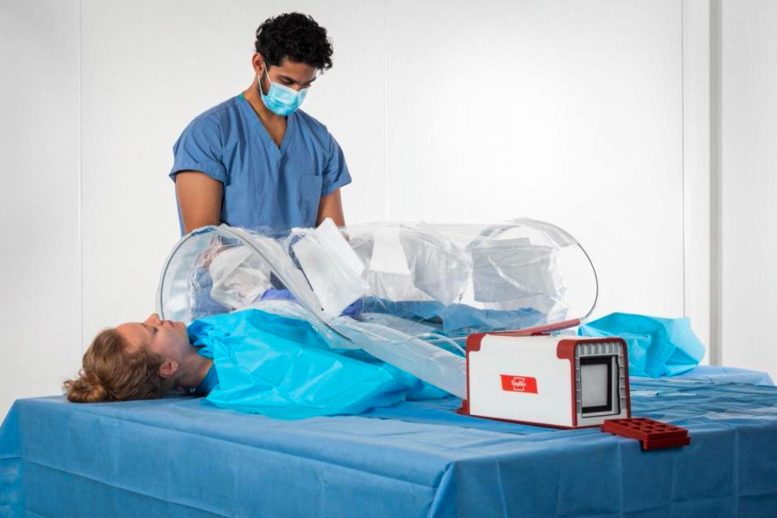
The MIT D-Lab-supported startup SurgiBox has developed a portable kit that doctors can use to create sterile operating environments where they’re needed most.
SurgiBox, a startup collaborating with MIT’s D-Lab, has developed a portable surgery system to provide safe surgical access in areas without sterile operating rooms, a concept that was demonstrated successfully during a humanitarian mission to Ukraine.
In March, two vans filled with doctors and medical supplies crossed the Polish border into Ukraine and made their way to Kyiv as part of a humanitarian mission. Both vans were packed with traditional medical supplies the country is in desperate need of, such as tourniquets, bandages, and suture kits. But one van also carried about 50 units of an entirely new system that makes it possible to perform surgery safely in places without sterile operating rooms.
The systems were designed by SurgiBox, a startup that has worked extensively with MIT D-Lab for more than a decade, and they hold promise for applications far outside of warzones. Most of the world’s population lacks ready access to operating rooms, and in situations like severe weather and other natural disasters, healthcare operations can be disrupted just when they’re needed most.
The SurgiBox system includes a bubble with armholes facing inward, a module that filters and controls airflow, and a battery. The entire thing fits inside of a backpack and can be set up in minutes.
“We’re trying to get safe surgery to patients that need it,” says SurgiBox founder Debbie Teodorescu, who is also an affiliated researcher at MIT D-Lab. “In this day and age, outside of a very small chunk of the world, it’s very difficult to get surgery safely. You can have the same doctors, the same outstanding skills, but if you’re lacking in the facilities and the equipment, you just can’t offer the same care.”
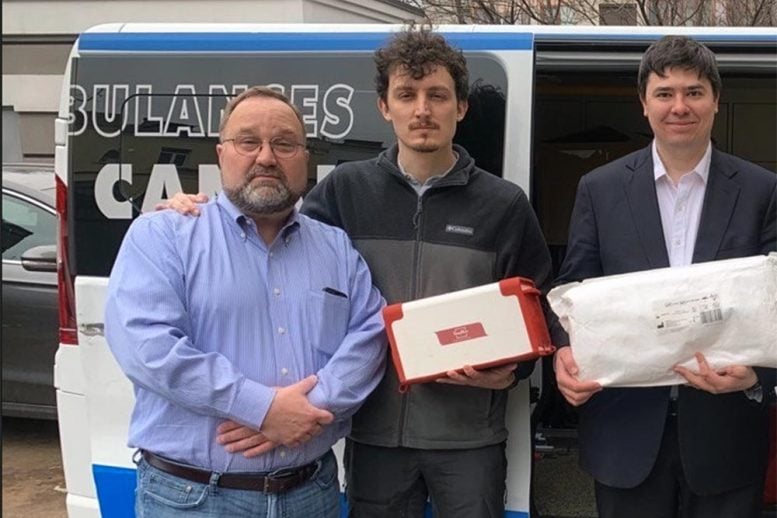
For the Ukraine donation, SurgiBox’s team flew to Poland, waited in a long queue at the Ukrainian border, and then drove for several hours into Kyiv, where they withstood air raid alarms at all hours while training doctors on how to use the system.
The trip was arduous and gave SurgiBox’s team a newfound appreciation for Ukrainians’ daily hardships. In many ways, it was also the culmination of a far longer journey that started with an idea Teodorescu had back in 2009.
Finding Your People
Teodorescu was a student at Harvard University when she first got involved with D-Lab as part of a research project around 2009.
“It was such a friendly and welcoming environment, and at the end of the project they said, ‘If you’re ever working on something or want to bounce ideas around, we’re your people,’” she recalls.
Soon after that experience, she got the idea for SurgiBox while lamenting how difficult it was to conduct surgery safely in so much of the world.
“I thought, ‘We’re able to protect our experiments wherever we need using glove boxes, so why can’t we do the same thing for patients?’” Teodorescu remembers. “That’s how SurgiBox came about — a surgical glovebox. Now, it’s not really a box, and we don’t include gloves, but the same concept holds: You can provide patient protection at the point of need.”
To pursue that vision, Teodorescu immediately returned to D-Lab, where she began working with people including Dan Frey, the faculty research director at the time; Workshop Manager Jack Whipple, and Technical Instructor Dennis Nagle, who passed away in 2020. D-Lab students also tackled early design and business problems for SurgiBox as part of their master’s and undergraduate theses and as team projects in the classes 2.722J (D-Lab: Design) and 2.729 (Design for Scale). Another former D-Lab student, Macauley Kenney SM ’16, is currently SurgiBox’s chief operating officer in addition to serving as a lecturer at MIT.
“D-Lab is really an amazing place,” says SurgiBox CEO and co-founder Mike Teodorescu, who met Debbie as a student at Harvard and also worked at D-Lab as a visiting scholar for two years. “I’ve been at four universities as a student and professor, and I have to say D-Lab is really unique. It’s really welcoming, and if you’re working on something to help make lives better for people and if you’re tackling a major humanitarian problem, they welcome you.”
The design SurgiBox’s team eventually settled on is compact and lightweight while also mimicking the environment of an operating room.
“Surgeons don’t want to change their workflow,” Debbie Teodorescu says. “It’s already a huge cognitive burden to do surgery. They don’t want to deal with things that increase that cognitive burden. We’re preserving their workflow by saying, ‘You’re going to treat the patient the way you’d treat them for surgery anyway. You’re going to more or less flip a switch to turn the system on, and then you stick your arms through just like you’re wearing a gown, and begin the surgery.’”
Expanding Access to Safe Surgery
Last month’s Ukraine donation was one of several that SurgiBox has made to the country. After the first, the Ukraine Operation Command South sent back a letter thanking the company for saving 31 lives and asking for more. SurgiBox’s team realized that because of damage to health care infrastructure around the country, Ukraine’s civilian doctors were also using the system for situations like childbirth and to treat issues like gallbladder infections and appendicitis.
For the latest donation, Mike Teodorescu traveled to Kyiv with Michael Samotowka, a surgeon with the charitable organization MedGlobal and with HCA Florida Healthcare, and Emanuele Lagazzi, a clinical research fellow at Massachusetts General Hospital, both of whom had previously traveled to Ukraine on aid missions.
“I want to especially thank [Samotowka and Lagazzi] for their ongoing humanitarian work, as well as credit nonprofit organizations like MedGlobal, which provide critically needed assistance to disaster and war-affected regions,” Mike Teodorescu says.
SurgiBox is now ramping up production of its systems ahead of its second medical device certification from the European Union and an official product launch across the 28-country bloc this summer. SurgiBox’s first full production batch will go to Doctors Without Borders.
In the long run, SurgiBox’s team believes the system could be used to conduct surgery at patient bedsides if patients are elderly or especially vulnerable to infection. They also note that in some countries, doctors drive around in ambulances, and SurgiBox could be used to perform mobile surgeries.
More broadly, they also see the system as an inexpensive alternative to operating rooms for many procedures.
“We think SurgiBox could be used to lower health care costs and also give doctors and patients more flexibility,” Mike Teodorescu says. “There’s a whole set of costs associated with cleaning the operating room, getting it ready for patients, and getting the patient prepped for the operating room. Having some of that at a patient’s bedside would be hugely beneficial.”
Never miss a breakthrough: Join the SciTechDaily newsletter.
Follow us on Google and Google News.