
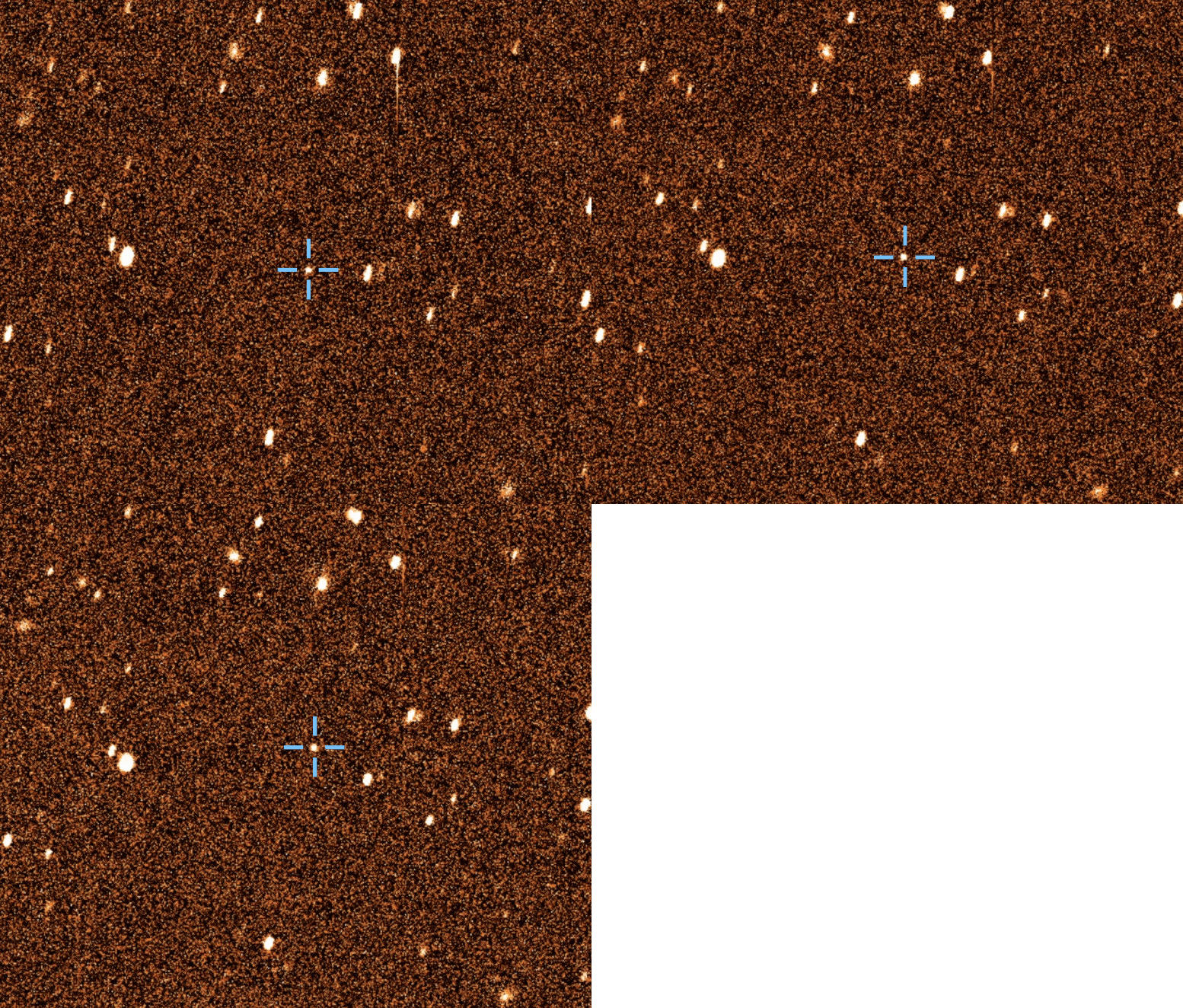
A reasonably small 4-8 m (~13-26 foot) asteroid recently flew by Earth, passing close to satellites orbiting in the geostationary ring at a distance of about 42,735 km (~26,554 miles) from Earth’s center and only about 1200 km (~750 miles) from the nearest satellite.
After the initial discovery, observers around the world rapidly set their eyes on the ‘new’ space rock, determining it would safely pass our planet in one of the closest flybys ever recorded.
While the asteroid, now named 2020 HS7, came close to the geostationary ring, it passed ‘under’ the nearest satellite and posed no major risk as their orbits did not intersect.
UFO spotted in Hawaii
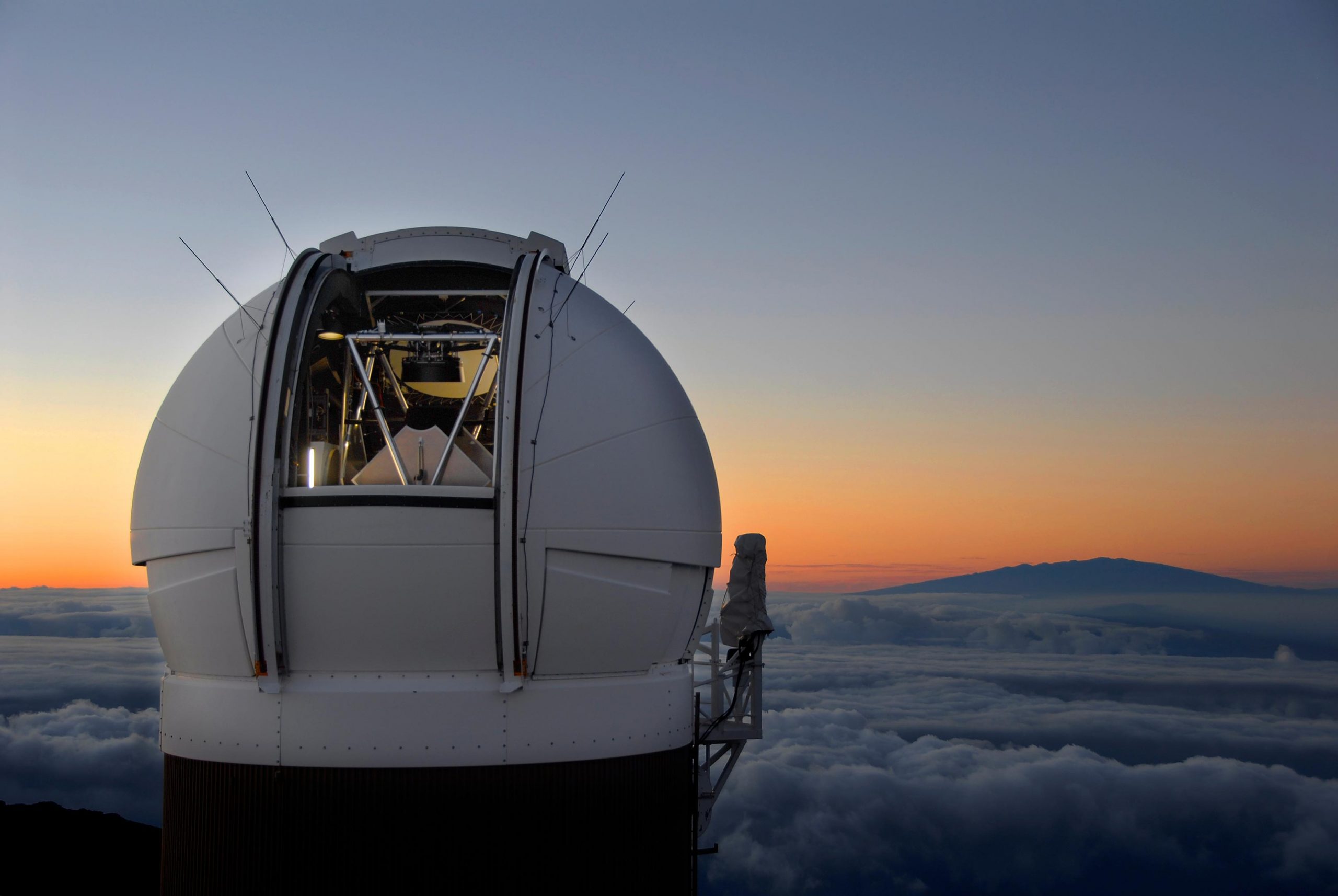
On the evening of April 27 (European time), NASA’s Panoramic Survey Telescope and Rapid Response System (Pan-STARRS) in Hawaii reported observations of a new asteroid, temporarily labeled P20ZIf8.
The night before, one of the Pan-STARRS survey telescopes had spotted an unidentified object flying through space. Less than an hour of observations showed that this object was already extremely close to Earth, with a roughly 10% probability of collision the following day.
Rapid global response deems asteroid small and safe
Observers around the world quickly joined the effort to find out more about this unknown asteroid. Only 50 minutes after the initial Pan-STARRS report was released, the Xingming Observatory in China obtained the first follow-up ‘astrometry’ — data on its position, motion, and brightness.
Soon after, the Tautenburg observatory in Germany – a frequent collaborator with ESA’s Near-Earth Object Coordination Centre, part of the Planetary Defence Office – monitored the space rock, after the Agency alerted them to it and asked for immediate observations.
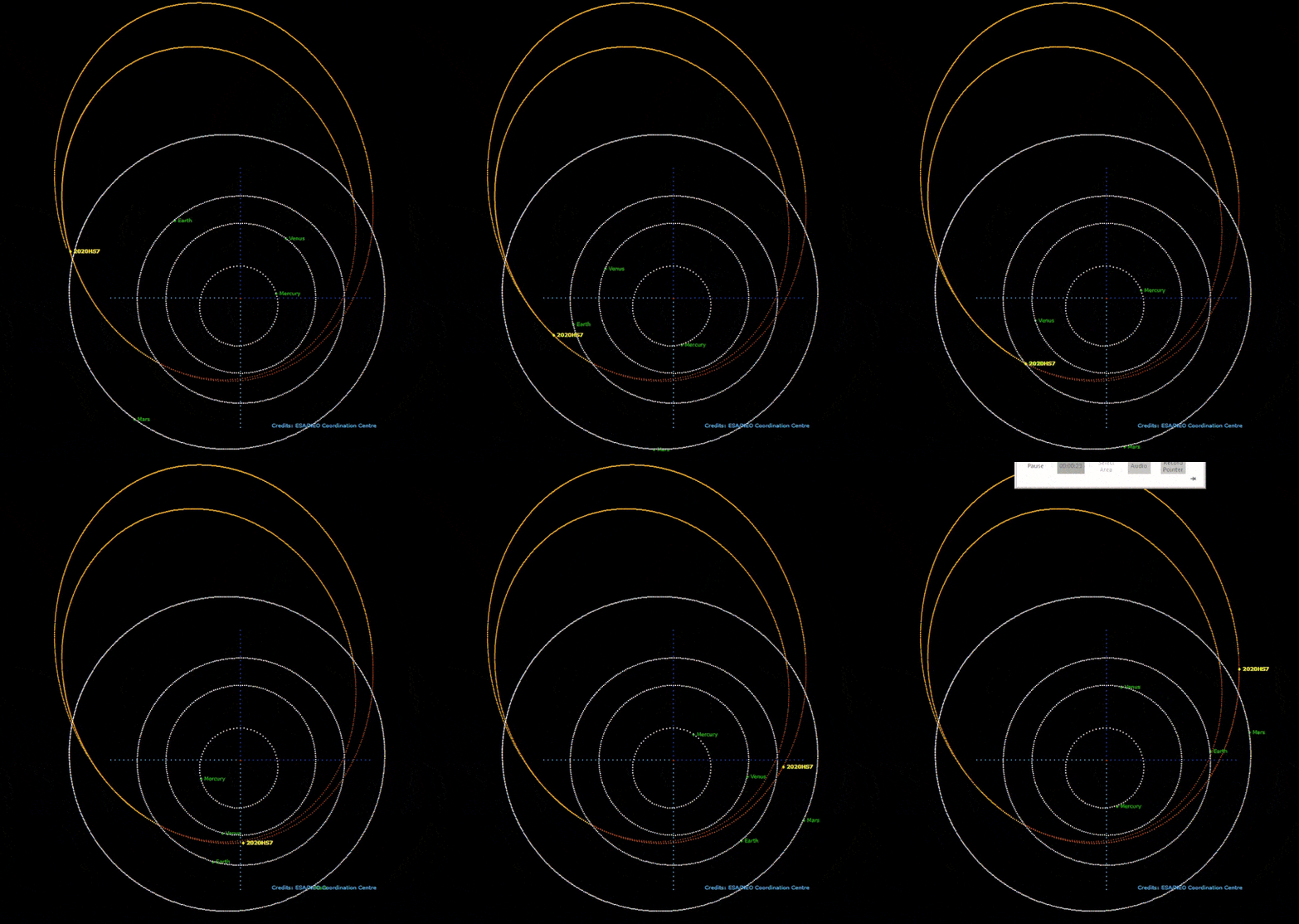
With this data, it became clear that the object was not going to collide with the Earth, but it was heading towards a very close fly-by the following day, roughly at the distance of Earth’s geostationary ring.
At just a few meters in size, ‘P20ZIf8’ would not have caused any significant threat if it had been on a collision course, as it would likely have burned up in Earth’s atmosphere.
Despite posing no threat to Earth, the detection, follow-up and characterization of this new asteroid was an interesting exercise, testing the discovery and rapid follow-up capabilities of observers worldwide.
One of the closest asteroids to fly by
Subsequent observations obtained by additional ESA collaborators and many other observatories worldwide determined that the flyby of the asteroid, now named 2020 HS7, ranks among the 50 closest ever recorded.
We now know with a precision of just a few kilometers and a few seconds, that the flyby occurred on April 28 at about 18:49:40 UTC (20:49:40 CEST), at a distance of about 42,745 km (~26,554 miles) from Earth’s center.
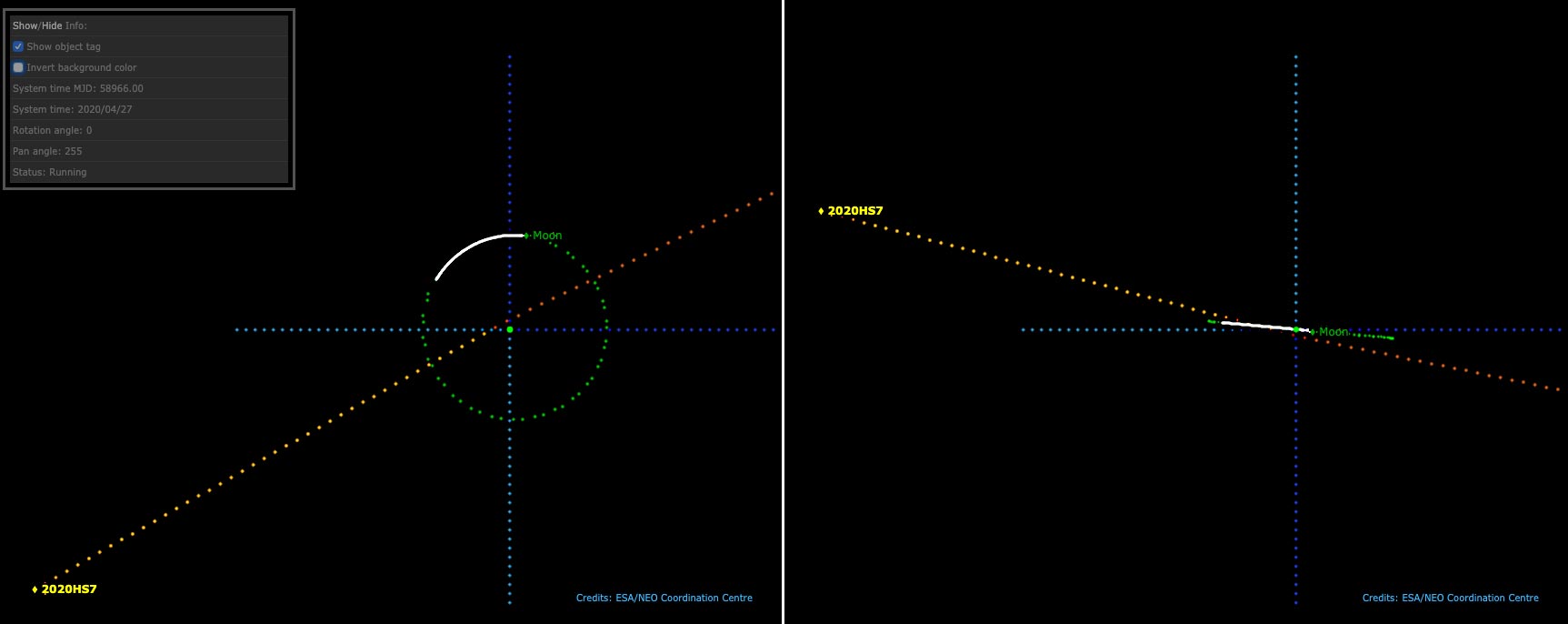
That these numbers are so precise, shows that the trajectory of a nearby object can be established with exquisite accuracy even with just a day’s worth of data, if good observational coverage can be obtained.
Interestingly, the fly-by happened only 15 hours before the closest approach of (52768) 1998 OR2, a much larger kilometer-sized object that attracted the attention of the worldwide media. However, this latter object approached our planet at a distance 16 times farther than the Moon (more than 6 million kilometers away), while 2020 HS7 came significantly closer to us, representing a more significant event for the astronomical community.
Never miss a breakthrough: Join the SciTechDaily newsletter.
Follow us on Google and Google News.
32 Comments
I’m one of those dolts that can’t do the kilometer to miles conversion in his head. I wish these writers would put the miles in parentheses or something.
I updated the article to include Imperial units in parentheses.
Normally we inlcude them on SciTechDaily.com for convenience of our readers, but this time I decided not to bother as we sometimes get complaints about using non-metric units on a scientific site. It seems like it is best to include them.
For a very rough estimate, usually good enough for articles such as this, miles is half of kilometers. Obviously(?) then, kilometers is twice the miles.
1 km = 0.6 miles
I agree that
Why isn’t more of the population concerned about our only home in this shooting gallery. We just won’t always be so lucky. I say Thanks to those keeping watch. To the Goverments of earth fund these scientists
I believe there’s a real good chance that there is lots of things planning to hit 🌎 I know right now it’s already arrived.Right now we are in World War Three. And Evil People Soul Suckers WILL NOT BEAT GOD FOR IT WAS WRITTEN LOVE IS THE ANSWER NOT Hate not Evil. God is Love pure Love if its not of Love its not of God. And only Love 💘 can change our World.. Why are PEOPLE killing instead of SAVING. True 💘 LOVE is the only right answer..
You’re correct there is a lot of evil in this world trying to remove my duelling elected President. The Democrats are filled with so much hate. That they lie to their minions to believe a fake story. President Trump will go down as the greatest President ever.
I’m just curious, but how come we can see the moon and the planets so clearly in NASA’s pictures but not this asteroid that was so close? Hell, we even have Hubble’s Deep Field.
Maybe it’s where Hubble and other teles hopes that good cant see it.
The main reason is that the moon is about 1 million times the size of this asteroid, so it appears much more detailed given the same magnification. For example, in an HD image of the moon, this asteroid would be just a single pixel.
Do not allow China or any other feudal language nation to meddle with outer space.
The thing is there are a lot more of these guys floating around up there than we give credit for.
We need to figure out a way to “push them aside” while they still are up there…
Why doesnt an asteroid of such a tiny mass get trapped by earth’s gravitational field?
It is moving too fast. To be pulled into Earth by gravity it would have to be traveling much slower or come much closer.
Its approach speed to Earth is above orbital speed and its relative departure speed is the same. It’s on a so-called escape trajectory. That is not to say Earth’s gravity won’t affect its motion. Look at the animation in the article above. See that Earth is pulling it into a higher orbit around the Sun. We use such gravity-assist to navigate our spacecraft around the solar system.
In other news, a toy ship on Lake Michigan almost hit a car parked in front of my home in Hartford, CT, passing within 1,200 km of it.
Warnings no chance happenings
Warnings not chance encounter more are coming look at blockholes are suddenly changing in strength and functionality
According to India standard time on 04-05-2020 @10:15pm approx I saw a big blue spot with the fire at its back,it was moving very fast & visible for 3 seconds only at approx 120Southeast, So what was that!?
Thanks for the article. And we should be really thankful to the scientific community and others watching these events for us. But apart from ‘knowing’ where and how an asteroid is coming, are we really prepared to divert/face if such objects hit the earth, given the speed at which they strike and the extremely short period of response? Just a lay man’s doubt. Thanks.
If the asteroid had an gravitational energy of its own, then could it have deflected the orbits of our geostationary satellites?
It’s nowhere near massive enough to do that.
Wow! That was too close for comfort. Glad you are working for us in this pandemic, to watch what we can’t see coming. The development of more to help us is so important.
This is not grazing the geo satellites orbits unless you think that by walking down the street in Los Angeles you nearly bump into someone walking in New York City. Even then, this would be about 1,000 miles more distant.
What would happen if a larger asteroid hits the earth hard?
I read this article and felt that the information and grammatical context of it had been very well written and thought out by the authors, and my scientific curiosities were piqued. After digesting this very well presented information I then decided to continue on to read the comments section.
all I’ve got to say is what in the elementary School dropout hell are some of you people trying to say? There are run-on sentences that make absolutely 0 sins even if they were properly punctuated, it’s kind of scary to think that amazing information about unprecedented events like this can be read over by people of such miniscule cognitive function, and, rather than boost awareness of the hard work of these men and women of letter, and encourage the development of the readers intelligence, only a droning and stupifying cacophony of imbecilic chatter ensure.
Spell check and grammar check your work (everywhere in your lives) please, or just go back and finish 2nd grade? They might give you that gold star sticker if you hurry and call them today.
and even with Google thinking I wanted it to be Auto corrected/destructed, my post still had a discernible message. Please just look over what you write, Google and siri mess up a bit, but only a just a bit.
You are a elitist.
I believe that this spectacle of arrogance and ego, stand firmly in the WAY of adult learning!
You are a insecure little person who must belittle others to feel superior.
There is no space we live in a dome it’s what keeps the air in the van Allan belt is electro magnetic and nothing can get through it in 2016 nasa which in Hebrew means deception put a video out telling us the Gemini space craft which took 30 years to complete was ready to go to mars But they are not able to get past the van Allan belt yet when they can they will be able to go to mars what I can not understand is did they not have to go through it 3 times to get to the moon and 3times to get back the moon is a luminary and is only 70 miles wide
In my book and asteroid is not a UFO we associate UFOs with alien spaceships.
Where in this article is the speed pf the unidentified flying object cited?
Just for the sake of argument…I haven’t met any scientist who lives in the center of the earth (even were it possible) so telling me an object is going to whiz by the earth at 40,000 miles from the center is really telling me it is going to pass by within 15,000 miles of the earth’s surface (on average). I would tend to be a bit more excited and concerned over that distance (which actually means something to me on a personal level) than the distance from the center of the earth. Interestingly, it would probably get the attention of more politicians and “science” comittees since it would be much closser to them. Just thought I would share that with you, Mr. Oneil. Thanks for a well written article in any event!