
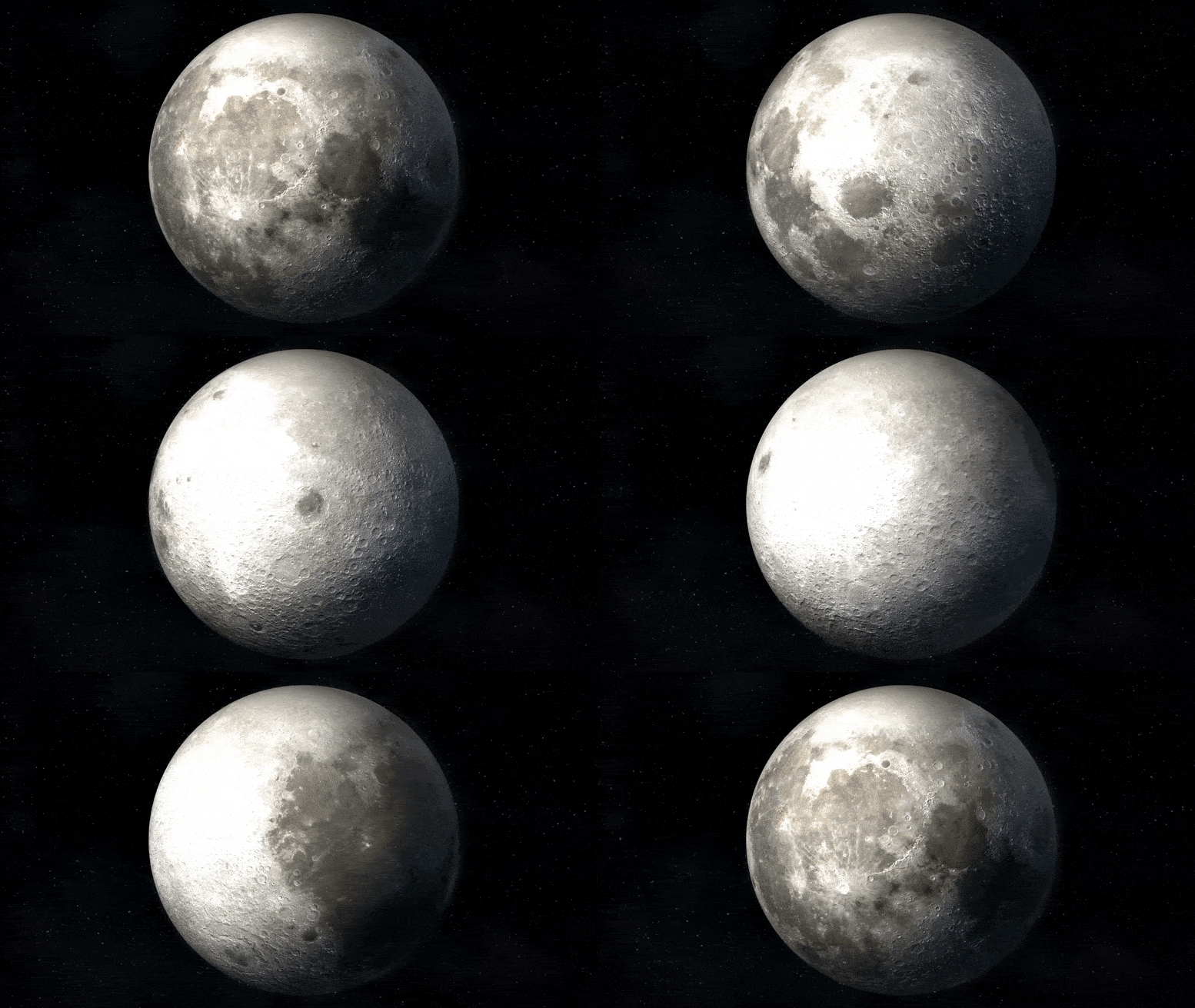
The New Study Analyzed Soil Samples Brought Back From the Chang’E-5 Mission
According to a study that examined soil samples returned as part of the Chang’E – 5 (CE-5) mission in 2020, the active volcanic activity helped create the moon’s surface mineralogy as recently as 2 billion years ago, leaving an iron-rich and high-calcium surface of basalts that is geographically younger than the lunar geology community previously thought.
A group of scientists from the National Astronomical Observatories of the Chinese Academy of Sciences (NAOC) under the direction of Professor Li Chunlai recently published their results in Nature Communications. In order to determine the mineral composition of lunar soil samples returned by CE-5, the study used both spectroscopic and x-ray diffraction (XRD) analysis techniques.
“Near-side lunar soil samples we analyzed turned out to be primarily pyroxene,” said Prof. LI. “This came as a surprise to us because earlier remote sensing-based studies indicated a high abundance of olivine – another common volcanic mineral composite in the basalt category.”

Revised Timeline of Lunar Mare Formation
Studies based on the Apollo and Luna missions suggested that active volcanism shaped the lunar mare between 4.3 billion and 3.1 billion years ago, with the majority of that activity occurring between 3.6 billion and 3.8 billion years ago. The lunar mare is the term for the dark basaltic plains formed by volcanic activity triggered by ancient large asteroid impacts on the far side of the moon. These earlier investigations relied on information gathered by moon orbiters like NASA’s Moon Minerology Mapper and Earth-based telescopes.
“Though we can infer a lot about the mineral composition of the moon remotely, having actual lunar soil samples here on Earth in our lab for analyses opened up the possibility of a much more thorough and precise compositional analysis,” Li said.
Li and his team first analyzed their three soil samples using spectroscopic techniques. “The overall spectral shape of the samples was essentially consistent,” Li said. They went on to deploy XRD, which demonstrated the samples were composed of the minerals augite, pigeonite, plagioclase, forsterite, fayalite, ilmenite, quartz, apatite, and glassy materials. The XRD result showed that the samples were composed of mostly pyroxene, not olivine, as earlier studies indicated.
“Preliminary works have identified that the CE-5 returned soil sample is basically comprised of a type of lunar basalt that has never been sampled before,” Li and his team wrote in their Oct. 10 paper. “In comparison with the mare samples collected from previous missions, the bulk composition of pyroxene in CE-5 samples is relatively iron and calcium-rich based on electron microprobe analysis.”
To analyze the samples, the researchers measure the wavelengths of light absorbed and reflected when exposed to precisely calibrated x-ray and visible light emissions. What each sample reflects is mapped according to wavelength on an X-axis and intensity on a Y-axis, generating a spectrographic fingerprint.
Lunar Mineralogy and Exploration
“There was such a striking similarity among the three samples,” Li said, “and that suggests to us that the iron-rich pyroxene we observed is similar across other near-side mare. This greatly enhances our understanding of the mineralogy of the near side of our moon.”
Li and his team’s study follows other recent developments that have intrigued lunar scientists as well as the astronomy community as a whole, including news earlier this year also generated by CE-5 returned samples signaling that there may be water on the moon in the form of subterranean trapped ice.
“These are exciting new developments for lunar geologists,” Li said. “Additional samples brought back as part of future missions will continue to further our understanding of the moon’s surface and have potentially big implications for space exploration, as the scientific community finds ways to utilize the moon’s mineralogy, and possibly water.”
Reference: “Spectral interpretation of late-stage mare basalt mineralogy unveiled by Chang’E-5 samples” by Dawei Liu, Xing Wang, Jianjun Liu, Bin Liu, Xin Ren, Yuan Chen, Zhaopeng Chen, Hongbo Zhang, Guangliang Zhang, Qin Zhou, Zhoubin Zhang, Qiang Fu, and Chunlai Li, 10 October 2022, Nature Communications.
DOI: 10.1038/s41467-022-33670-6
Never miss a breakthrough: Join the SciTechDaily newsletter.
Follow us on Google and Google News.