
Close Menu
    Facebook X (Twitter) Instagram
    SciTechDaily
    • Biology
    • Chemistry
    • Earth
    • Health
    • Physics
    • Science
    • Space
    • Technology
    Facebook X (Twitter) Pinterest YouTube RSS
    SciTechDaily
    Home»Biology»Surprising Scientists: Eurasian Jays Exhibit Human-Like Memory Traits
    Biology

    Surprising Scientists: Eurasian Jays Exhibit Human-Like Memory Traits

    By PLOSMay 25, 2024No Comments4 Mins Read
    Facebook Twitter Pinterest Telegram LinkedIn WhatsApp Email Reddit
    Share
    Facebook Twitter LinkedIn Pinterest Telegram Email Reddit
    Neuroscience Brain Boost Energy Signals Concept
    New research shows that Eurasian jays have a memory similar to human episodic memory, enabling them to recall incidental details about past events, which may help them in locating food.

    A study has found that jays can remember incidental details, which is similar to episodic memory in humans.

    According to a study recently published in the open-access journal PLOS ONE, Eurasian jays have the ability to recall incidental details of past events, a trait indicative of episodic memory in humans. This research was conducted by James Davies and his team at the University of Cambridge, UK.

    When remembering events, humans have the ability to “mental time travel,” consciously reimagining past experiences and potentially recalling details that seemed unimportant at the time. Some researchers have suggested that this “episodic memory” is unique to humans. In this study, Davies and colleagues ran a memory experiment to test for episodic-like memory in seven Eurasian jays, birds that excel at remembering the location of stored food.

    Jaylo the Jay Experiment
    Jaylo the jay watching as food is put in the cup with the blue string in the encoding phase. Credit: James Davies, CC-BY 4.0

    In the experiment, the birds watched food get placed beneath one cup in a line of four identical cups and were then rewarded for correctly selecting the baited cup. Over several trials, the birds were trained to identify the correct cup by remembering its position in line. Then, at test, the jays were given an unexpected memory assessment: they watched food get placed beneath one of the cups, which now all had unique visual characteristics, but they were then separated from the cups for 10 minutes while the cups were relocated and rearranged. Despite the changed positions of the cups and the added time delay, the birds still correctly identified the baited cup according to their visual characteristics 70% of the time.
    Eurasian Jay Bird
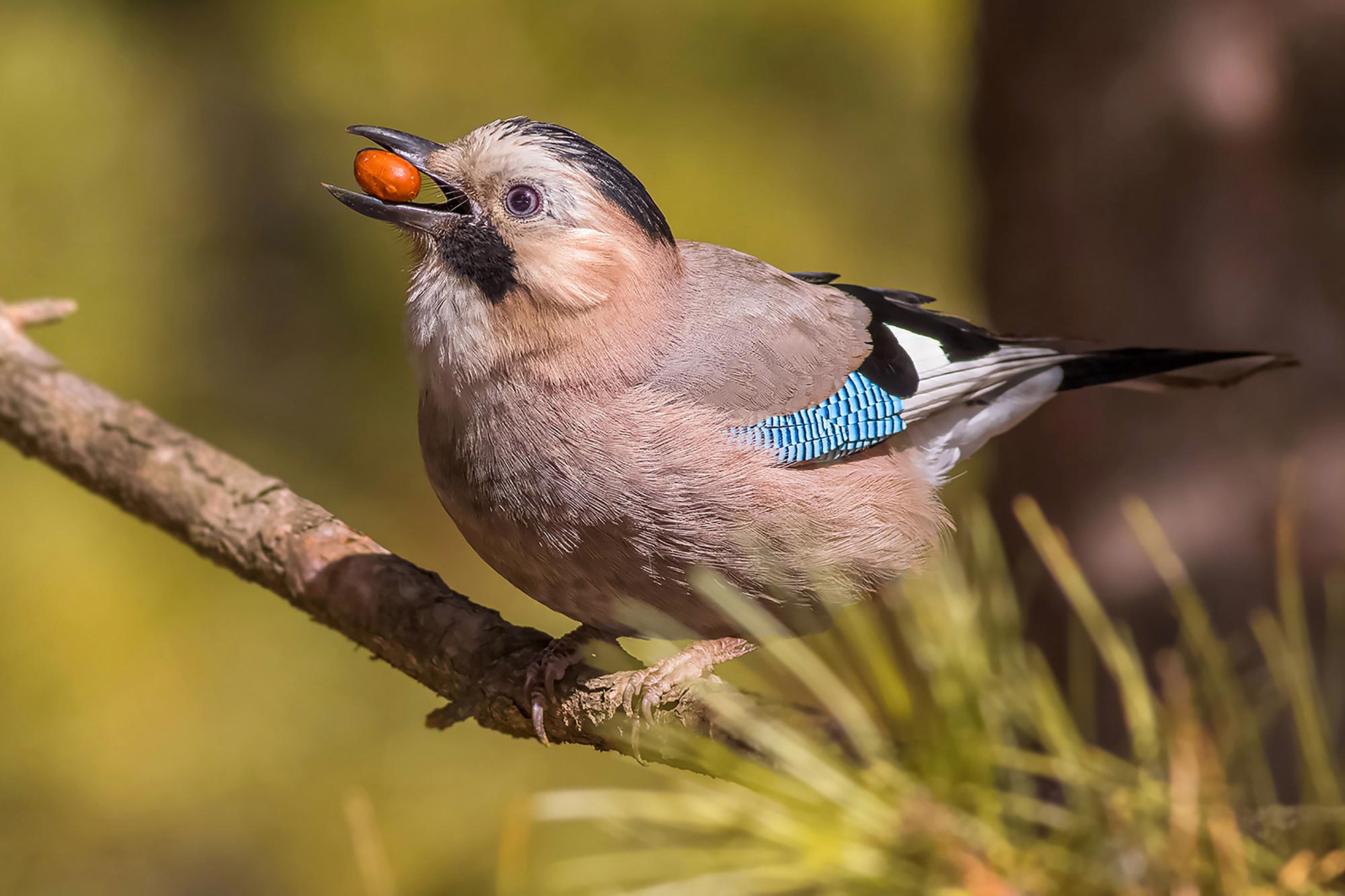
    Eurasian jays are colorful, intelligent birds found across Europe, North Africa, and Asia. They have striking pinkish-brown feathers with blue wing patches and are known for their loud calls. These clever birds love acorns, which they often bury to eat later, helping forests grow by spreading seeds. You can spot them in woodlands and parks, where their bright plumage and lively behavior stand out.

    Eurasian Jays

    Eurasian jays (Garrulus glandarius) are medium-sized, colorful members of the crow family (Corvidae) native to Europe, North Africa, and parts of Asia. Recognizable by their striking plumage, they feature a mix of pinkish-brown feathers, a black mustache stripe, blue and white wing patches, and a white rump. These birds are known for their intelligence and complex behaviors, including their ability to plan for the future and use tools.

    Eurasian jays primarily feed on a varied diet of acorns, nuts, seeds, insects, and occasionally small vertebrates. They are notable for their habit of caching food, particularly acorns, which they bury to eat later and play a significant role in forest ecology by aiding in the dispersal of oak trees. These jays are often found in woodlands, parks, and gardens, where they are known for their loud and distinctive calls.

    Implications of the Study

    These results suggest that even though visual differences between the cups were unimportant during training, the birds were able to notice those differences at test and recall them later, similar to episodic memory in humans. This study indicates that episodic-like memory might aid jays in finding food stores, and the researchers suggest that future studies might investigate whether the birds can perform similar feats of memory in other non-food-related scenarios.

    The authors add: “As the jays were able to remember details that held no specific value or relevance at the time that the memory was created, this suggests that they are able to record, recall, and access incidental information within a remembered event. This is an ability that characterizes the type of human memory through which we mentally ‘relive’ past events (or episodes), known as ‘episodic’ memory.”

    Reference: “Eurasian jays (Garrulus glandarius) show episodic-like memory through the incidental encoding of information” by James R. Davies, Elias Garcia-Pelegrin and Nicola S. Clayton, 15 May 2024, PLOS ONE.
    DOI: 10.1371/journal.pone.0301298

    Never miss a breakthrough: Join the SciTechDaily newsletter.
    Follow us on Google and Google News.

    Birds Brain Memory PLOS
    Share. Facebook Twitter Pinterest LinkedIn Email Reddit

    Related Articles

    Magnetic Brain Stimulation Can Improve Memory

    Four Genes May Increase Memory Loss and Risk of Alzheimer’s

    Reactivation of the Hippocampus Causes Memory Recall

    Hearing Loss Rapidly Changes Brain Motor Areas That Control Song

    “Area X” of Zebra Finch May Provide Insights to Human Speech Disorders

    Diets Lacking in Omega-3 Fatty Acids May Cause Your Brain to Age Faster

    Stimulating the Entorhinal Cortex of the Brain Boosts Memory

    Synchronized Brain Oscillations Crucial for Short-Term Memory

    Mother’s Nurturing Results in Larger Hippocampus in Children

    Leave A Reply Cancel Reply

    • Facebook
    • Twitter
    • Pinterest
    • YouTube

    Don't Miss a Discovery

    Subscribe for the Latest in Science & Tech!

    Trending News

    One of the Universe’s Largest Stars May Be Getting Ready To Explode

    Scientists Discover Enzyme That Could Supercharge Ozempic-Like Weight Loss Drugs

    Popular Sweetener Linked to DNA Damage – “It’s Something You Should Not Be Eating”

    Ancient “Rock” Microbes May Reveal How Complex Life Began

    Researchers Capture Quantum Interference in One of Nature’s Rarest Atoms

    “A Plague Is Upon Us”: The Mass Death That Changed an Ancient City Forever

    Scientists Discover Game-Changing New Way To Treat High Cholesterol

    This Small Change to Your Exercise Routine Could Be the Secret to Living Longer

    Follow SciTechDaily
    • Facebook
    • Twitter
    • YouTube
    • Pinterest
    • Newsletter
    • RSS
    SciTech News
    • Biology News
    • Chemistry News
    • Earth News
    • Health News
    • Physics News
    • Science News
    • Space News
    • Technology News
    Recent Posts
    • 20-Year Study Finds Daily Multivitamins Don’t Extend Lifespan
    • Landmark Study Links Never Marrying to Significantly Higher Cancer Risk
    • Revolutionary Imaging Technique Unlocks Secrets of Matter at Extreme Speeds
    • Where Does Mass Come From? Scientists Find Evidence of a New Exotic Nuclear State
    • Quantum Breakthrough: Unhackable Keys Sent Over 120 km Using Quantum Dots
    Copyright © 1998 - 2026 SciTechDaily. All Rights Reserved.
    • Science News
    • About
    • Contact
    • Editorial Board
    • Privacy Policy
    • Terms of Use

    Type above and press Enter to search. Press Esc to cancel.