
Close Menu
    Facebook X (Twitter) Instagram
    SciTechDaily
    • Biology
    • Chemistry
    • Earth
    • Health
    • Physics
    • Science
    • Space
    • Technology
    Facebook X (Twitter) Pinterest YouTube RSS
    SciTechDaily
    Home»Biology»Targeting NPCs: A New Approach to Combating Blood Cancers
    Biology

    Targeting NPCs: A New Approach to Combating Blood Cancers

    By Sanford Burnham PrebysAugust 20, 2024No Comments3 Mins Read
    Facebook Twitter Pinterest Telegram LinkedIn WhatsApp Email Reddit
    Share
    Facebook Twitter LinkedIn Pinterest Telegram Email Reddit
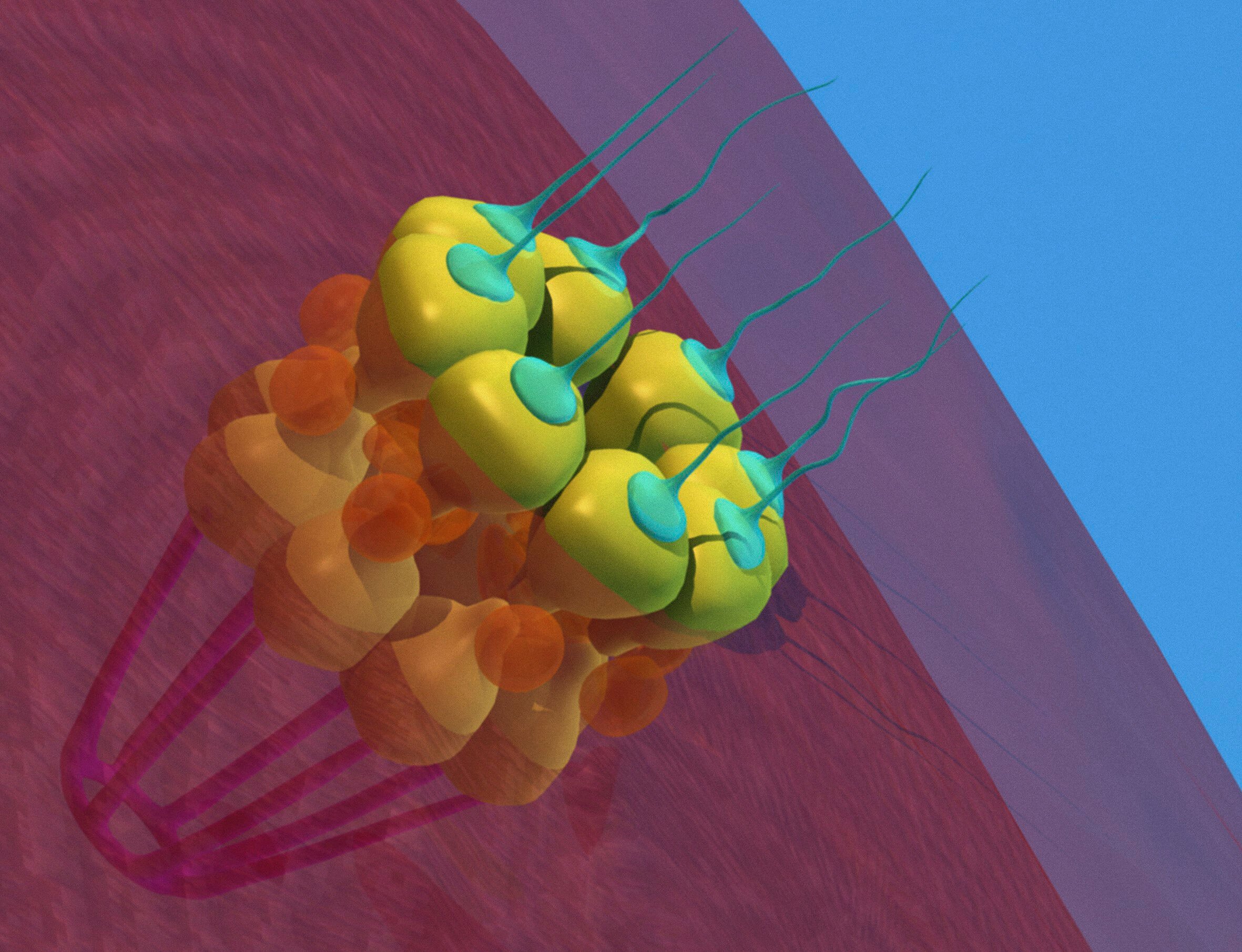
    Nuclear Pore in a Eukaryotic Cell
    A computer graphic depicts a nuclear pore in a eukaryotic cell. Nuclear pores are large protein complexes that span the nuclear membrane and allow the movement of molecules, such as proteins, RNAs, and other molecules between the nucleus and the cell’s cytoplasm. Credit: M. Towler and J. Aitken, Wellcome Collection

    Nuclear pore complexes regulate critical cell functions and vary in cancer cells. A recent study identified Nup358, a key NPC protein, as essential for myeloid cell development, linking its dysfunction to blood cancers.

    Nuclear pore complexes (NPCs) are protein-based channels that control the movement of molecules in and out of the nucleus. They play a crucial role in regulating essential cellular functions, including gene expression, chromatin organization, and RNA processes that affect cell survival, growth, and differentiation.

    In recent years, new studies, including work by Maximiliano D’Angelo, Ph.D., associate professor in the Cancer Metabolism and Microenvironment Program at Sanford Burnham Prebys, have noted that NPCs in cancer cells are different, but how these alterations contribute to malignancy and tumor development—or even how NPCs function in normal cells—is poorly understood.

    The Role of Nup358 in Myeloid Cell Development

    In a new paper, published in Science Advances, D’Angelo with first author Valeria Guglielmi, Ph.D., and co-author Davina Lam, uncover Nup358, one of roughly 30 proteins that form the NPCs, as an early player in the development of myeloid cells, blood cells that if not formed or working properly leads to myeloid disorders such as leukemias.

    Maximiliano D'Angelo
    Maximiliano D’Angelo, Ph.D., is an associate professor in the Cancer Metabolism and Microenvironment Program at Sanford Burnham Prebys. Credit: Sanford Burnham Prebys

    The researchers found that when they eliminated Nup358 in a mouse model, the animals experienced a severe loss of mature myeloid cells, a group of critical immune cells responsible for fighting pathogens that are also responsible for several human diseases including cancer. Notably, Nup358 deficient mice showed an abnormal accumulation of early progenitors of myeloid cells referred to as myeloid-primed multipotent progenitors (MPPs).

    Insights into Blood Cell Differentiation

    “MPPs are one of the earliest precursors of blood cells,” said D’Angelo. “They are produced in the bone marrow from hematopoietic stem cells, and they differentiate to generate the different types of blood cells.

    “There are different populations of MPPs that are responsible for producing specific blood cells and we found that in the absence of Nup358, the MPPs that generate myeloid cells, which include red blood cells and key components of the immune system, get stuck in the differentiation process.”

    Fundamentally, said Gugliemi, Nup358 has a critical function in the early stages of myelopoiesis (the production of myeloid cells). “This is a very important finding because it provides insights into how blood cells develop, and can help to establish how alterations in Nup358 contribute to blood malignancies.”

    The findings fit into D’Angelo’s ongoing research to elucidate the critical responsibilities of NPCs in healthy cells and how alterations to them contribute to immune dysfunction and the development and progression of cancer.

    “Our long-term goal is to develop novel therapies targeting transport machinery like NPCs,” said D’Angelo, who recently received a two-year, $300,000 Discovery Grant from the American Cancer Society to advance his work.

    Reference: “Nucleoporin Nup358 drives the differentiation of myeloid-biased multipotent progenitors by modulating HDAC3 nuclear translocation” by Valeria Guglielmi, Davina Lam and Maximiliano A. D’Angelo, 5 June 2024, Science Advances.
    DOI: 10.1126/sciadv.adn8963

    This research was supported in part by a Research Scholar Grant from the American Cancer Society (RSG-17-148-01), the Department of Defense (grant W81XWH-20-1-0212), and the National Institutes of Health (AI148668).

    Never miss a breakthrough: Join the SciTechDaily newsletter.
    Follow us on Google and Google News.

    Cancer Cell Biology Protein Sanford Burnham Prebys
    Share. Facebook Twitter Pinterest LinkedIn Email Reddit

    Related Articles

    Hidden “Trade Winds” Inside Cells Could Explain Cancer Spread

    Scientists Shrink Pancreatic Cancer Tumors by Starving Their Cellular “Neighbors”

    Scientists Kill Cancer Cells by “Shutting the Door” to the Nucleus – May Lead to New Type of Cancer Treatment

    Researchers Identify BAD as Key Seizure-Suppressing Protein

    Cdt1 Protein Has a Role in DNA Replication and Mitosis

    Examining the Mechanism Behind Melanoma Drug Resistance

    Tyrosine Phosphatase SHP2 and Breast Cancer

    Zelboraf Nearly Doubles Median Survival Time for Patients with Metastatic Melanoma

    Researchers Discover Proteins Responsible for Cancer Cell Movement

    Leave A Reply Cancel Reply

    • Facebook
    • Twitter
    • Pinterest
    • YouTube

    Don't Miss a Discovery

    Subscribe for the Latest in Science & Tech!

    Trending News

    New Pill Lowers Stubborn Blood Pressure and Protects the Kidneys

    Humans May Have Hidden Regenerative Powers, New Study Suggests

    Scientists Just Solved the Mystery of Why Crabs Walk Sideways

    Doctors Are Surprised by What This Vaccine Is Doing to the Heart

    This Popular Supplement May Boost Your Brain, Not Just Your Muscles

    Scientists Say This Simple Supplement May Actually Reverse Heart Disease

    Warming Oceans Could Trigger a Dangerous Methane Surge

    This Simple Movement Could Be Secretly Cleaning Your Brain

    Follow SciTechDaily
    • Facebook
    • Twitter
    • YouTube
    • Pinterest
    • Newsletter
    • RSS
    SciTech News
    • Biology News
    • Chemistry News
    • Earth News
    • Health News
    • Physics News
    • Science News
    • Space News
    • Technology News
    Recent Posts
    • Study Reveals Dangerous Flaw in AI Symptom Checkers
    • New MRI Breakthrough Captures Stunningly Clear Images of the Eye and Brain
    • Scientists Warn Sitting Too Much Can Harm Your Body in Surprising Ways
    • Your Blood Pressure Reading Could Be Wrong Because of One Simple Mistake
    • Scientists Discover Cheap Material That Kills Deadly Superbugs
    Copyright © 1998 - 2026 SciTechDaily. All Rights Reserved.
    • Science News
    • About
    • Contact
    • Editorial Board
    • Privacy Policy
    • Terms of Use

    Type above and press Enter to search. Press Esc to cancel.