
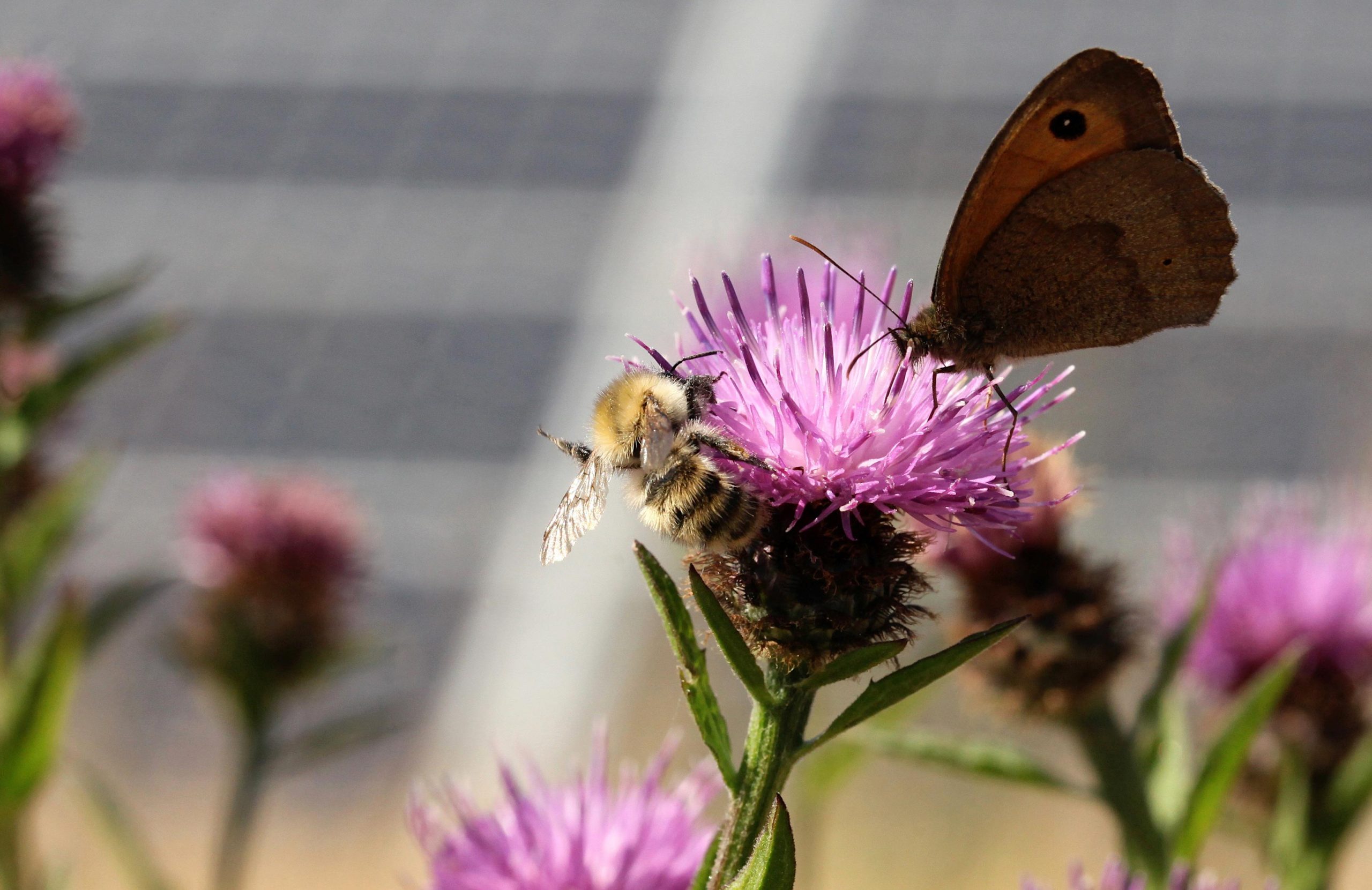
Researchers assessing the impact of solar energy development across Europe have come up with ten ways in which the expansion of solar can be shaped to ensure pollinators benefit.
Space-hungry solar photovoltaic (PV) is set to dominate future global electricity supply, but with careful decision making, efforts to secure clean energy need not come at the expense of biodiversity — particularly pollinators which are in sharp decline.
Bees, hoverflies, wasps, beetles, butterflies, and moths play a key role in food production, with around 75% of the leading global food crops and 35% of global crop production relying on them to some extent.
Writing in the journal Renewable and Sustainable Energy Reviews, a Lancaster-led team of environmental scientists systematically reviewed the available evidence on how land management practices relating to solar parks in North West Europe could enhance pollinator biodiversity.
Along with colleagues from the University of Reading, they highlighted ten evidence-based ways to protect and even enhance pollinator biodiversity ranging from sowing wildflowers to connecting solar parks to nearby areas of semi-natural habitat.
Their findings are timely as, in a bid to tackle climate change and reduce greenhouse gas emissions, more power is being generated from renewable sources — at the beginning of 2020 a record-breaking 47% of the UK’s electricity came from renewables, including wind, solar, hydro, wave and biomass.
Land-Hungry Solar Parks Create Environmental Tradeoffs
Solar parks can produce large amounts of power, with the UK’s largest solar park set to power 91,000 homes once complete. But, solar parks also take up land, with potential impacts on the environment. In the UK approximately half of PV has been installed as ground-mounted solar parks, ranging in size from 1-40 hectares.
Shading caused by rows of solar panels affects air temperature, rainfall, and evaporation which has a knock on effect on soil, vegetation, and biodiversity.
However, in the UK solar parks are often built in intensively managed agricultural landscapes and thus are poor for biodiversity. In this scenario, solar parks may in fact provide opportunities to establish hotspots of pollinator biodiversity which in turn can help pollinate local crops such as oilseed, strawberries and apples.
Lancaster University’s Hollie Blaydes said: “Many pollinators are in decline both in the UK and in other parts of the world. Actions to conserve pollinators include reversing agricultural intensification and maintaining natural habitat, both of which can be achieved within solar parks. Often built amongst agricultural land, solar parks offer a unique opportunity to provide pollinator resources where they are most needed.”
Pollinator-Friendly Solar Parks Can Aid Local Crop Yields
Prof Simon Potts, University of Reading, said: “As well as promoting biodiversity, pollinator-friendly solar parks also have the potential to provide tangible economic benefits to farmers through enhancing pollination services to adjacent agricultural land, boosting crop yields.
“Imagine a world where solar parks not only produced much needed low carbon electricity but were also diverse and attractive wildflower meadows buzzing with insect life.”
Dr. Alona Armstrong, Lancaster University Environment Centre said: “Land use change for solar parks could cause further degradation of our environment but, if done well, offers much potential to improve our environment. If we transition well, we could use energy system decarbonization to also address the ecological crisis. Given where we are, can we afford not to?”
Reference: “Opportunities to enhance pollinator biodiversity in solar parks” by H. Blaydes, S. G. Potts, J. D. Whyatt and A. Armstrong, 18 April 2021, Renewable and Sustainable Energy Reviews.
DOI: 10.1016/j.rser.2021.111065
Funded by NERC (ENVISION DTP), with support from Low Carbon, authors included Hollie Blaydes (Lancaster University), Dr Alona Armstrong (Lancaster University), Prof Simon Potts (University of Reading) and Prof Duncan Whyatt (Lancaster University)
Never miss a breakthrough: Join the SciTechDaily newsletter.
Follow us on Google and Google News.