
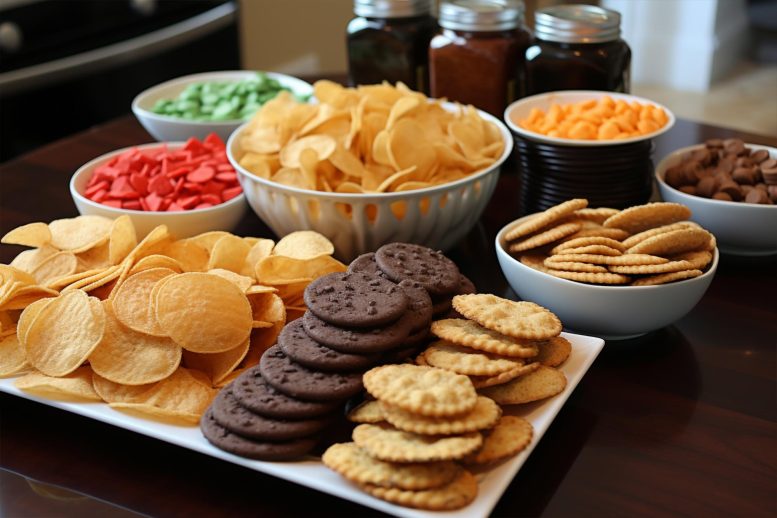
Tobacco-owned food brands in the U.S. have been linked to the promotion of addictive, unhealthy foods, leading to prevalent health issues like obesity.
Many of us know all too well the addictive nature of many foods marketed in the United States — most call it “junk food.” In fact, this kind of salty, sweet, and high-fat fare makes up the lion’s share of what’s marketed to Americans.
Researchers employ a more scholarly term for food items featuring purposely tempting combinations of salts, fats, and sugars: They’re “hyperpalatable.”
Now, an investigator at the University of Kansas has conducted research showing food brands owned by tobacco companies — which invested heavily into the U.S. food industry in the 1980s — appear to have “selectively disseminated hyperpalatable foods” to American consumers.
The study was published on September 8 in the peer-reviewed journal Addiction.
Research Findings and Implications
“We used multiple sources of data to examine the question, ‘In what ways were U.S. tobacco companies involved in the promotion and spread of hyperpalatable food into our food system?’” said lead author Tera Fazzino, assistant professor of psychology at KU and associate director of the Cofrin Logan Center for Addiction Research and Treatment at the KU Life Span Institute.
“Hyperpalatable foods can be irresistible and difficult to stop eating. They have combinations of palatability-related nutrients, specifically fat, sugar, sodium or other carbohydrates that occur in combinations together.”
Fazzino’s previous work has shown today that 68% of the American food supply is hyperpalatable.
“These combinations of nutrients provide a really enhanced eating experience and make them difficult to stop eating,” she said. “These effects are different than if you just had something high in fat but had no sugar, salt, or other type of refined carbohydrate.”
Fazzino and her co-authors found between 1988 and 2001, tobacco-owned foods were 29% more likely to be classified as fat-and-sodium hyperpalatable and 80% more likely to be classified as carbohydrate-and-sodium hyperpalatable than foods that were not tobacco-owned.
Tobacco Companies and Their Intent
The KU researchers used data from a public repository of internal tobacco industry documents to determine ownership of food companies, then combed nutrition data from the U.S. Department of Agriculture in longitudinal analyses to estimate how much foods were “formulated to be hyperpalatable, based on tobacco ownership.”
“The question about their intent —we can’t really say from this data,” Fazzino said. “But what we can say is there’s evidence to indicate tobacco companies were consistently involved with owning and developing hyperpalatable foods during the time that they were leading our food system. Their involvement was selective in nature and different from the companies that didn’t have a parent tobacco-company ownership.”
Fazzino’s co-authors were KU doctoral students Daiil Jun and Kayla Bjorlie, along with Lynn Chollet Hinton, assistant professor of biostatistics and data science at KU Medical Center.
The KU researchers said they built their investigation inspired by earlier work by Laura Schmidt at the University of California-San Francisco.
“She and her team established that the same tobacco companies were involved in the development and heavy marketing of sugary drinks to kids — that was R.J. Reynolds — and that Philip Morris was involved in the direct transfer of tobacco marketing strategies targeting racial and ethnic minority communities in the U.S. to sell their food products,” Fazzino said.
Hyperpalatable Foods Today
While tobacco companies divested from the U.S. food system between the early to mid-2000s, perhaps the shadow of Big Tobacco has remained. The new KU study finds the availability of fat-and-sodium hyperpalatable foods (more than 57%) and carbohydrate-and-sodium hyperpalatable foods (more than 17%) was still high in 2018, regardless of prior tobacco ownership, showing these foods have become mainstays of the American diet.
“The majority of what’s out there in our food supply falls under the hyperpalatable category,” Fazzino said. “It’s actually a bit difficult to track down food that’s not hyperpalatable. In our day-to-day lives, the foods we’re surrounded by and can easily grab are mostly the hyperpalatable ones. And foods that are not hyperpalatable, such as fresh fruits and vegetables – they’re not just hard to find, they’re also more expensive. We don’t really have many choices when it comes to picking between foods that are fresh and enjoyable to eat (e.g., a crisp apple) and foods that you just can’t stop eating.”
Fazzino said using metrics of hyperpalatability could be one way to regulate formulations of food that are engineered to induce sustained eating.
“These foods have combinations of ingredients that create effects you don’t get when you eat those ingredients separately,” the KU researcher said. “And guess what? These combinations don’t really exist in nature, so our bodies aren’t ready to handle them. They can excessively trigger our brain’s reward system and disrupt our fullness signals, which is why they’re difficult to resist.”
As a result, consumers of hyperpalatable foods are more prone to obesity and related health consequences, even when they don’t intend to overeat.
“These foods may be designed to make you eat more than you planned,” Fazzino said. “It’s not just about personal choice and watching what you eat – they can kind of trick your body into eating more than you actually want.”
Reference: “US tobacco companies selectively disseminated hyper-palatable foods into the US food system: Empirical evidence and current implications” by Tera L. Fazzino, Daiil Jun, Lynn Chollet-Hinton and Kayla Bjorlie, 8 September 2023, Addiction.
DOI: 10.1111/add.16332
Never miss a breakthrough: Join the SciTechDaily newsletter.
Follow us on Google and Google News.