
Close Menu
    Facebook X (Twitter) Instagram
    SciTechDaily
    • Biology
    • Chemistry
    • Earth
    • Health
    • Physics
    • Science
    • Space
    • Technology
    Facebook X (Twitter) Pinterest YouTube RSS
    SciTechDaily
    Home»Earth»The Craters on Earth: New Atlas Presents and Explains the Impact Sites of Meteorites and Asteroids Worldwide
    Earth

    The Craters on Earth: New Atlas Presents and Explains the Impact Sites of Meteorites and Asteroids Worldwide

    By University of FreiburgNovember 8, 20208 Comments2 Mins Read
    Facebook Twitter Pinterest Telegram LinkedIn WhatsApp Email Reddit
    Share
    Facebook Twitter LinkedIn Pinterest Telegram Email Reddit
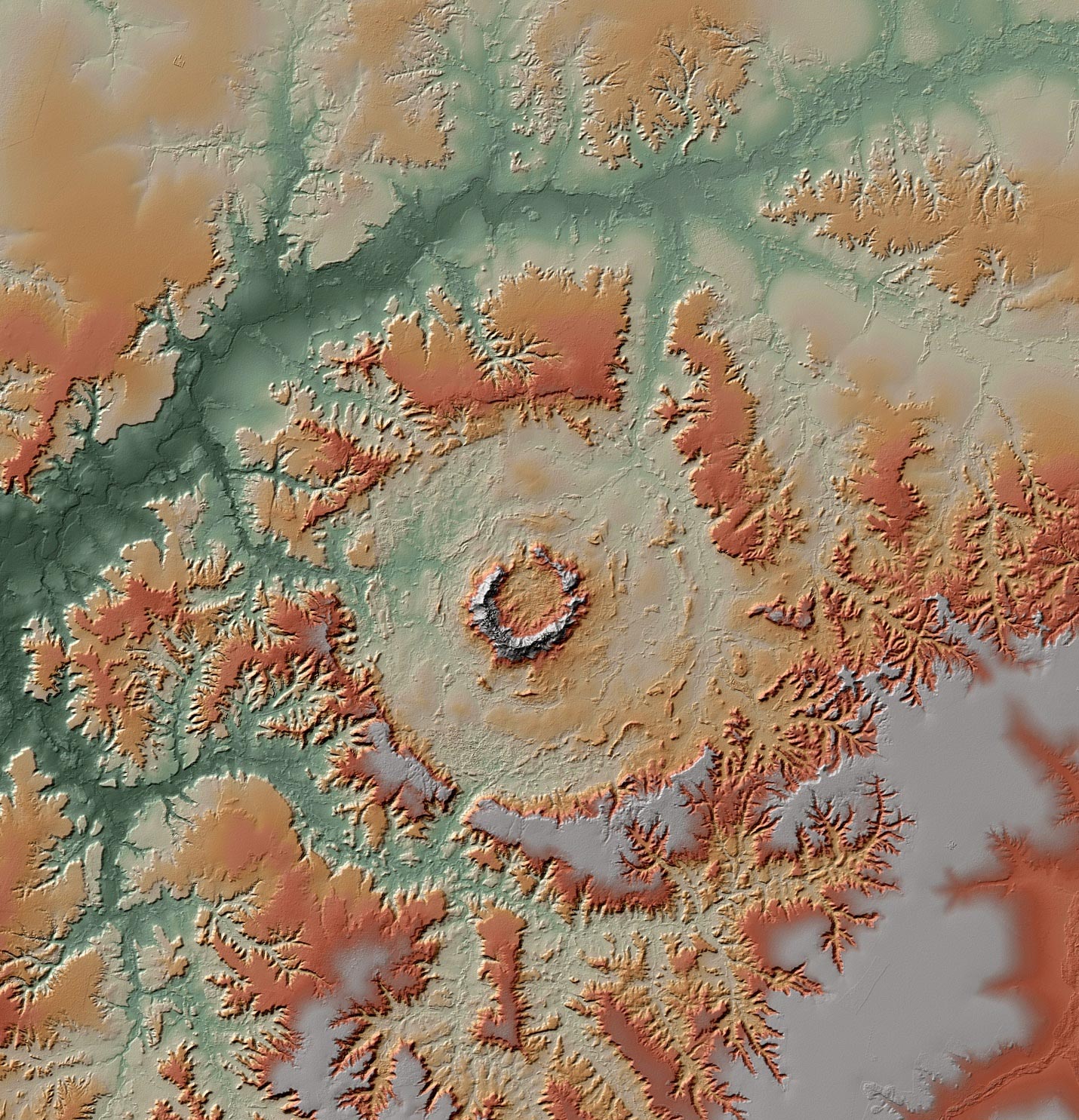
    Serra da Cangalha, Brazil, Impact Structure
    Physical map of the Serra da Cangalha, Brazil, impact structure, produced using the TanDEM-X mission digital elevation model. Credit: Gottwald, Kenkmann, Reimold: Terrestrial Impact Structures, The TanDEM-X Atlas, Verlag Dr. Friedrich Pfeil

    Prof. Dr. Thomas Kenkmann, geologist from the University of Freiburg’s Institute of Earth and Environmental Sciences, together with mineralogist Prof. Dr. Wolf Uwe Reimold from the University of Brasilia, Brazil, and Dr. Manfred Gottwald from the German Aerospace Center (DLR) published an atlas providing a comprehensive overview of all known impact craters on every continent. The authors present the more than 200 terrestrial impact sites in high-resolution topographic maps and satellite images, complete with detailed geological descriptions and photographs of the crater structures and their rocks. They also explain the essential details of each impact event.

    The formation of craters by asteroid and comet impact has always been a fundamental process in the solar system, explains Kenkmann. As the planets developed along with their moons, these impacts played an important part in accreting planetary mass, shaping the surfaces of planetary bodies, and later also influencing their development. And larger meteorite impacts eventually affected the development of life on Earth.

    Today, mapping of what can still be seen of the impact structures on the Earth’s surface can be done by satellites in low Earth orbit. From 2010 to 2016, the DLR successfully measured the Earth’s surface with the radar satellites of the TanDEM-X mission. The acquired data allowed, for the first time, to derive a worldwide terrain model with a height accuracy of up to one meter. From this global digital elevation model the authors have been able to produce this complete topographic atlas of 600 pages with information about all terrestrial impact craters known to date.

    Reference: Gottwald, M., Kenkmann, T., Reimold, W. U. (2020): Terrestrial Impact Structures. The TanDEM-X Atlas. Part 1 and 2. Munich.

    Never miss a breakthrough: Join the SciTechDaily newsletter.
    Follow us on Google and Google News.

    Geology Geophysics Meteorites Popular University of Freiburg
    Share. Facebook Twitter Pinterest LinkedIn Email Reddit

    Related Articles

    Textbooks and Geoscientists May Be Wrong About How the Alps Were Formed

    Strange Precariously Balanced Rocks Provide Earthquake Forecasting Clues

    Largest Extraterrestrial Diamonds Ever Discovered: Cosmic Diamonds Formed During Gigantic Planetary Collisions

    Deep-Earth Structures Discovered That May Signal Enormous Hidden Metal Lodes

    Geophysicist’s “Mind-Blowing” Discovery: Plato Was Right – Earth Is Made, on Average, of Cubes

    Mystery of Earth’s Vanishing Crust Solved by MagLab Geochemists – Prevailing Theories Contradicted

    Researchers Probe Materials at Extreme Deep-Earth Conditions to Decipher Earth’s Evolutionary Tale

    Arctic Sea Ice Loss is Impacting Atlantic Ocean Water Circulation System

    Study Reveals Ancient Impact of Massive Asteroid

    8 Comments

    1. Clyde Spencer on November 8, 2020 5:30 pm

      A huge amount of work went into compiling this! This is an example of good science.

      Reply
    2. David Dutra on November 8, 2020 11:13 pm

      Are there any transmitters and, or antennas on the Mars spacecraft looking for response ?

      Reply
      • Torbjörn Larsson on November 9, 2020 5:13 am

        Did you accidentally post to the wrong thread? It is hard to respond without having the context.

        Reply
    3. Coal Wood on November 9, 2020 6:17 am

      There 9s what I have always believed to be a crater in Albany, GA at a location named Hilsman Park: 31.590695, -84.168169

      Local legend has it as a Lime Sink or sink hole, but it has all the characteristics of an impact crater.

      Reply
    4. KARARYU THE DRAGON GHOUL on November 9, 2020 9:10 am

      Uh, will Chicxulub Crater, as well as other undersea craters be on it? Can’t wait to see.

      Reply
      • TonyM on November 9, 2020 10:48 am

        I doubt. The figure of around 200 corresponds to the content of the Earth Impact Database held at University of New Brunswick

        Reply
    5. Timmyturner on November 9, 2020 4:10 pm

      How,where ,and when can I get a copy? how much is it?

      Reply
    6. Steve on November 9, 2020 7:14 pm

      Data like this may help us to eventually predict asteroid impacts with greater accuracy in the future.

      Reply
    Leave A Reply Cancel Reply

    • Facebook
    • Twitter
    • Pinterest
    • YouTube

    Don't Miss a Discovery

    Subscribe for the Latest in Science & Tech!

    Trending News

    Researchers Have Found a Dietary Compound That Increases Longevity

    Scientists Baffled by Bizarre “Living Fossil” From 275 Million Years Ago

    Your IQ at 23 Could Predict Your Wealth at 27, Study Finds

    320 Light-Years Away, a Planet Confirms a Fundamental Cosmic Assumption

    The Crown Jewel of Dentistry? Breakthrough Tech Could Transform Tooth Repair

    Python Blood Could Hold the Secret to Weight Loss Without Side Effects

    Naturally Occurring Bacteria Completely Eradicate Tumors in Mice With a Single Dose

    New “Nanozyme Hypothesis” Could Rewrite the Story of Life’s Origins

    Follow SciTechDaily
    • Facebook
    • Twitter
    • YouTube
    • Pinterest
    • Newsletter
    • RSS
    SciTech News
    • Biology News
    • Chemistry News
    • Earth News
    • Health News
    • Physics News
    • Science News
    • Space News
    • Technology News
    Recent Posts
    • A New Chapter in Chemistry? Scientists Uncover New Way Metals Bind Oxygen
    • New Study Reveals Earth Is Getting Brighter at Night – About 2% Each Year
    • Accidental Deep Ocean Discovery Reveals Hidden Carbon Sink
    • Cooling the Planet Could Come at a Devastating Cost
    • These New Molecules Could Change How We Treat Lupus and Arthritis
    Copyright © 1998 - 2026 SciTechDaily. All Rights Reserved.
    • Science News
    • About
    • Contact
    • Editorial Board
    • Privacy Policy
    • Terms of Use

    Type above and press Enter to search. Press Esc to cancel.