
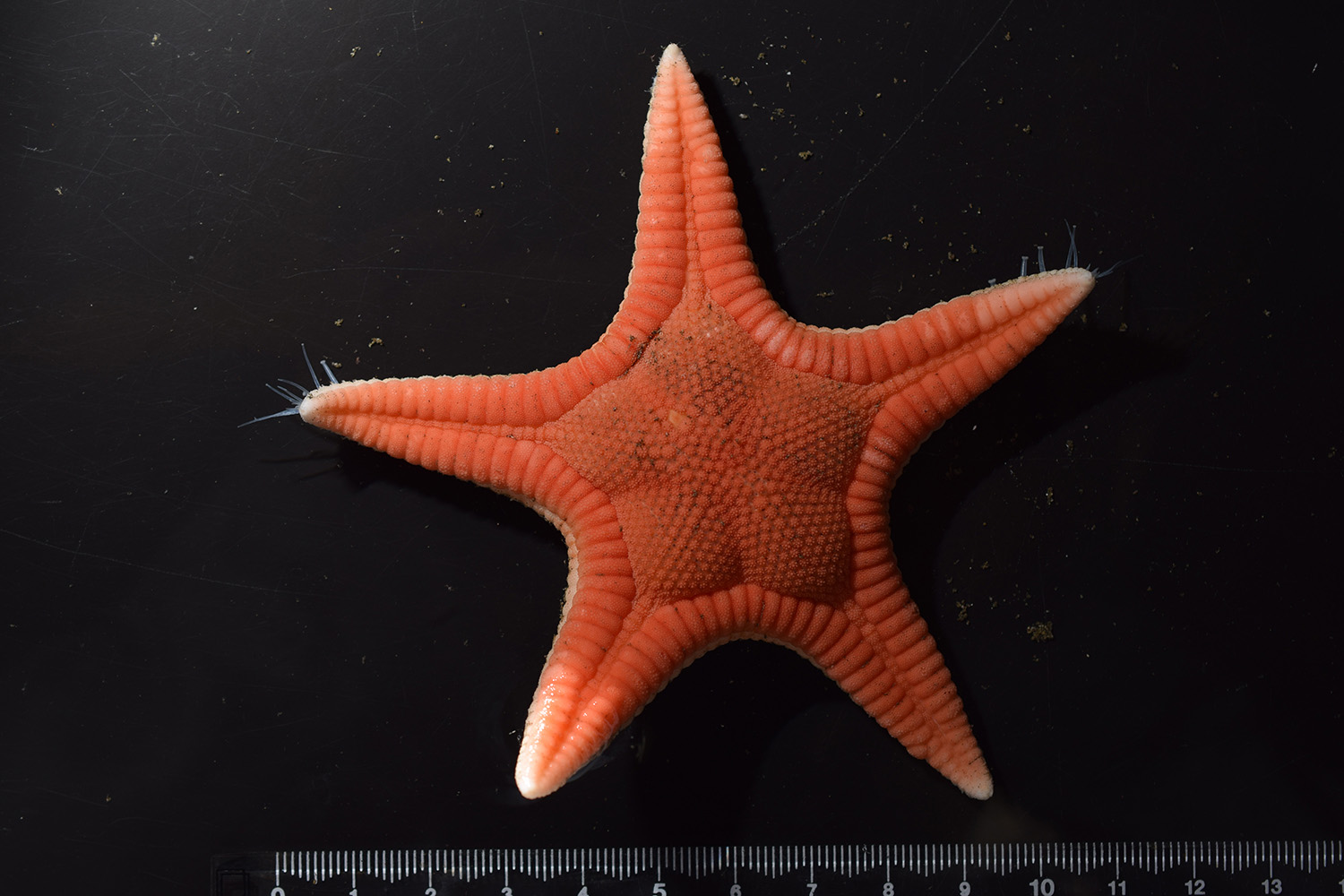
A new species of starfish has been discovered in Japan, marking the first such discovery in over 50 years.
A new species of starfish has been discovered by researchers in Japan, thanks to a collaborative effort involving scientists, fishers, as well as aquarium and museum staff. The newly identified starfish, named Paragonaster hoeimaruae, is part of the Pseudarchasteridae family. It features a unique red and beige coloration, with five arms, and measures just over 10 centimeters in size. According to the researchers, this discovery highlights the value of teamwork in enhancing our understanding of oceanic biodiversity.
Did you know that starfish are not really fish? Despite the name, they are more closely related to spiky sea urchins and squishy sea cucumbers. While they may appear docile and floppy stranded on a sandy beach, they are actually important predators that can have up to 50 arms, span a meter, and live for decades.
Starfish Facts and Importance
There are about 2,000 known species of starfish. Now, a collaboration among researchers at the University of Tokyo, Enoshima Aquarium, Marine Science Museum, Fukushima Prefecture, and the Yamaguchi Prefectural Fisheries Research Center in Japan has led to the discovery of a new species around the country’s coast.
The new species belongs to a family of starfish called Pseudarchasteridae. Until now, only four species of Pseudarchasteridae, of two genera (biological ranking, between family and species, for classifying animals), had been seen in Japanese waters.
Discovering Paragonaster hoeimaruae
“We discovered the starfish – newly named Paragonaster hoeimaruae – off the coast of the Izu Peninsula in Sagami Bay, south of Tokyo. We also found another in the Sea of Japan, northwest of Yamaguchi Prefecture in southwestern Japan,” explained lead researcher Itaru Kobayashi from the Misaki Marine Biological Station of the University of Tokyo. “They were caught between 150 meters and 350 meters deep, have a well-proportioned body with five arms, and are a beautiful red on the surface and beige underneath.”
The team gathered a variety of species from around Japan between 2021 and 2023. They were collected from shrimp and crab cages used by fishers in Hokkaido and Shizuoka prefectures, in northern and central Japan, respectively, and beam trawl surveys (where a large net is dragged across the ocean floor) conducted by a Yamaguchi prefectural fisheries research ship. The starfish’s name hoei was taken from the fishing vessel Hoei-maru, which first collected the specimen.
The team also recorded other starfish in locations different from where they had previously been found. Of particular note was Gephyreaster swifti, a surprisingly large starfish about 30 centimeters in diameter, found off the north coast of Hokkaido. Previously, it had only been recorded across the Pacific west coast of the United States and Canada along with islands in the Bering Sea to the north.
Significance of the Findings
“About 250 species of starfish live around Japan, and we were surprised that one so large as this had been overlooked. Our research highlights how the diversity of species in Japanese waters is still underestimated,” said Kobayashi. “These exciting discoveries show how important it is for fishers, aquariums, universities, and other research institutions to work together to better understand our oceans and marine biodiversity.”
Reference: “Pseudarchasteridae (Asteroidea: Paxillosida) in Japanese waters, with description of a new species and range extension of three species” by Itaru Kobayashi, Takayuki Sonoyama, Mai Hibino, Mitsuhisa Kawano and Hisanori Kohtsuka, 2 August 2024, Journal of Natural History.
DOI: 10.1080/00222933.2024.2377336
This study was supported by the Research Institute of Marine Invertebrates under Grant [KO2023, No. 5]. The specimens that were collected during the project ‘Marine Fisheries Stock Assessment and Evaluation for Japanese Waters’, were supported by the Japan Fisheries Agency.
Never miss a breakthrough: Join the SciTechDaily newsletter.
Follow us on Google and Google News.