
A new atomic material mimics brain behavior, enabling self-learning and energy-efficient AI without software.
An intelligent material that learns by physically changing itself, similar to how the human brain works, could be the foundation of a completely new generation of computers. Radboud physicists working toward this so-called “quantum brain” have made an important step. They have demonstrated that they can pattern and interconnect a network of single atoms, and mimic the autonomous behavior of neurons and synapses in a brain. They report their discovery in Nature Nanotechnology.
Considering the growing global demand for computing capacity, more and more data centers are necessary, all of which leave an ever-expanding energy footprint. “It is clear that we have to find new strategies to store and process information in an energy efficient way,” says project leader Alexander Khajetoorians, Professor of Scanning Probe Microscopy at Radboud University.
“This requires not only improvements to technology, but also fundamental research in game changing approaches. Our new idea of building a ‘quantum brain’ based on the quantum properties of materials could be the basis for a future solution for applications in artificial intelligence.”
Quantum Brain
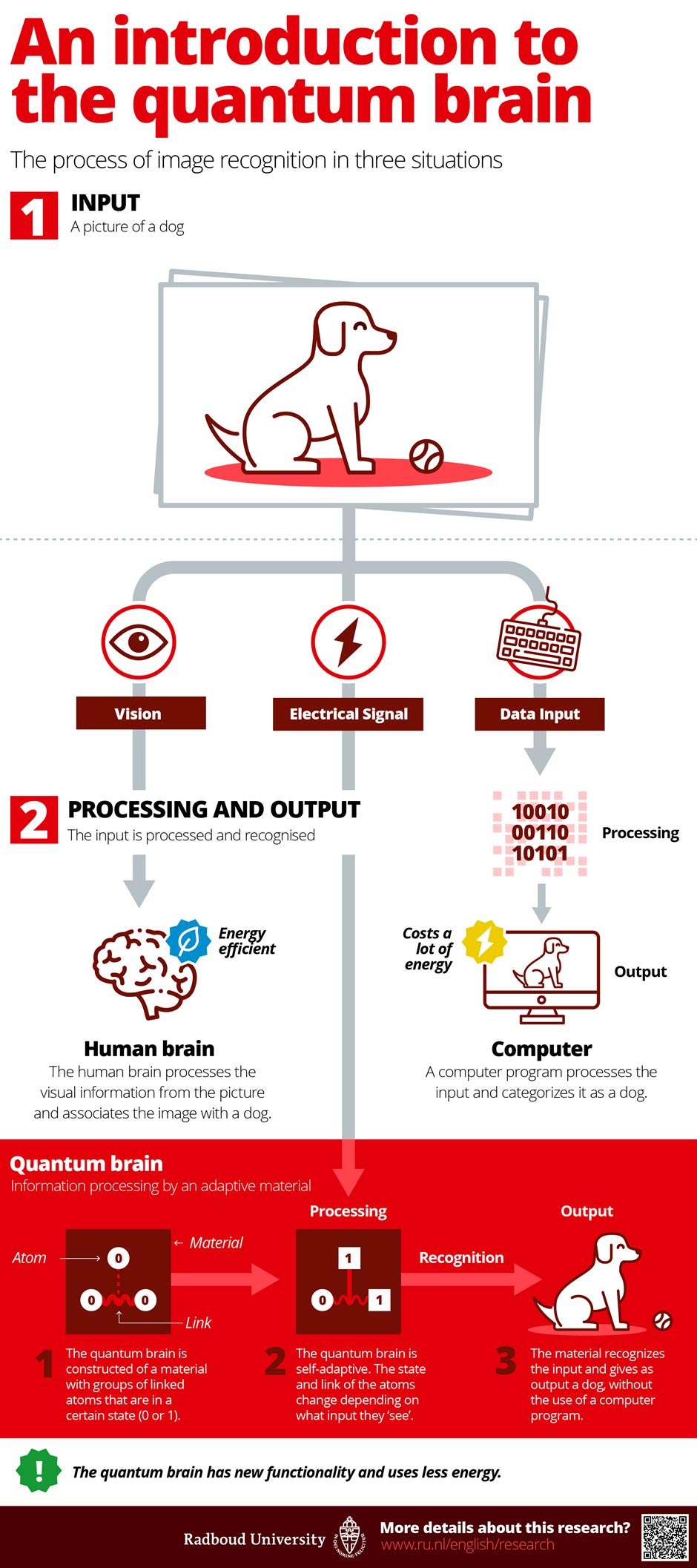
For artificial intelligence to work, a computer needs to be able to recognize patterns in the world and learn new ones. Today’s computers do this via machine learning software that controls the storage and processing of information on a separate computer hard drive. “Until now, this technology, which is based on a century-old paradigm, worked sufficiently. However, in the end, it is a very energy-inefficient process,” says co-author Bert Kappen, Professor of Neural Networks and Machine Intelligence.
The physicists at Radboud University researched whether a piece of hardware could do the same, without the need of software. They discovered that by constructing a network of cobalt atoms on black phosphorus they were able to build a material that stores and processes information in similar ways to the brain, and, even more surprisingly, adapts itself.
Self-Adapting Atoms
In 2018, Khajetoorians and collaborators showed that it is possible to store information in the state of a single cobalt atom. By applying a voltage to the atom, they could induce “firing,” where the atom shuttles between a value of 0 and 1 randomly, much like one neuron. They have now discovered a way to create tailored ensembles of these atoms, and found that the firing behavior of these ensembles mimics the behavior of a brain-like model used in artificial intelligence.
In addition to observing the behavior of spiking neurons, they were able to create the smallest synapse known to date. Unknowingly, they observed that these ensembles had an inherent adaptive property: their synapses changed their behavior depending on what input they “saw.” “When stimulating the material over a longer period of time with a certain voltage, we were very surprised to see that the synapses actually changed. The material adapted its reaction based on the external stimuli that it received. It learned by itself,” says Khajetoorians.
Exploring and Developing the Quantum Brain
The researchers now plan to scale up the system and build a larger network of atoms, as well as dive into new “quantum” materials that can be used. Also, they need to understand why the atom network behaves as it does. “We are at a state where we can start to relate fundamental physics to concepts in biology, like memory and learning,” says Khajetoorians.
“If we could eventually construct a real machine from this material, we would be able to build self-learning computing devices that are more energy efficient and smaller than today’s computers. Yet, only when we understand how it works – and that is still a mystery – will we be able to tune its behavior and start developing it into a technology. It is a very exciting time.”
Reference: “An atomic Boltzmann machine capable of self-adaption” by Brian Kiraly, Elze J. Knol, Werner M. J. van Weerdenburg, Hilbert J. Kappen and Alexander A. Khajetoorians, 1 February 2021, Nature Nanotechnology.
DOI: 10.1038/s41565-020-00838-4
Never miss a breakthrough: Join the SciTechDaily newsletter.
Follow us on Google and Google News.
4 Comments
Wait… what! Brain w/o wetware. Awesome. Star Trek’s Data you are next.
I’m still waiting for Star Trek’s food replicator. I know just the place to put it in my kitchen. I’m keeping a Slim Jim in the freezer for the day Amazon deliver’s my replicator.
Interesting
I understand advancement of technology but wouldn’t this be better applied as a way to pin point inactivity in neurons and develope external solution to repair this disconnect so the process can eventually be used to heal brain injury and non function of neurons in humans. Also they should try using the new double layer graphine with the quantum magnetic field capabilities instead of the black phosphorous.
You don’t need a lot of fancy gear to make homemade baby food.