
Groundbreaking research reveals that it’s possible to isolate the therapeutic benefits of psychedelics from their hallucinogenic effects.
By using a mouse model, scientists have identified specific neural circuits that handle the anti-anxiety properties of these drugs, distinct from those that produce hallucinations. This discovery paves the way for developing safer, non-hallucinogenic therapies using psychedelic principles.
Exploring Psychedelic Drug Effects in Neuroscience
New research suggests that it could be possible to separate treatment from hallucinations when developing new drugs based on psychedelics. The anti-anxiety and hallucination-inducing qualities of psychedelic drugs work through different neural circuits, according to research using a mouse model. The work is published Nov. 15 in Science.
The research shows that decoupling the beneficial effects of psychedelics from their hallucinogenic effects isn’t just a matter of chemical compound design. It’s a matter of targeted neural circuitry.
“In the past, we did this using chemistry by making new compounds, but here we focused on identifying the circuits responsible for the effects, and it does seem that they are distinct,” said study co-author David E. Olson, director of the Institute for Psychedelics and Neurotherapeutics (IPN) and a professor of chemistry and of biochemistry and molecular medicine at the University of California, Davis. “This is an important mechanistic study that validates our earlier results.”
Assessing Anti-Anxiety in Mice
The researchers measured anxiety in mouse models with two tests: the elevated plus maze and the marble burying test.
In the elevated plus maze, mice are placed in a cross-shaped maze raised a couple of feet off the ground. Two arms of the maze have high walls while the other two arms remain open and have no walls. Mice with high anxiety tend to stay in the closed arms with high walls, not willing to explore the open arms.
In the marble burying test, mice with high anxiety tend to continuously and compulsively bury marbles in their bedding.
“It is well known that in mice, psychedelics induce reduced marble burying and promote exploration of the open arms of the plus maze,” said Christina Kim, the study’s corresponding author and an assistant professor of neurology, core member of the Center for Neuroscience and IPN affiliate. “But there is also an intoxicating or hallucinogenic-like effect, which can be measured through head twitches in mice.”
In the study, the team dosed mouse models with the psychedelic 2,5-dimethoxy-4-iodoamphetamine (DOI). They found that six hours after the dose, the mice still exhibited reduced marble burying and increased open arm time in the elevated plus maze. However, the head twitches associated with hallucinations had disappeared.
“We thought that if we could identify which neurons activated by DOI were responsible for reducing anxiety, then we might be able to reactivate them at a later time to mimic those anti-anxiety-like effects,” Kim said.
Harnessing Optogenetics for Anxiety Reduction
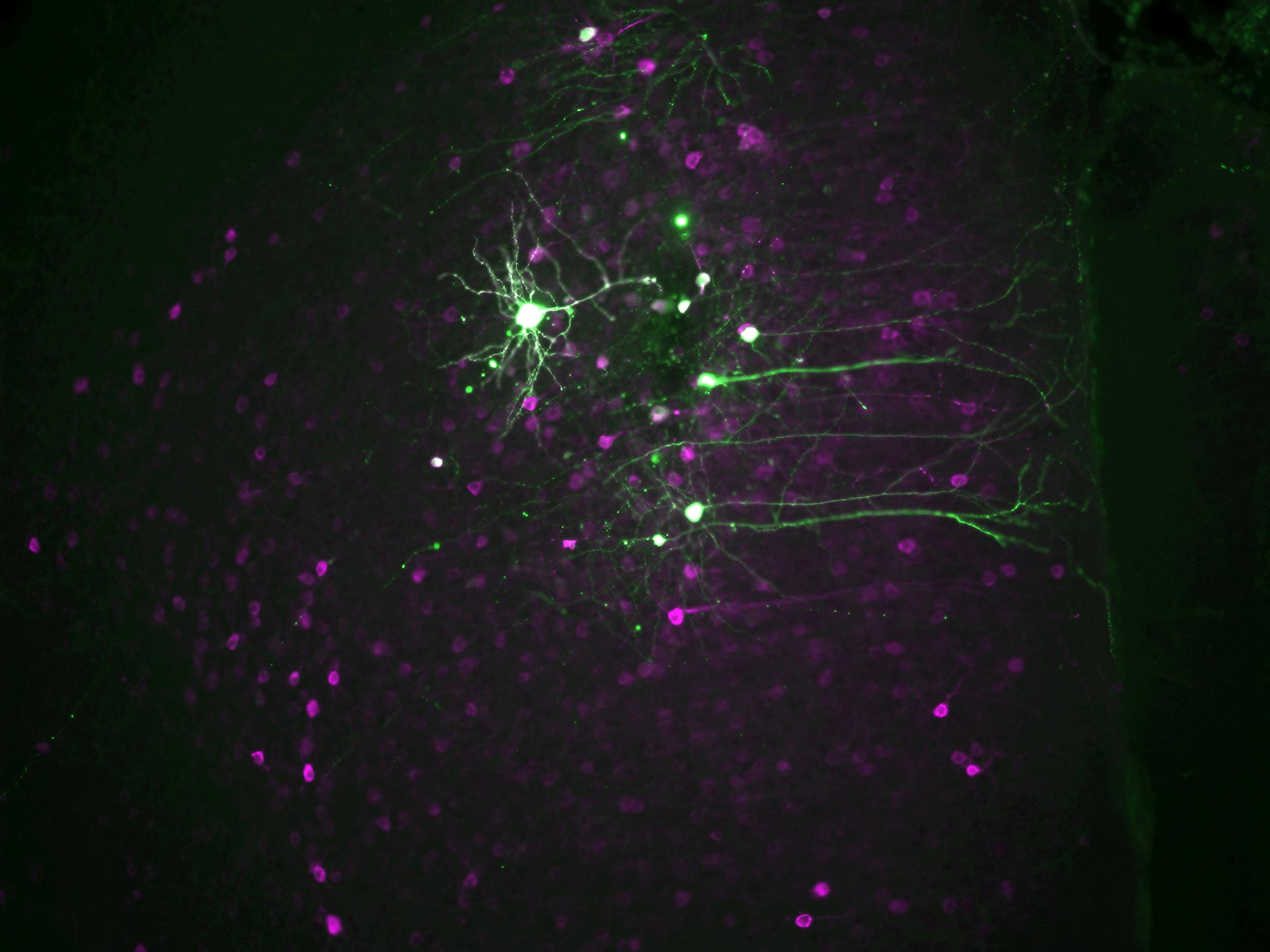
To identify the specific neural circuits associated with anti-anxiety effects, the team used a molecular tagging tool called scFLARE2 to highlight the neurons activated by DOI in the medial prefrontal cortex — a brain region known to be involved in reducing anxious behavior in mice.
The tagging allowed the team to isolate a psychedelic responsive network that extends beyond 5-HT2AR expressing neurons, the main receptor avenue through which psychedelics promote neuroplasticity.
Equipped with a fluorescent map of the neurons activated by DOI, the team then used optogenetics, or light, to reactivate those neurons.
“When we performed the scFLARE2 tagging and reactivation of these specific prefrontal cortex cells, we could still drive a reduction in anxiety-like behaviors, measured as decreased marble burying and increased open arm exploration in the elevated plus maze,” Kim said. “We could do this just by targeting the DOI-activated cells and then reactivating them the next day.”
Unraveling Neural Mechanisms and Potential Applications
The team also used single nucleus RNA sequencing to genetically profile the specific types of neurons in the DOI-activated network. Of the nine neuron group types identified, three exhibited high activation.
“While some of the cell types activated by DOI had strong 5-HT2AR expression, there were others that did not,” Kim said. “What is likely happening is that we are getting direct activation of cells that express 5-HT2AR, and then they go on to activate additional downstream cells that can trigger behavioral changes.”
“It is important to realize that the cells that we are tagging and reactivating extend beyond just those that express the receptor for the drug,” she added.
The finding emphasizes how activating single touchpoints in the brain spirals out into the rest of the network.
“While DOI is a potent psychedelic, it is not being explored as a potential therapeutic drug in the clinic. Thus the findings here are focused on dissecting the basic circuit mechanisms of this important class of drugs,” Kim said.
Elucidating exactly how psychedelics affect the brain is a major goal of the IPN.
“Understanding which neural circuits psychedelics activate to elicit their effects is the kind of basic science needed to ultimately develop targeted therapeutics with better safety profiles,” Olson said.
Reference: “Isolation of psychedelic-responsive neurons underlying anxiolytic behavioral states” by J. Muir, S. Lin, I. K. Aarrestad, H. R. Daniels, J. Ma, L. Tian, D. E. Olson and C. K. Kim, 14 November 2024, Science.
DOI: 10.1126/science.adl0666
Co-authors Jessie Muir, a postdoctoral researcher at the Center for Neuroscience, and Sophia Lin, a junior specialist at the Center for Neuroscience, spearheaded the DOI study. Additional authors on the study include I.K. Aarrestad, H.R. Daniels, J. Ma and L. Tian.
Funding for the research was provided by the Burroughs Wellcome Fund Career Award at the Scientific Interface, the Brain & Behavior Research Foundation Young Investigator Award, the Searle Scholars Program, The Kavli Foundation, the UC Davis Behavioral Health Center for Excellence Pilot Award, the Canadian Institutes of Health Research postdoctoral training award, the National Institutes of Health, the Boone Family Foundation and the Camille Dreyfus Teacher-Scholar Award.
Never miss a breakthrough: Join the SciTechDaily newsletter.
Follow us on Google and Google News.