
Revolutionizing Smart Contact Lenses with a Tear-Powered Battery
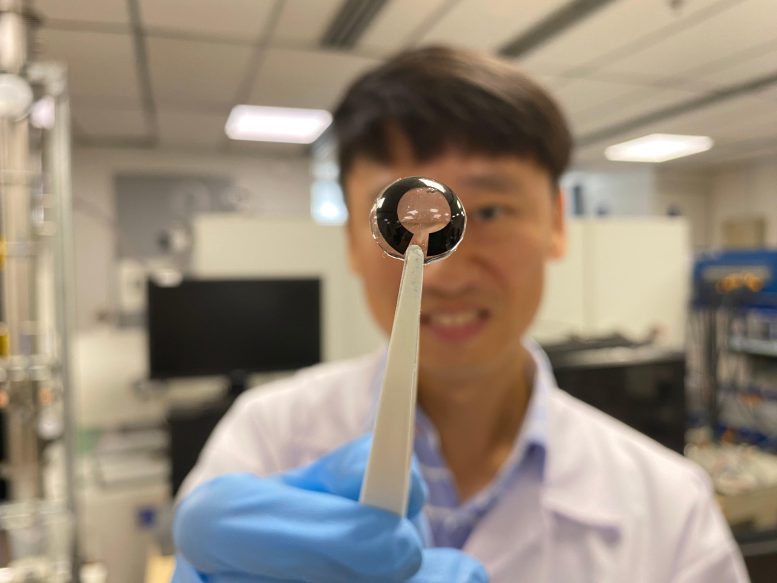
Researchers at Nanyang Technological University in Singapore (NTU Singapore) have created a flexible battery that’s as thin as a human cornea. This innovative energy storage device charges itself when submerged in a saline solution and has the potential to fuel smart contact lenses in the future.
Smart contact lenses are high-tech contact lenses capable of displaying visible information on our corneas and can be used to access augmented reality. Current uses include helping to correct vision, monitoring wearers’ health, and flagging and treating diseases for people with chronic health conditions such as diabetes and glaucoma. In the future, smart contact lenses could be developed to record and transmit everything a wearer sees and hears to cloud-based data storage.
Overcoming the Limitations of Traditional Battery Technology
However, to reach this future potential a safe and suitable battery needs to be developed to power them. Existing rechargeable batteries rely on wires or induction coils that contain metal and are unsuitable for use in the human eye, as they are uncomfortable and present risks to the user.
The NTU-developed battery is made of biocompatible materials and does not contain wires or toxic heavy metals, such as those in lithium-ion batteries or wireless charging systems. It has a glucose-based coating that reacts with the sodium and chloride ions in the saline solution surrounding it, while the water the battery contains serves as the ‘wire’ or ‘circuitry’ for electricity to be generated.
The battery could also be powered by human tears as they contain sodium and potassium ions, at a lower concentration. Testing the current battery with a simulated tear solution, the researchers showed that the battery’s life would be extended an additional hour for every twelve-hour wearing cycle it is used. The battery can also be charged conventionally by an external power supply.
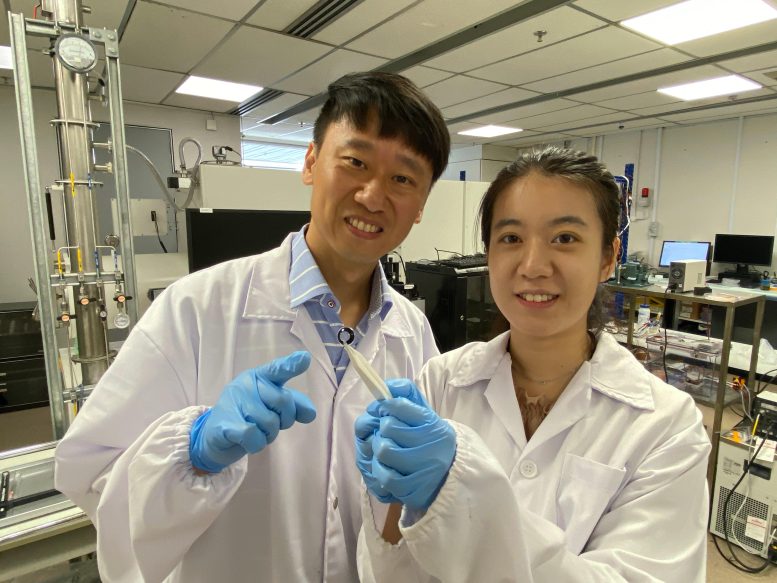
Associate Professor Lee Seok Woo, from NTU’s School of Electrical and Electronic Engineering (EEE), who led the study, said: “This research began with a simple question: Could contact lens batteries be recharged with our tears? There were similar examples of self-charging batteries, such as those for wearable technology that are powered by human perspiration.
“However, previous techniques for lens batteries were not perfect as one side of the battery electrode was charged and the other was not. Our approach can charge both electrodes of a battery through a unique combination of enzymatic reaction and self-reduction reaction. Besides the charging mechanism, it relies on just glucose and water to generate electricity, both of which are safe to humans and would be less harmful to the environment when disposed of, compared to conventional batteries.”
Co-first author Dr Yun Jeonghun, a research fellow from NTU’s EEE said: “The most common battery charging system for smart contact lenses requires metal electrodes in the lens, which are harmful if they are exposed to the naked human eye. Meanwhile, another mode of powering lenses, induction charging, requires a coil to be in the lens to transmit power, much like a wireless charging pad for a smartphone. Our tear-based battery eliminates the two potential concerns that these two methods pose, while also freeing up space for further innovation in the development of smart contact lenses.”
Highlighting the significance of the work done by the research team, NTU School of Mechanical & Aerospace Engineering Associate Professor Murukeshan Vadakke Matham, who specializes in biomedical and nanoscale optics and was not involved in the study, said: “As this battery is based on glucose oxidase, which occurs naturally in humans and powered by chloride and sodium ions, such as those in our tears, they should be compatible and suitable for human usage. Besides that, the smart contact lenses industry has been looking for a thin, biocompatible battery that does not contain heavy metals, and this invention could help further their development to meet some unmet needs of the industry.”
The research team has filed for a patent through NTUitive, NTU’s innovation and enterprise company. They are also working towards commercializing their invention.
The findings were recently published in the journal Nano Energy.
Cry Me a Current
The team demonstrated their invention using a simulated human eye (see video). The battery, which is about 0.5 millimetres-thin generates electrical power by reacting with the basal tears — the constant tears that create a thin film over our eyeballs — for the devices embedded within the lenses to function.
The flexible and flat battery discharges electricity through a process called reduction when its glucose oxidase coating reacts with the sodium and chloride ions in the tears, generating power and current within the contact lenses.
The team demonstrated that the battery could produce a current of 45 microamperes and a maximum power of 201 microwatts, which would be sufficient to power a smart contact lens.
Laboratory tests showed that the battery could be charged and discharged up to 200 times. Typical lithium-ion batteries have a lifespan of 300 to 500 charging cycles.
Overnight Glucose-Based Recharging
The team recommends that the battery should be placed for at least eight hours in a suitable solution that contains a high quantity of glucose, sodium, and potassium ions, to be charged while the user is asleep (see Figure 1).
Co-first author Miss Li Zongkang, a PhD student from NTU’s EEE said: “Although wireless power transmission and supercapacitors supply high power, their integration presents a significant challenge due to the limited amount of space in the lens. By combining the battery and biofuel cell into a single component, the battery can charge itself without the need for additional space for wired or wireless components. Furthermore, the electrodes placed at the outer side of the contact lens ensure that the vision of the eye cannot be obstructed.”
The NTU team will be conducting further research to improve the amount of electrical current their battery can discharge. They will also be working with several contact lens companies to implement their technology.
Reference: “A tear-based battery charged by biofuel for smart contact lenses” by Jeonghun Yun, Zongkang Li, Xinwen Miao, Xiaoya Li, Jae Yoon Lee, Wenting Zhao and Seok Woo Lee, 13 March 2023, Nano Energy.
DOI: 10.1016/j.nanoen.2023.108344
Never miss a breakthrough: Join the SciTechDaily newsletter.
Follow us on Google and Google News.