

Galaxies may not be as simple as “young and blue” or “old and red.” A new idea from astrophysicist Charles Steinhardt proposes a third type: red star-forming galaxies that break the mold.
These galaxies challenge what we thought we knew about how stars are born and suggest the universe may have formed far more stars than we ever estimated. They could also explain mysterious galaxies that stop forming stars suddenly and hint that the cosmic story is more complicated – and more fascinating – than we realized.
Challenging Cosmic Assumptions
The universe doesn’t come with an instruction manual – but if it did, University of Missouri astrophysicist Charles Steinhardt thinks some key pages might be missing. Either the universe has been following a different set of rules than we thought, or we’ve been misinterpreting the ones we have.
Astronomers have traditionally sorted galaxies into two main categories: blue galaxies, which are young and actively forming stars, and red galaxies, which are older and no longer producing new stars. But Steinhardt is proposing a third kind: red star-forming galaxies – galaxies that are still making stars, but mostly low-mass ones that give them a reddish appearance.
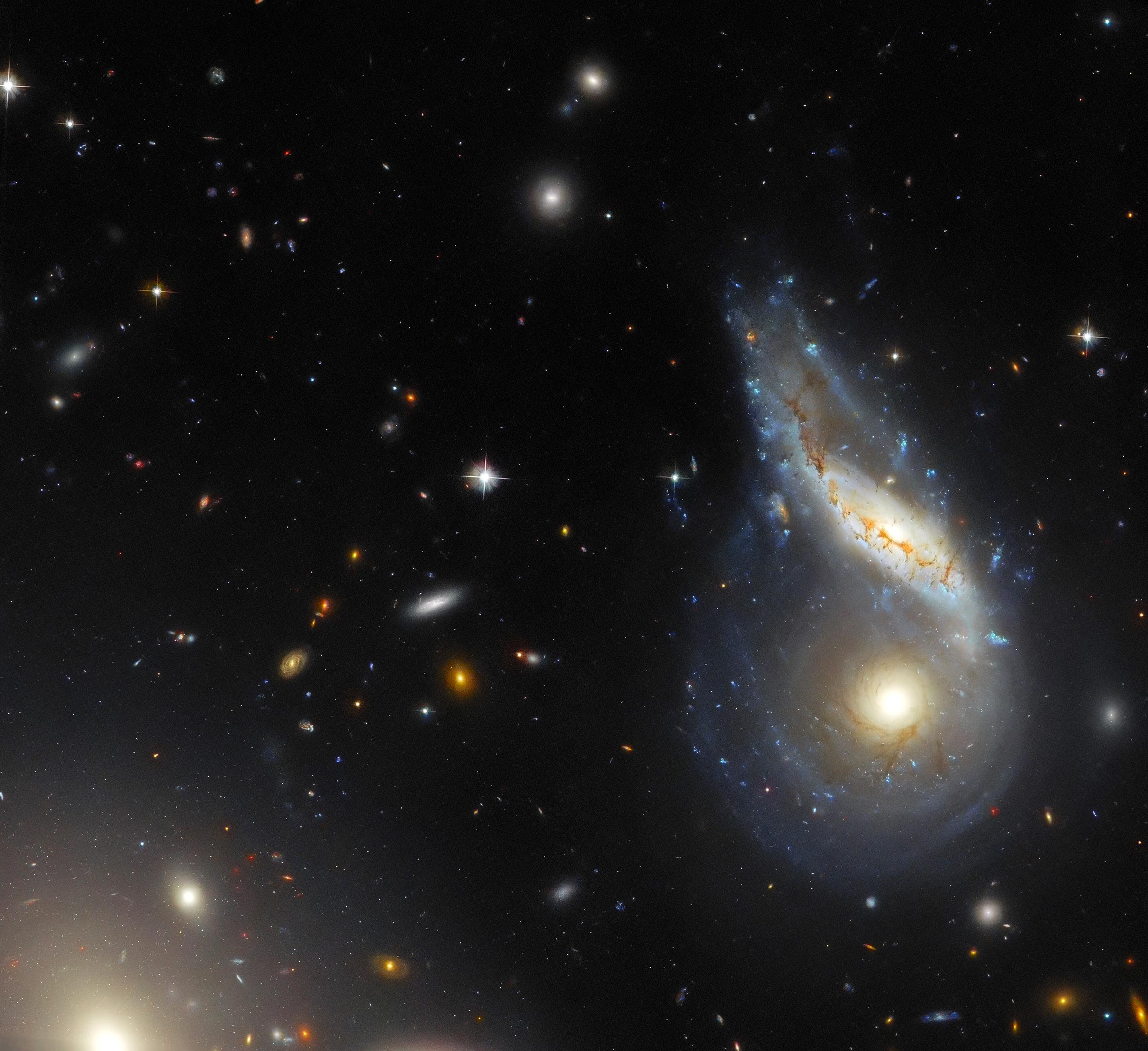
Acknowledgment: L. Shatz
Why Red Star-Forming Galaxies Matter
“Red star-forming galaxies primarily produce low-mass stars, making them appear red despite ongoing star birth,” he said. “This theory was developed to address inconsistencies with the traditional observed ratios of black hole mass to stellar mass and the differing initial mass functions in blue and red galaxies — two problems not explainable by aging or merging alone. However, what we learned is that most of the stars we see today might have formed under different conditions than we previously believed.”

A New Layer in Galactic History
Steinhardt’s research suggests that red star-forming galaxies might have played a much bigger role in the universe’s history. This could change our current understanding of how galaxies evolve, the processes that shape them, and how we measure star formation throughout the universe’s history.
“The existence of these galaxies could mean that the universe has formed significantly more stars than previously estimated,” he said. “It supports the idea that the life cycle of galaxies is more complex than a simple progression from blue to red and dead.”
A New Take on Post-Starburst Galaxies
Traditionally, galaxies are known to have evolved either through gradual aging or by merging, where the collisions can trigger bursts of new stars. Therefore, astronomers have long been puzzled by post-starburst galaxies, which suddenly stop making new stars after a short period of intense star formation. The common theory is that two galaxies collide, causing a quick burst of new stars before running out of energy and going quiet.
But Steinhardt suggests another possibility. Some of these galaxies may have been slowly forming small, red stars instead of experiencing a sudden burst of star formation. If that’s true, he said, we may need to change how we define post-starburst galaxies, as some might belong to a different category of red star-forming galaxies.
Future Research and Student-Led Projects
In the future, Steinhardt and his students in Mizzou’s Department of Physics plan on conducting more advanced tests to further investigate star-forming galaxies. Junior Mathieux Harper and a team of undergraduate students will look for more evidence to support the idea that some post-starburst galaxies fall into the newly proposed category. Meanwhile, sophomores Carter Meyerhoff and Zach Borowiak will lead a research project using data from the European Space Agency’s Gaia satellite to study over two billion stars in the Milky Way.
“Do Red Galaxies Form More Stars Than Blue Galaxies?” was published in the Astrophysical Journal.
Reference: “Do Red Galaxies Form More Stars than Blue Galaxies?” by and Charles L. Steinhardt, 28 March 2025, The Astrophysical Journal.
DOI: 10.3847/1538-4357/adb95b
Never miss a breakthrough: Join the SciTechDaily newsletter.
Follow us on Google and Google News.
2 Comments
Do Red Galaxies Form More Stars Than Blue Galaxies?
GOOD.
Scientific research guided by correct theories can enable researchers to think more. Inviscid, incompressible, and isotropic spaces can form spatiotemporal vortices through topological phase transitions. These spatiotemporal vortices can form extremely complex spatiotemporal structures through spin and self-organization.
According to the topological vortex theory (TVT), space is not only the background, but also the protagonist of the cosmic narrative. It nurtures brilliant starry sky, humanity, wisdom and life with its ideal fluid properties.
In the vast ocean of ideal fluids of absolute space, there are no Gods, only eternal fluid mechanics.
You really should try writing on philosophy. You seem to have a knack for it.