
Heat waves and cold spells are occurring more frequently around the Great Lakes, according to research from the University of Michigan. These changes have important effects on the region’s weather, economy, and ecosystems.
Heat waves and cold spells have long been a natural feature of life around the Great Lakes. However, recent research from the University of Michigan reveals that these temperature extremes are now occurring in a fundamentally different pattern compared to just three decades ago.
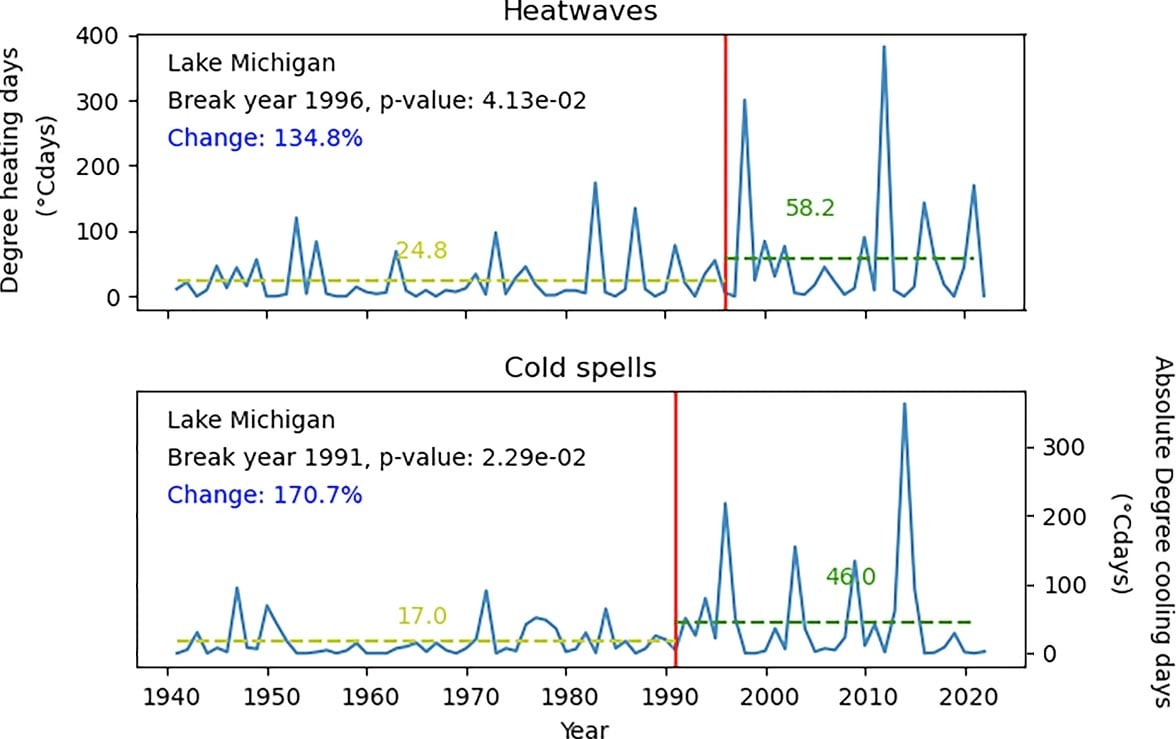
“The appearance of these extreme temperatures is increasing,” said Hazem Abdelhady, a postdoctoral research fellow in the U-M School for Environment and Sustainability, or SEAS. “For most lakes, the appearance is up more than 100% compared with before 1998.” That timing is significant because it coincides with the 1997-1998 El Niño, which is one of the strongest on record, he added.
To uncover this pattern, Abdelhady and his team created an advanced modeling method to track surface temperatures across the Great Lakes. This approach enabled them to analyze the occurrence of heat waves and cold spells as far back as 1940. Surface water temperature strongly influences regional weather, a major consideration for people living in the area, as well as for travelers and shipping operations. However, Abdelhady noted that the rising frequency of extreme temperature events could also have less visible but significant impacts on the ecosystems and economic systems that depend on the lakes.
“These types of events can have huge impacts on the fishing industry, which is a billion-dollar industry, for example,” Abdelhady said. Tribal, recreational, and commercial fishing in the Great Lakes account for a total value of more than $7 billion annually, according to the Great Lakes Fishery Commission.
Sudden shifts threaten ecosystems and water quality
According to Abdelhady, fish are generally able to adjust to slow shifts in water temperature by moving to more suitable areas, but they may not be able to escape sudden temperature swings. Fish eggs are especially vulnerable to unexpected spikes or drops.
Extended periods of heat or cold can also interfere with the lakes’ natural processes of mixing and layering, which are crucial for maintaining water quality and supporting aquatic life. These disruptions can affect ecosystems and the water sources that communities depend on for both drinking and recreation.
With the current patterns now identified across all five Great Lakes, the research team is working to expand their model to forecast future extreme temperature events. Abdelhady explained that by exploring how these events relate to larger climate systems, like El Niños and La Niñas, we can become better equipped to manage the risks they pose.
“If we can understand these events, we can start thinking about how to protect against them,” Abdelahdy said.
The study was conducted through the Cooperative Institute for Great Lakes Research, or CIGLR, and published in Communications Earth & Environment, part of the Nature journal family. The work was supported by the National Science Foundation, its Global Centers program, and the National Oceanic and Atmospheric Administration, or NOAA.
Capturing the greatness of the lakes
A major challenge in this research was the sheer scale of the system being studied. While computer models exist to simulate the behavior of typical lakes worldwide, the Great Lakes present a unique case.
They form a connected system of five distinct lakes, hold over 20% of the planet’s fresh surface water, and have a combined shoreline that rivals the length of the entire U.S. Atlantic coast (including the Gulf of Mexico).
In many regards, the Great Lakes have more in common with coastal oceans than with other lakes, said study coauthor Ayumi Fujisaki-Manome, who is an associate research scientist with SEAS and CIGLR.
“We can’t use the traditional, simpler models for the Great Lakes because they really don’t do well,” Fujisaki-Manome said.
So Abdelhady turned to modeling approaches used to study coastal oceans and tailored them for the Great Lakes. But there was also a data hurdle to overcome in addition to the modeling challenges.
Filling in historical gaps with data
Satellites have enabled routine direct observations of the Great Lakes starting about 45 years ago, Fujisaki-Manome said. But when talking about climate trends and epochs, researchers need to work with longer time periods.
“The great thing with this study is we were able to extend that historical period by almost double,” Fujisaki-Manome said.
By working with available observational data and trusted data from global climate simulations, Abdelhady could model Great Lakes temperature data and validate it with confidence back to 1940.
“That’s why we use modeling a lot of the time. We want to know about the past or the future or a point in space we can’t necessarily get to,” said coauthor Drew Groneworld, an associate professor in SEAS and a leader of the Global Center for Climate Change and Transboundary Waters. “With the Great Lakes, we have all three of those.”
David Cannon, an assistant research scientist with CIGRL, and Jia Wang, a climatologist and oceanographer with NOAA’s Great Lakes Environmental Research Laboratory, also contributed to the study. The study is a perfect example of how collaborations between universities and government science agencies can create a flow of knowledge that benefits the public and the broader research community, Gronewold said.
The team’s model is now available for other research groups studying the Great Lakes to explore their questions. For the team at U-M, its next steps are using the model to explore spatial differences across smaller areas of the Great Lakes and using the model to look forward in time.
“I’m very curious if we can anticipate the next big shift or the next big tipping point,” Gronewold said. “We didn’t anticipate the last one. Nobody predicted that, in 1997, there was going to be a warm-winter El Niño that changed everything.”
Reference: “Climate change-induced amplification of extreme temperatures in large lakes” by Hazem U. Abdelhady, Ayumi Fujisaki-Manome, David Cannon, Andrew Gronewold and Jia Wang, 15 May 2025, Communications Earth & Environment.
DOI: 10.1038/s43247-025-02341-x
Never miss a breakthrough: Join the SciTechDaily newsletter.
Follow us on Google and Google News.
16 Comments
“If we can understand these events, we can start thinking about how to protect against them,”
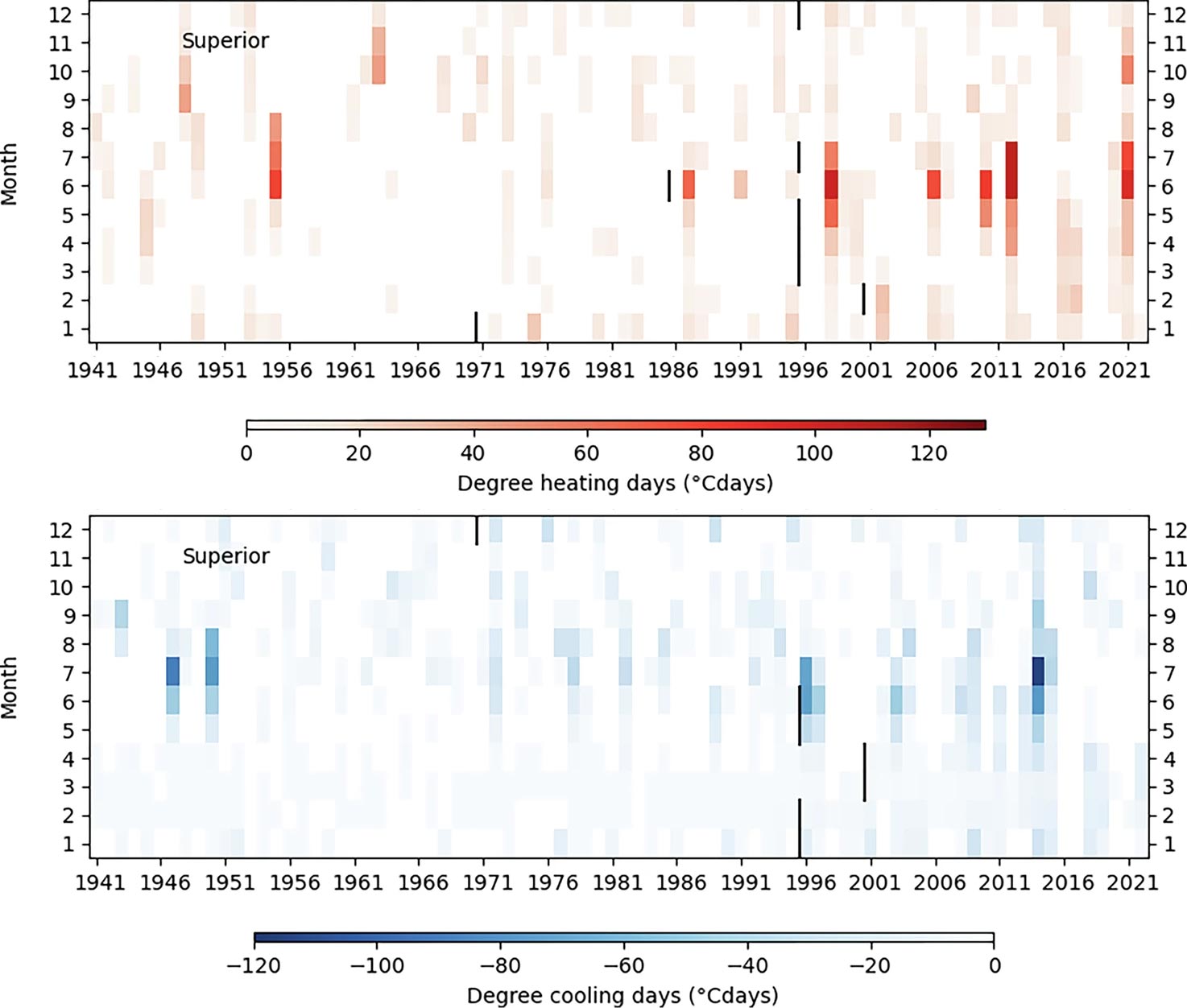
It is understandable that most of the extreme heating days occur in the Summer. Why do most of the extreme cooling days also appear to happen in the Summer? Why are the breakpoints (phase shifts) different for heating and cooling days?
There also appears to be an out-of-phase periodicity in both since the step-up in extreme heating and cooling days. Any thoughts on that? Could it be as simple as a ‘run’ in heads (or tails) in a coin flipping experiment?
“The Great Lakes Changed FOREVER in 1998.”
Is someone trying out their new crystal ball? How can we be certain that is is “forever?” That is a long time! Longer than from now until the “12th of Never.” Nothing is “forever!” Probably even the universe (at least as we know it) isn’t forever. This is a science website. Perhaps the person writing the article titles could keep that in mind. If it changed once, odds are that it will change again.
Can’t wait until the next Ice age. That will fix these global warming chicken lettles
The temperature data taken before and after 1990 are not comparable if the methods used are different. Another “chicken little” study, biased.
Wow since 30 years out of 3 billion years. Only a fool would think they know what’s normal for the atmosphere.
It’s time to stop all of the Geo Weather Engineering. It was in the early 1990’s that we kicked that inti high gear with HAARP (Boiling the Ionosphere) and spraying various metals into the Stratosphere to either reflect the Suns UV or to control rain. The Earth is perfectly capable of setting its own natural Weather patterns. Nothing that is happening now is natural, but if man can stop meddling with it, I believe that it would level out on its own in a few years.
Do you claim to have personal, first-hand knowledge of the “Geo Weather Engineering” and the “HAARP” experiment? Or is it something that you have just read about and accepted without evidence?
Sounds like a permanent college academic/climate chicken little trying to justify millions of dollars of worthless government grant money!!
Why do we think we know everything?
As long as we still get cold spells, maybe we can harvest ice to get through the hot spells. 😂
I’ve lived in the Great Lake region my entire life. I am now living on the shore of Lake Michigan. The lake did change in 1998, and 1999, and 1987 and every other year. The lake constantly changes; with water levels changing by as much as three feet in some years, and temperatures by degrees every day. Models are fun for academics to play with but if you think anyone can code a model accounting for the complete complexity of this gigantic and complicated ecosystem, well then you are just out of your mind.
We can only control some things like pollution. If we do are part at what we can control hopefully it will help.
We didn’t have any data so we made a computer model to verify what we want to believe.
Without question, summers and winters are nothing like I experienced as a kid growing up in southern Ontario- and are quite different today than in the 90s even. These fires we are currently seeing were forecast as a result of an increasing warming world- and voilà- here we are
These denialists are just kooks and fools
Yes, when I was a kid the snow in Northern Illinois came up to my knees. It matters not that I was half as tall then as I am now.
Before satellites became abundant in the late-20th Century, we had no way of knowing where the smoke was coming from or how extensive the fires were. Without good historical data, which is rare, we have no way of knowing just how much things have changed. One person’s “denialist” is another person’s realist.
It might be worth noting that the boreal forests are fire adapted, meaning that they have been experiencing burning for all their evolutionary history.
Liberal propaganda from a liberal university. Keep up the climate change agenda.