
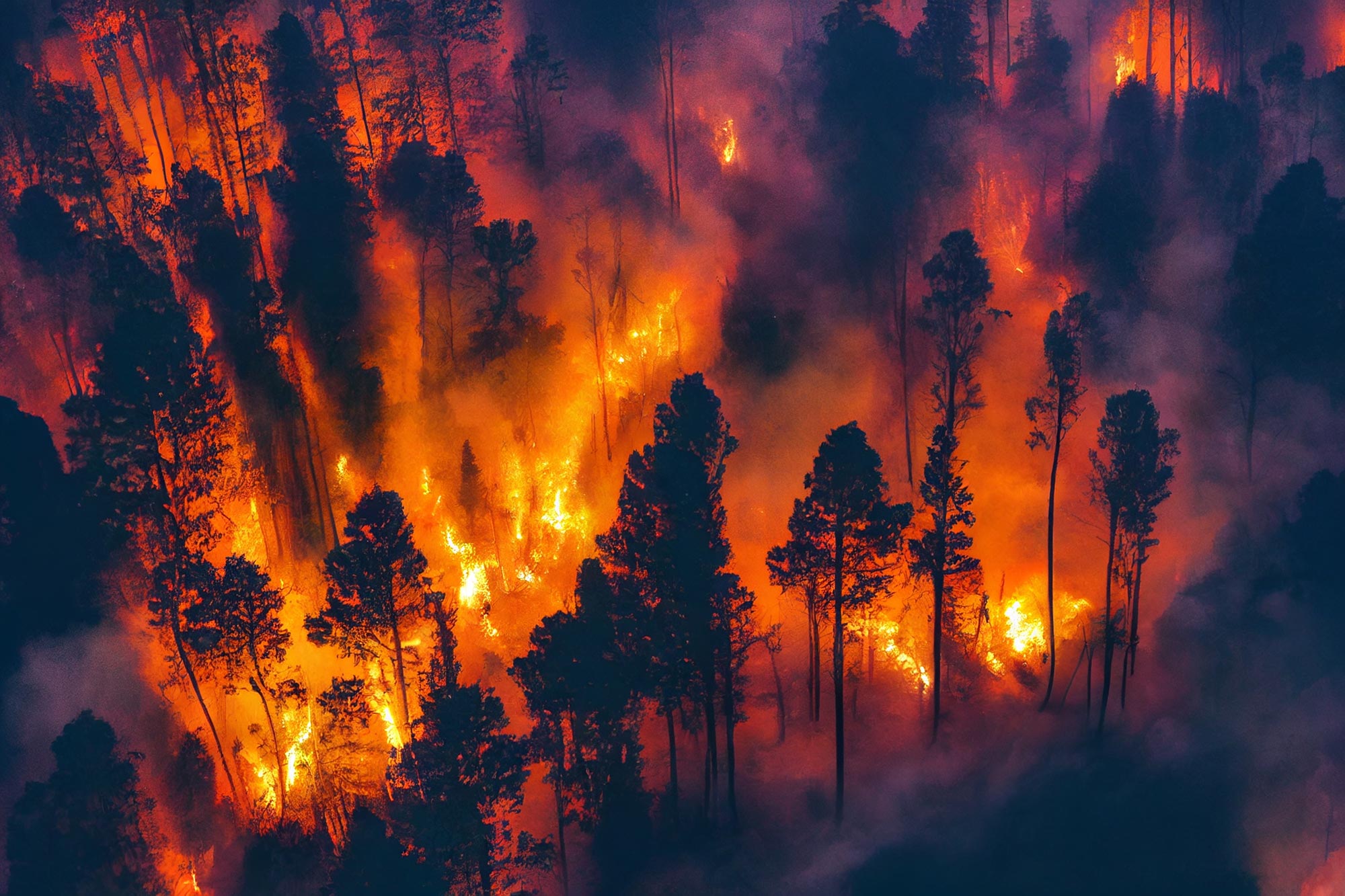
By stopping fires for generations, the western U.S. may have made its wildfire problem far worse.
Wildfires are not always harmful to forests. In many ecosystems, fire helps remove accumulated debris, returns nutrients to the soil, and supports healthy regeneration. For more than 100 years, the United States has invested billions of dollars in suppressing wildfires to protect communities, infrastructure, and sensitive landscapes. While this approach has reduced immediate risks, it has also limited the natural fires that forests depend on, allowing fuel to build up and increasing the likelihood of larger and more intense fires in the future.
Study finds millions of hectares behind on natural burning
New research that will be presented at AGU’s 2025 Annual Meeting in New Orleans shows that nearly 38 million hectares of land in the western United States have burned less often than they historically should have. Researchers describe this widespread shortfall as a “fire deficit.” The estimate was revised from 59 million hectares in the abstract to a final figure of 38 million hectares after further analysis.
“Conditions are getting so warm and dry that it’s causing huge amounts of fire compared to the historical record,” said Winslow Hansen, director of the Western Fire and Forest Resilience Collaborative and scientist at Cary Institute of Ecosystem Studies. “However, we still are dealing with the legacy of 150 years of fire suppression. Together, drying conditions and overly dense fuels portend a challenging and more fiery future.”
Hansen presented the research on December 18 at AGU25, where more than 20,000 scientists gathered to share new findings in Earth and space science.
How scientists measured fire deficit and fire surplus
To identify where fire has been missing and where it has become too frequent, researchers relied on geospatial evidence including pollen records and soil samples. These data helped establish historical fire return intervals, which were then reconstructed using the Landfire program to compare past fire activity with modern patterns.
Most of the West is far behind on burning
When current fire activity was compared with historical benchmarks, the researchers found that 74% of the western U.S. is now in a fire deficit. Closing that gap would require roughly 3.8 million hectares of forest to burn each year for the next decade. That annual total is about three times the forested area that burned in 2020, which remains the highest wildfire burn year on record in the United States.
Restoring healthier fire cycles will require multiple tools
Although the scale of needed burning is daunting, Hansen and his colleagues say it can be addressed using a mix of approaches. These include prescribed burns, mechanical thinning to remove excess vegetation, and allowing some wildfires to burn under controlled conditions.
“There are still lots of wildfires that burn today… that are reducing our fuel loads and revitalizing ecosystems,” said Hansen. “Instead of suppressing those fires and putting them out, we’ve got to let them do good ecological work to help us tackle this challenge when risk is low.”
Some regions are burning too often
While much of the West has experienced too little fire, the southwest faces the opposite issue. In shrublands and chapparal ecosystems, particularly in Southern California, human caused ignitions have led to a fire surplus.
“You’re getting more fire than you would have historically, which can even threaten resilience,” Hansen said. “These shrubland ecosystems might not be able to regenerate if the fire is too frequent.”
Parts of Cascadia are also showing signs of a fire surplus. Researchers link this trend to climate change, which is driving higher temperatures and more frequent drought, conditions that make fires more likely.
“I was a little bit surprised to see these signals of climate change-driven surplus already,” said Hansen. “I’d expected that would be something we would see in the next decade or two instead.”
Never miss a breakthrough: Join the SciTechDaily newsletter.
Follow us on Google and Google News.
1 Comment
Clear-cut lumbering is certain better and more controllable. Good article.