

Microbes supporting the production of more metabolic energy could be key to the evolution of large brains.
Microbes that enhance metabolic energy production may have played a crucial role in the evolution of large brains.
- First study to demonstrate that gut microbes from different animal species shape variations in their biology.
- Provides fresh insights into human evolution, especially the development of large brains.
- Mice with gut microbes from large-brained primates ate more but grew slower and accumulated less body fat.
- Excess energy in these mice was used to produce high levels of glucose, the brain’s primary fuel.
Brain Energy Needs and Microbial Influence
Brain tissue is among the most energetically costly in the body, and as a result, larger-brained mammals require more energy to support brain growth and maintenance. Exactly which biological changes allowed human ancestors to meet the very high needs for energy as they evolved larger brains has remained unclear. A new Northwestern University study points to the role of gut microbes, tiny living organisms in our digestive system that help break down food and produce energy.
In a controlled lab experiment, researchers implanted microbes from two large-brain primate species (human and squirrel monkey), and one small-brain primate species (macaque), into mice.
Their findings showed the mice with microbes from large-brain primate species produced and used more energy, while those with microbes from the small-brain species stored more energy as fat.
Broader Impact on Understanding Evolution
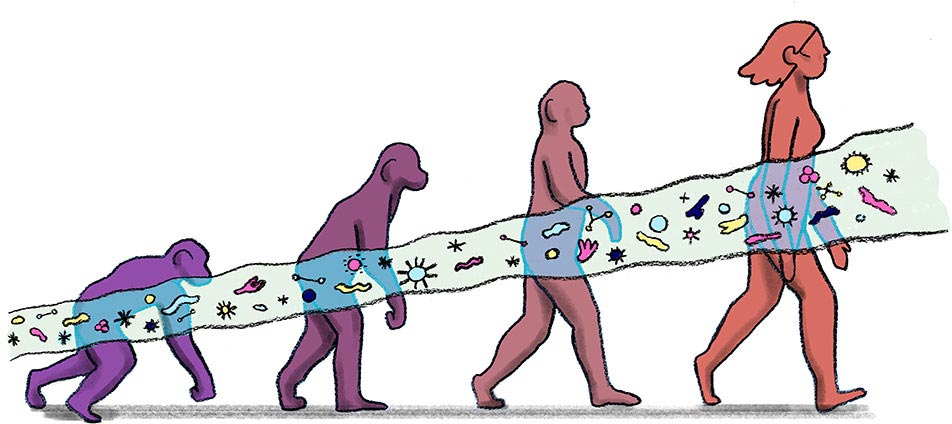
The data is the first to show gut microbes from different animal species shape variations in biology between animal species and supports the hypothesis that gut microbes might influence evolution by changing how an animal’s body works.
The study offers a new perspective on human evolution, particularly the evolution of our large brains.
The findings will be published today (December 2) in the journal Microbial Genomics.
Comparing Primate Energy Use and Metabolic Development
Prior studies have compared the influence of genes and the environment on primates with bigger and smaller brains. However, there are very few studies comparing how different primates use energy. Even less information is available on how metabolism develops in different primate species.
“We know the community of microbes living in the large intestine can produce compounds that affect aspects of human biology — for example, causing changes to metabolism that can lead to insulin resistance and weight gain,” said the study’s first author Katherine Amato, associate professor of anthropology at Northwestern.
“Variation in the gut microbiota is an unexplored mechanism in which primate metabolism could facilitate different brain-energetic requirements,” Amato said.
After introducing the gut microbes into microbe-free mice, the researchers measured changes in mouse physiology over time, including weight gain, fat percentage, fasting glucose, liver function and other traits. They also measured differences in the types of microbes and the compounds they were producing in each group of mice.
Observed Patterns and Conclusions
The researchers expected to find microbes from different primates would lead to differences in the biology of the mice inoculated with them. They also expected mice with human microbes to have the greatest difference in biology from mice with microbes from the other two species.
“While we did see that human-inoculated mice had some differences, the strongest pattern was the difference between large-brained primates (humans and squirrel monkeys) and smaller-brained primates (macaques),” Amato said.
The mice given microbes from the humans and squirrel monkeys had similar biology, even though these two larger-brained primate species are not close evolutionary relatives of one another. This suggests something other than shared ancestry — likely their shared trait of large brains is driving the biological similarities seen in the mice inoculated with their microbes.
“These findings suggest that when humans and squirrel monkeys both separately evolved larger brains, their microbial communities changed in similar ways to help provide the necessary energy,” Amato said.
Future Research Directions
In future studies, the researchers hope to run the experiment with microbes from additional primate species varying in brain size. They would also like to collect more information on the types of compounds the microbes are producing and gather additional data on the biological traits of the hosts such as immune function and behavior.
Reference: “The primate gut microbiota contributes to interspecific differences in host metabolism” by Elizabeth K. Mallott, Sahana Kuthyar, Won Lee, Derek Reiman, Hongmei Jiang, Sriram Chitta, E. Alexandria Waters, Brian T. Layden, Ronen Sumagin, Laura D. Manzanares, Guan-Yu Yang, Maria Luisa Savo Sardaro, Stanton Gray, Lawrence E. Williams, Yang Dai, James P. Curley, Chad R. Haney, Emma R. Liechty, Christopher W. Kuzawa and Katherine R. Amato, 2 December 2024, Microbial Genomics.
DOI: 10.1099/mgen.0.001322
Never miss a breakthrough: Join the SciTechDaily newsletter.
Follow us on Google and Google News.