

MIT Senior David Darrow’s love of math fuels other passions such as mentoring and learning new languages.
David Darrow, an avid outdoor enthusiast and MIT senior, studies math with a focus on fluid dynamics and climate modeling. His academic journey features both successes and challenges, enriching his experience. He has also cultivated language skills to enhance his mathematical research and aims to use his knowledge in academia to address climate issues.
David Darrow enjoyed spending time outdoors, going on hikes, and camping with his Boy Scout group when he was a child growing up in Wallingford, Connecticut. He was continuously curious about the natural world and was enthralled by the surroundings.
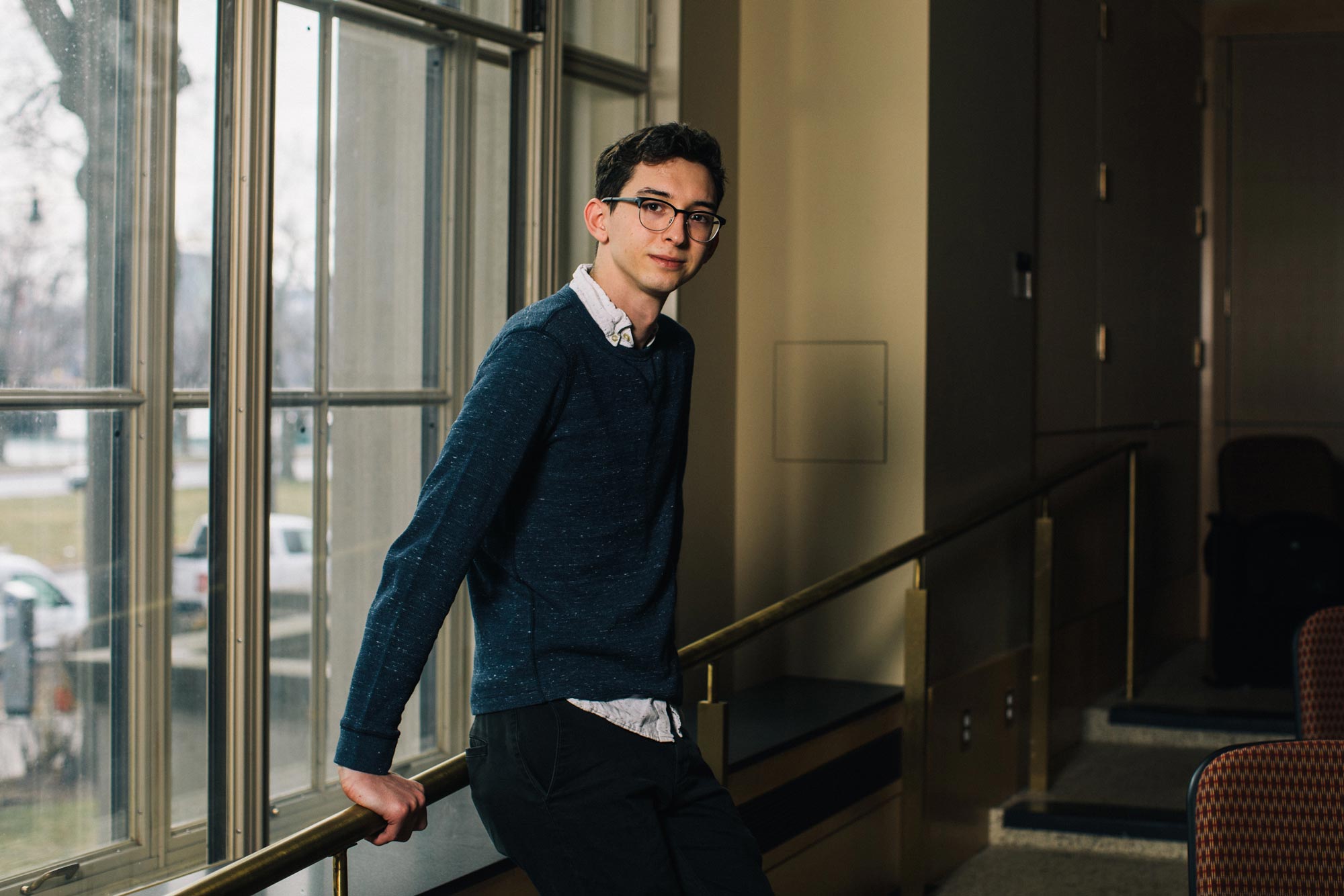
Now a senior at MIT majoring in math and minoring in German and physics, Darrow is still studying natural phenomena. With fluid dynamics and climate modeling as his primary fields of interest, he loves to use math as a way to explore the world around him.
“I see math as the language that the universe operates within. It is a very cool way to understand how nature works,” he says.
Darrow’s introduction to mathematical research at MIT started when he was a senior in high school, through the MIT PRIMES research program for high school students. Under the guidance of two mentors, he worked to come up with a new algorithm to simulate fluid movement more accurately and efficiently in a cylinder. While the project was ultimately unsuccessful, mathematically speaking, it galvanized his interest in the field — with failures included.
Challenges and Collaborations
Beginning his first year at MIT, Darrow undertook numerous research projects on everything from minimal surface theory to convex geometry. While some were successful, others were not. Darrow says the failures have been some of his biggest challenges — and inspirations for new research ideas.
“That’s one of the big things about math research: Sometimes it just fails and there is nothing you can do about it. But if these things didn’t fail, it wouldn’t be interesting to study them in the first place,” he says.
In the spring of his junior year, Darrow worked alongside postdoc Daniel Alvarez-Gavela to study the symplectic topology of homotopy spheres. This was Darrow’s first project working side-by-side with someone else; his previous research experiences had been more independently driven.
Language Skills and Multicultural Insights
Darrow is currently studying protein folding with PhD candidate George Stepaniants, using statistical geometry to study and compare the differences between the folds of these large, complex molecules. Using catalogued data, he hopes to see if certain proteins are related and share an evolutionary past.
Darrow has also discovered a second passion during his time at MIT: language. Beginning with German in his first year, he is now learning Russian and French and revisiting Spanish, which he began studying in high school. His interest in these languages is partly driven by the fact that many of the subjects he is interested in were pioneered in languages other than English. Thus, by learning languages such as German and Spanish, he can connect to more people in mathematics and learn from their research. He also understands that some experts are more comfortable conversing in their native language, so he might miss out on valuable information — about math or many other topics.
Embracing Online Education
“There are a lot of people you can’t connect with if you don’t speak the same language they do,” he says.
Additionally, Darrow has been attempting to translate his own research into various languages. For instance, he gave a lecture on one of his convex geometry research projects at the V. Neumann-Lara colloquium in Mexico in the spring of his junior year. In the hopes of getting published, he has also submitted work to two French publications.
The pandemic has also increased Darrow’s appreciation for languages, as he sees the value of the internet as a learning tool for online education. Using programs like Duolingo and MIT Open Courseware himself, he understands the far-reaching potential that accessible and user-friendly platforms have to revolutionize learning, specifically in subjects like math and science.
“There are a lot of people in the U.S. who have language barriers, or partial language barriers, which makes traditional U.S. education very difficult. If you aren’t 100 percent comfortable with English, then learning calculus in English is going to be much tougher — to no fault of your own,” he says.
Future Aspirations in Academia
Darrow enjoys tutoring in all subjects, seeing it as a way to further his love of education and learning. “I think education is a big part of the research process,” he says.
In graduate school, Darrow hopes to study how fluid dynamics relate to the climate, looking at things like geophysical fluid flows and oceanographic modeling. He sees math, and fluid dynamics specifically, as a way to help predict and better respond to changes caused by climate issues.
“A lot of that comes down to how good our models are and how good our math is,” he says.
Darrow’s end goal is to go into academia, using his experience in mentorship and teaching to make himself a better teacher and researcher.
“I think it’s important to try to apply your skills to do something good, but also help other people get there themselves,” he says.
Never miss a breakthrough: Join the SciTechDaily newsletter.
Follow us on Google and Google News.
8 Comments
Great story about a brilliant young mind. Good luck Darrow.
Probably totally wrong but could stellar black holes be like the galaxy’s subway system and the supermassive holes are the way to reach other galaxy’s because nature dosnt waste creating that many galaxy’s if 99% are unreachable
That’s a total aside, but: no. There is no evidence for wormholes.
And while it would be irrelevant if humans think space is wasted – 99.99 % of the universe is not stars or planets where humans can live – who says it is physically wasted? The universe is nicely homogenized so it has the same background temperature in all directions, and that is due to inflation making it at least 10^5 times larger in volume than the observable universe. In fact, if inflationary anthropic multiverses is what makes our local universe randomly inhabited, there is an infinite volume of space that was ‘not wasted’ while enabling our universe. [And an infinite set of similarly insignificantly large inhabited other universes.]
You should talk to my friend Ryan Abernathy, he is a professor of climate physics at Columbia university and did his undergrad at MIT. Sounds like you two would get along and learn from each other 🙂
Instead of bullying me since last so many many years: Canada could have given me admission in an University; by now I could have become a highly skilled personal! But bullying is Canada’s dura mater!
Nice to see Darrow work on a subject I like, protein folding.
Not to trivialize the work of a young promising scientist, but like science is a tool for understanding, math appears to be a tool for science quantification. We develop mathematical tools and drop lots of them at the side as not being useful. They do not constrain physics as such.
… but there is a new ace that might continue our view… it is a one thing to see that there is a chaos and there is an order, but … I will not say what you need to figure out, cause you are stuck in wrong line and you don’t know how to backtrack…
I worked all my life with mathematics and computers and I came to one conclusion. Mathematics is an approximation to reality and it is not the absolute truth. It is a tool and reality is so complex and infinite that mathematics can not match it exactly. The laws of physics are idealistic theoretical approximations that only match real phenomena approximately.