
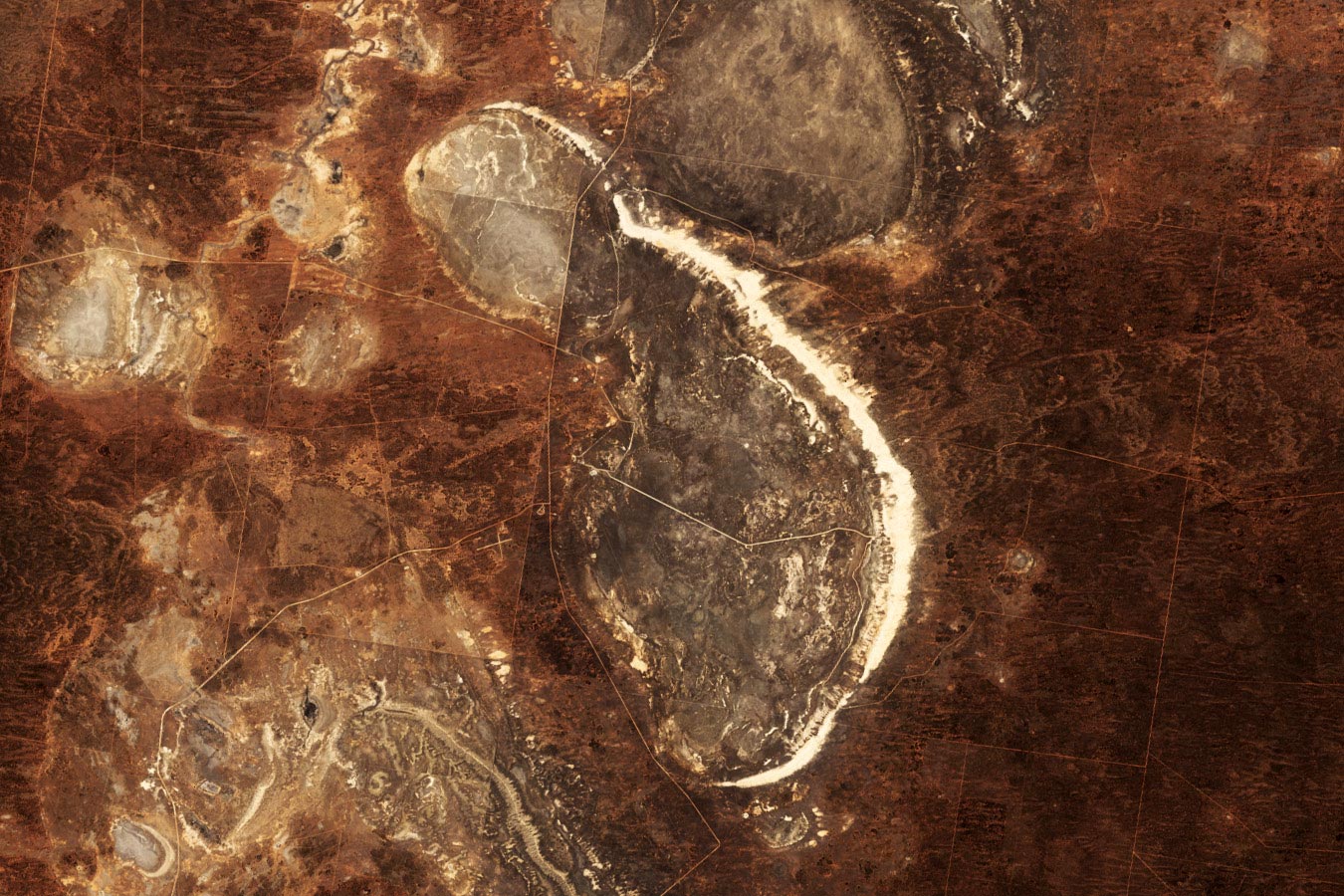
A lunette dune fringing this dried Australian lake preserves relics from ancient times, while today’s grazing patterns create sharp visible contrasts on the land.
In the remote desert of New South Wales, Australia, the Willandra Lakes Region, once filled with large Pleistocene lakes, hosted Australia’s First Peoples 50,000 years ago. The now-dry Lake Mungo, visible from space, contains archaeological sites like the famous “Mungo Lady” and “Mungo Man,” some of the oldest human remains found globally.
Ancient Lakes of New South Wales
The southwest corner of New South Wales, Australia, is a remote, semi-arid desert characterized by sheep pastures, dryland farms, and open spaces where kangaroos roam freely. However, around 2 million years ago and throughout much of the Pleistocene epoch, this region was home to a network of vast lakes that supported life for thousands of years.
Archaeological discoveries suggest that humans settled in what is now called the Willandra Lakes Region about 50,000 years ago. They thrived on the area’s abundant natural resources, including freshwater mussels, crustaceans, fish, emus, and marsupials. As the ice age ended, the climate became drier, causing the lakes to shrink, turn increasingly salty, and eventually dry up entirely around 18,500 years ago.
Visual Legacy From Space
This image, acquired on October 21, 2024, by the OLI-2 (Operational Land Imager-2) on Landsat 9, shows the remnant of one of these Pleistocene waterbodies, Lake Mungo. The dry lakebed is distinct for the large lunette dune fringing its eastern shoreline. These types of crescent-shaped mounds form on the downwind side of enclosed desert depressions. The Lake Mungo lunette, built up by the wind over the past 50,000 years, measures approximately 30 kilometers (18 miles) long—large enough to be easily visible from space.
Archaeological Richness of Lake Mungo
The dune has preserved an array of archaeological and geological treasures. Researchers have noted that all layers of the dune contain archaeological remains, indicating that humans occupied the area through various environmental conditions. In addition, a menagerie of megafaunal remains includes those of the giant marsupial and wombat-relative Zygomaturus trilobus, the large flightless bird Genyornis newtoni, the Tasmanian tiger, and giant kangaroos.
Famously, the remains of “Mungo Lady,” uncovered in the lunette dune in 1968, have been dated at 40,000–42,000 years old. They represent the oldest human remains found in Australia and are among the earliest anatomically modern human remains discovered anywhere in the world. The similarly aged bones of “Mungo Man” were found a few years later. The two skeletons provide some of the earliest evidence of cremation and ritual burial.
Insights Into Earth’s Geomagnetic History
Scientists have also turned up clues about our planet’s past at the site. In the 1970s, researchers found evidence of a “geomagnetic excursion” baked into 30,000-year-old hearths preserved there. Excursions are significant changes to the intensity of Earth’s magnetic field and the orientation of its magnetic poles. Whereas complete magnetic pole reversals occur about every 300,000 years on average, excursions may happen 10 times as often and on a regional scale.
Contemporary Landscape and Management
Today, the effects of various land management practices are visible as sharp contrasts in color on the semi-arid landscape. “The lines you can see in the images are fence-line boundaries between Mungo National Park and neighboring pastoral properties that mostly graze sheep,” said Mike Letnic, an applied ecologist and conservation biologist at the University of New South Wales.
Wild herbivores such as kangaroos and rabbits, along with domestic animals, graze in the brighter area containing the western portion of Lake Mungo’s lakebed, which is outside of the national park. Within park boundaries, grazing is limited to wild animals. However, according to Letnic, grazing pressure on the land is still high because these herbivores have no predators regulating their populations.
NASA Earth Observatory image by Wanmei Liang, using Landsat data from the U.S. Geological Survey.
Never miss a breakthrough: Join the SciTechDaily newsletter.
Follow us on Google and Google News.